A Compendium of the Ancient Gods
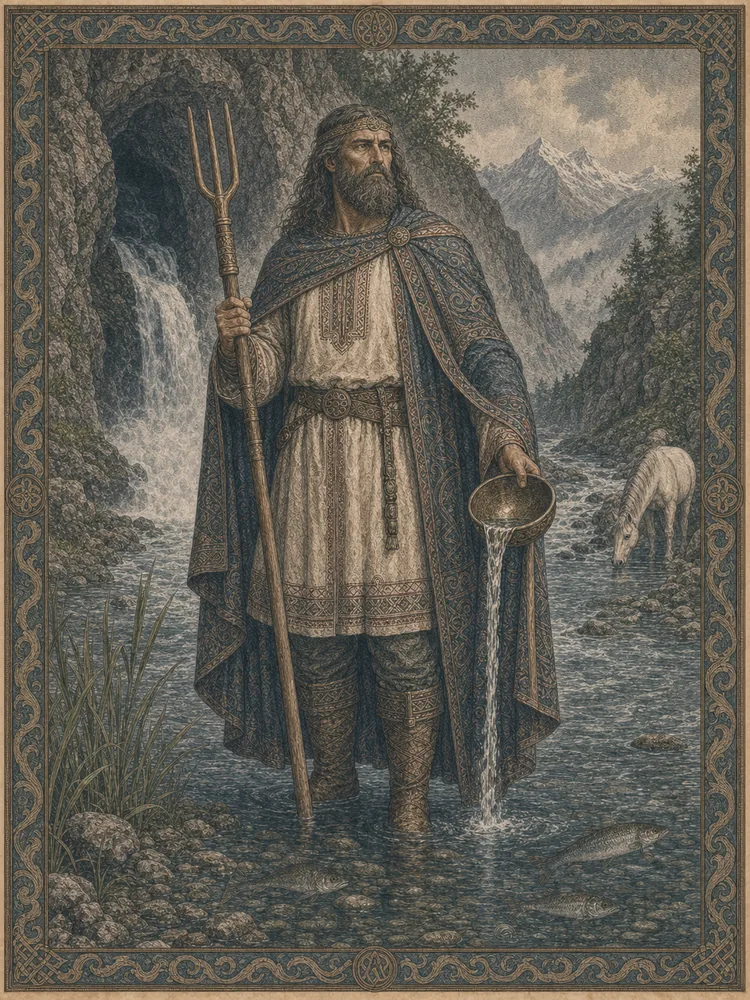
Donbettyr, plate

Donbettyr — the name combines Don (Ossetic for 'water,' the same word that gives the river-name Don and other major Eurasian river-names) and the Christian saint-name Peter (Bettyr) — was the lord of the waters in Ossetian religious imagination, the patron of rivers, streams, lakes, and the sea. The composite name reflects the late character of the figure: an indigenous water-deity whose name was Christianized (with the addition of the Saint Peter element) but whose function and cult continued largely unchanged. The pattern is typical of Caucasian folk-religion, where Christian veneer was added to deeper pre-Christian substrata.

Donbettyr ruled the underwater world from a great palace beneath the rivers; his daughters were the supernatural beauties whom various Nart heroes married. The most famous of these unions was that of Donbettyr's daughter Dzerassa with the Nart Akhsartag — the marriage that produced the twins Khamyts and Uryzmag, the founders of the Nart clan. So Donbettyr was the maternal grandfather of the Narts, and his bloodline ran through the entire heroic genealogy. The water-realm and the human-mortal realm were thus connected through the Nart founders' descent from a water-spirit, and the underwater world remained accessible to the heroes throughout the saga-cycle.

Donbettyr's children — the various daughters of the water-god, the supernatural beings called Donbettyrtae — were a class of water-spirits parallel to the Greek Nereids and the Slavic Rusalkas. They lived in the rivers and pools of the Caucasus, sometimes appearing to men in beautiful form, sometimes fish-tailed in the manner of mermaids; they could grant favors but could also drag the unwary down into the depths. Their cult survived in modern Ossetian folk-religion as a class of beings to be propitiated at river-crossings and at fishing-grounds.

The figure of Donbettyr has clear parallels with Iranian water-deities (the Avestan Apām Napāt, 'Grandson of the Waters,' is a structural cousin) and confirms the deep Iranian roots of Ossetian religion. The Christianization that added the Saint Peter element did not displace these older Iranian elements; rather, it provided a Christian-acceptable name for a continuing pre-Christian deity, in the typical pattern of religious-vocabulary Christianization that the previous book (on Caucasian Georgian religion) also illustrated.

Curator’s note

What the sources say, and what later tradition added. The sources for this bay

Donbettyr is one of the chief deities of the Nart corpus. The standard reference is John Colarusso's Nart Sagas from the Caucasus (2002), which gives English translations of major narratives. The Russian-language scholarly tradition is more extensive; V. I. Abaev's Iz osetinskogo eposa (1939, 'From the Ossetian Epic') and his Skifo-evropeiskie izoglossy (1965, 'Scythian-European Isoglosses') are foundational. The standard French scholarly study is Georges Dumézil's Le livre des héros: légendes ossètes sur les Nartes (1965). The Iranian-comparative material on Apām Napāt is in Mary Boyce's A History of Zoroastrianism, Vol. 1, and in Jaan Puhvel's Comparative Mythology.

When the sources speak

Dated witnesses for The Ossetian Nart Pantheon. A date marks when the evidence was written down, not when the belief began. The whole timeline

2nd–1st millennia BCE
Bronze and Iron Age regional cultures establish the archaeological backgrounds later labeled Thracian, Illyrian, Iberian, Caucasian, and Libyan.
8th–6th centuries BCE
Greek and Phoenician colonization creates new inscriptional, artistic, and commercial contact zones.
6th–4th centuries BCE
Classical authors begin describing frontier peoples and translating local gods into Greek categories.
3rd–1st centuries BCE
Hellenistic kingdoms, Carthage, and Rome intensify political and cultic exchange.
1st century BCE–3rd century CE
Roman provincial rule produces dedications, coins, reliefs, and interpretive equations across the Balkans, Iberia, Caucasus, and North Africa.
4th–7th centuries CE
Christianization and imperial change end or transform many public cult institutions while names persist in texts and places.
medieval period
Georgian chronicles and epic traditions, Iberian memory, and North African historical sources reshape pre-Christian inheritances.
1st millennium BCE–early CE
Iranian-speaking steppe cultures provide a distant linguistic and comparative background.

Floor plan

The rooms follow one another in the order their peoples first appear in the written record.

  1. The Cradle of Citiesc. 3400 BCE to 395 CE. 115 works
  2. The Gift of the Nilec. 4000 BCE to 395 CE. 73 works
  3. The Olympian Orderc. 1600 BCE to 750 CE. 152 works
  4. The Persian Worldc. 2000 BCE to 1010 CE. 30 works
  5. The Levantine Borderlandsc. 1200 BCE to 500 CE. 20 works
  6. The Edges of Empirec. 2000 BCE to 1500 CE. 33 works
  7. The Etruscan Worldc. 900 BCE to 750 CE. 22 works
  8. The Roman Inheritancec. 1200 BCE to 500 CE. 58 works
  9. The Northern Inheritancec. 2000 BCE to 1600 CE. 131 works