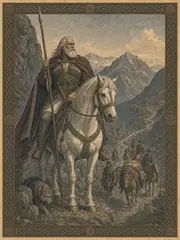
Satana (sometimes Satanaya in Circassian dialects, Setenay in some Caucasian variants) was the great matriarch of the Nart clan, the wise mother whose counsel guided the heroes through their adventures. She was not a goddess in the strict sense — she was mortal in origin (born from a star-radiance into the body of a beautiful Nart woman, in some versions; born from the marriage of Donbettyr's daughter Dzerassa, in others) — but her wisdom, her supernatural insight, and her central position in the Nart genealogy gave her a quasi-divine status, and she was venerated in Ossetian folk-tradition as a religious figure as well as a literary one.
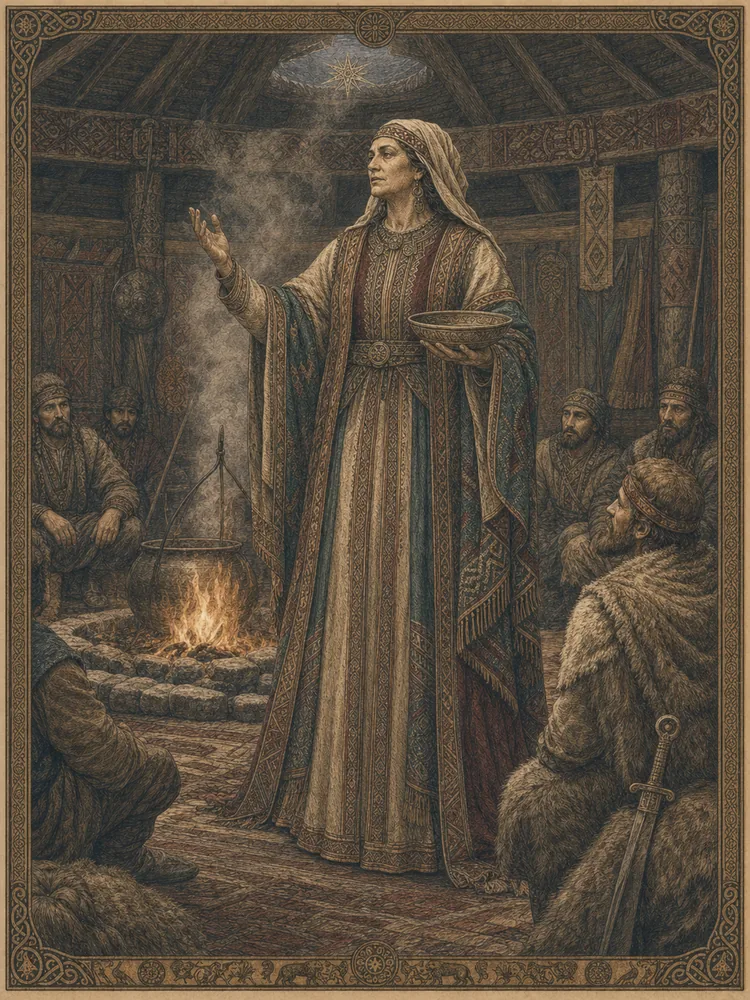
She was the wife of Uryzmag, the chief of the Nart clan and the elder of the founding twins; from their marriage, and from her relationships with the various other Nart heroes (some of whom she also married, with the complex polyandry-and-incest patterns that characterize the deep mythological strata of the corpus), descended much of the Nart genealogy. She was the brewer of the sacred Ronk drink (the Ossetian equivalent of the Norse mead-of-poetry, a magical drink that gave wisdom and courage), the keeper of the Narts' magical objects, and the dispenser of advice in every crisis.
Her wisdom was prophetic. She could see the future, knew the fates of the heroes, and gave counsel that was always finally vindicated even when initially resisted. The pattern is one of the clearest cases in Indo-European epic of the wise-female-counselor figure (parallels include the Greek Odysseus's Penelope and Circe, the Norse Gudrun and Brynhildr, the Celtic Medb and Étaín, the Persian Roxana). Satana stands at the head of this tradition in the Iranian-steppe world, with material that may be Sarmatian or Scythian in its deepest origins.
The various etymologies of her name have been proposed. Some scholars connect Satana with the Iranian goddess of the steppe-traditions (perhaps an Avestan Sandai or a Sarmatian *Satānā), others with later Christian-Islamic religious terminology (the name's resemblance to the Arabic-Hebrew Satan is probably accidental but has been the subject of speculation). The figure is in any case independent of the Christian Satan in her function and significance, and she was venerated in Ossetian folk-tradition as a positive religious figure, the great mother of the heroes.