A Compendium of the Ancient Gods
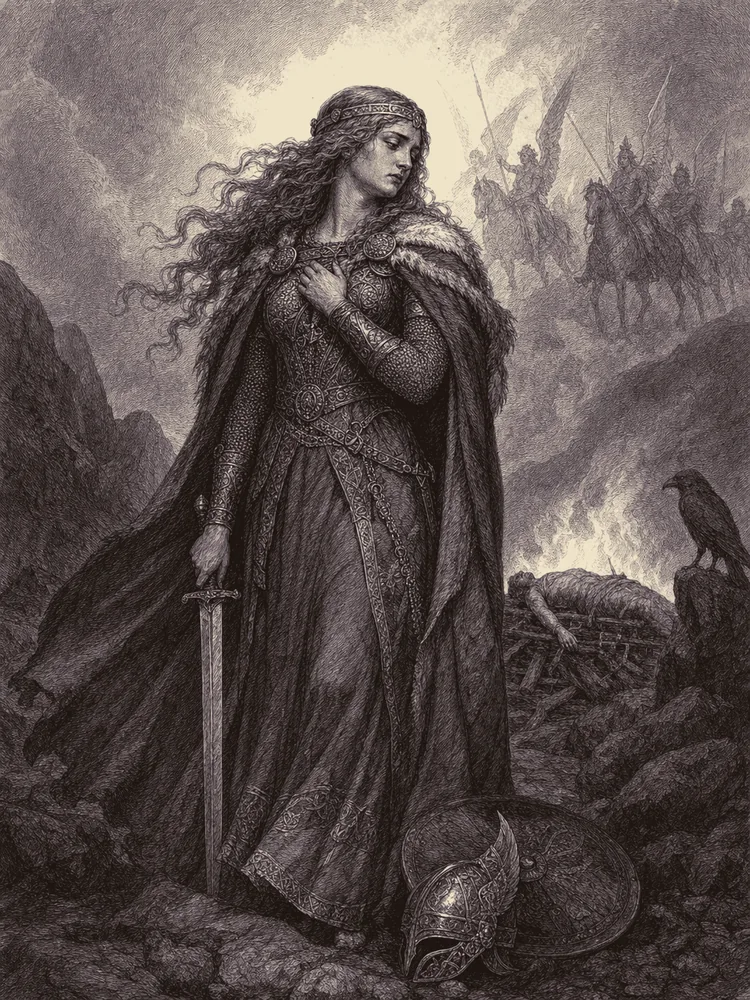
Brynhildr, plate

Brynhildr was a valkyrie, one of the maidens of Odin who chose the slain — but she had angered the chief of the gods by giving victory in a battle to the warrior whom Odin had marked for death. As her punishment Odin condemned her to sleep within a circle of fire upon a mountain, until a hero brave enough to ride through the flames should awaken her; and on awakening, she would no longer be a valkyrie but a mortal woman, who must marry a mortal man.

Sigurd Fáfnisbani came at last and rode through the fire upon his horse Grani; Brynhildr awoke, and the two pledged themselves to each other in the depths of love. But Sigurd was bound by other fates. He came afterward to the court of the Burgundian king Gjuki, where Queen Grímhild gave him a potion of forgetfulness, so that he forgot Brynhildr; he married Gjuki's daughter Gudrun, and at Gjuki's bidding rode again through the fire — this time in the borrowed shape of his brother-in-law Gunnar — to win Brynhildr for Gunnar's wife. Brynhildr, supposing that Gunnar had ridden through the fire, agreed to marry him.

It was Gudrun who, in a quarrel at the river where the women were washing their hair, finally revealed to Brynhildr the deception. Brynhildr, knowing now that Sigurd had broken the deepest of pledges (under whatever compulsion), demanded his death; Gunnar yielded, and his younger brother Guttorm was prevailed upon to do the killing. When Sigurd was slain, Brynhildr laughed once and then fell into terrible silence; she stabbed herself with a sword, asked to be burnt with Sigurd on a single pyre, and was so. The two passed together to the underworld, joined at last in death after their separation in life.
Curator’s note

What the sources say, and what later tradition added. The sources for this bay

Brynhildr is a central figure of the Norse heroic poetry: the Sigrdrífumál (the awakening on the mountain), Brot af Sigurðarkviðu, Sigurðarkviða in skamma, Helreið Brynhildar (her ride to the underworld), and substantial portions of Vǫlsunga saga. The German Nibelungenlied has Brünhild as a different sort of figure — a queen of Iceland defeated in athletic contest by Siegfried (acting for Gunther), then betrayed when Kriemhild reveals the deception. The Norse and German treatments are clearly the same legend evolved along separate paths over four centuries. The valkyrie identity is distinctive to the Norse version. Brynhildr is, with Medea and Helen, one of the great betrayed-betrayer figures of European myth.

Kin in the sources

Each tie is quoted from the entry that states it.

When the sources speak

Dated witnesses for The Norse and Germanic Gods. A date marks when the evidence was written down, not when the belief began. The whole timeline

2nd–1st millennia BCE
Indo-European language dispersals and regional Bronze Age cultures provide a remote comparative background, not a recoverable common canon.
c. 500 BCE–1 CE
Iron Age material culture, names, sanctuaries, and classical ethnography offer early but external evidence for Celtic and Germanic religions.
1st–4th centuries CE
Roman inscriptions and provincial cults preserve many Celtic, Germanic, and local divine names.
4th–8th centuries CE
Migration-period and early medieval conversion transform ritual institutions while heroic traditions continue.
8th–11th centuries CE
Viking Age poetry, runic evidence, archaeology, and Scandinavian conversion form the core context of Norse myth.
9th–12th centuries CE
Slavic, Baltic, and Finnic traditions enter chronicles and missionary accounts, often through hostile observers.
11th–14th centuries CE
Irish, Welsh, and Icelandic manuscripts preserve major narrative corpora in Christian literary environments.
12th–16th centuries CE
Saxo, saga compilers, Baltic chroniclers, and later antiquarians systematize or reinterpret older material.

Floor plan

The rooms follow one another in the order their peoples first appear in the written record.

  1. The Cradle of Citiesc. 3400 BCE to 395 CE. 115 works
  2. The Gift of the Nilec. 4000 BCE to 395 CE. 73 works
  3. The Olympian Orderc. 1600 BCE to 750 CE. 152 works
  4. The Persian Worldc. 2000 BCE to 1010 CE. 30 works
  5. The Levantine Borderlandsc. 1200 BCE to 500 CE. 20 works
  6. The Edges of Empirec. 2000 BCE to 1500 CE. 33 works
  7. The Etruscan Worldc. 900 BCE to 750 CE. 22 works
  8. The Roman Inheritancec. 1200 BCE to 500 CE. 58 works
  9. The Northern Inheritancec. 2000 BCE to 1600 CE. 131 works