A Compendium of the Ancient Gods
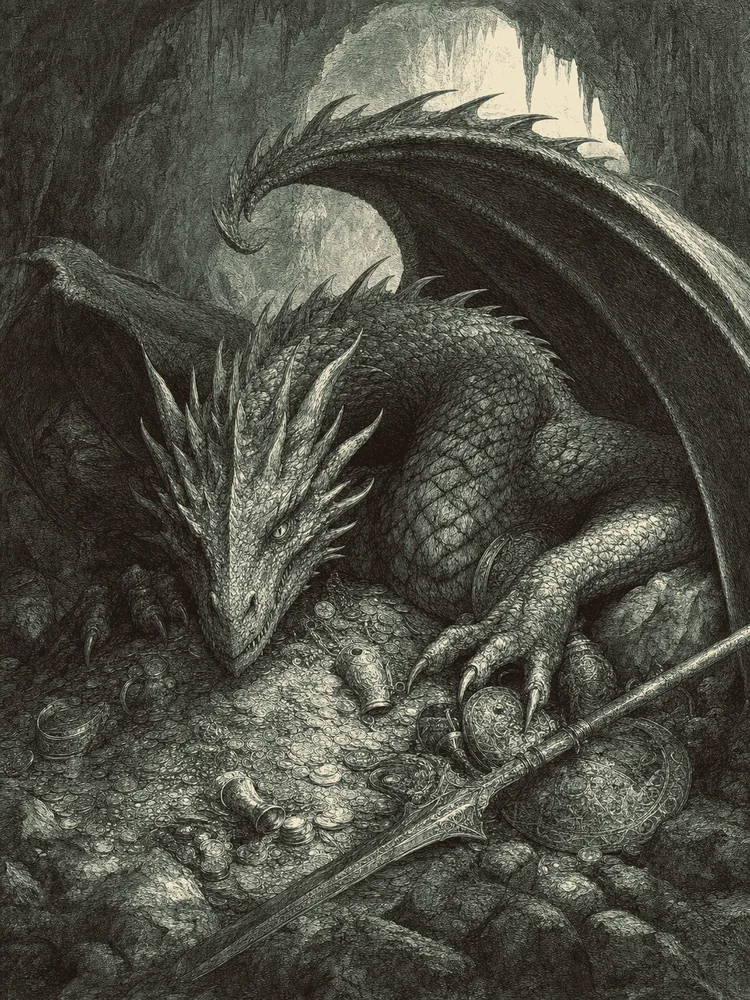
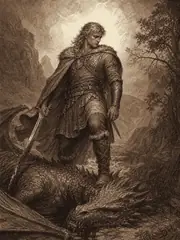
Fafnir, plate

Fáfnir was the son of Hreidmar, a man of the dwarvish kindred (or, in some accounts, an early human of magical lineage), and he had two brothers: Otr, who could take the form of an otter, and Regin, who was a smith. The brothers and their father lived together by the river. One day Otr in his otter-form was killed by the gods Odin, Hœnir, and Loki, who took him for a beast; and Hreidmar demanded as wergild the otter-skin filled with gold. The gods paid the gold, but Loki had taken the gold from a dwarf who cursed it: the gold would bring death to whoever held it.

Fáfnir, coveting the cursed gold, slew his own father Hreidmar in his sleep and took the hoard for himself; then, retreating to a heath called Gnitaheiðr, he drank deeply of the gold's curse, and his shape changed: he became a dragon, vast and venom-spewing, and lay coiled upon the gold for many years. Regin his brother, dispossessed and bitter, plotted to bring about Fáfnir's death by means of an outsider — and the outsider he found was Sigurd.

When Sigurd, prompted by Regin, dug a pit and waited for Fáfnir to pass, the dragon came down to drink at the river. As he passed over the pit, Sigurd thrust the sword Gram upward and killed him. Fáfnir died slowly, exchanging long words with Sigurd as he went — words that were preserved by the poets as the Fáfnismál, the wisdom of the dying dragon, who in his last moments knew much of the world. He warned Sigurd of the curse upon the gold; Sigurd took it nonetheless, and the curse worked itself out through his short life and the long destruction of his royal house.
Curator’s note

What the sources say, and what later tradition added. The sources for this bay

Fáfnir is treated chiefly in the Eddic poem Fáfnismál, with the prose framework filled in by the Vǫlsunga saga (chapters 14-18) and Snorri's Skáldskaparmál chapter 39. The dying dragon's wisdom-speech in Fáfnismál is one of the great gnomic passages of Eddic poetry, comparable to Hávamál in its concentration of proverbial knowledge. The curse on the gold (which Loki originally took from the dwarf Andvari) is laid out in Reginsmál. The motif of the man-turned-dragon by greed is unusual in Indo-European mythology — most dragons being primordial monsters, like Tiamat or Vritra; Fáfnir's transformation through gold-greed is more like a moral parable than a cosmogonic figure, and probably reflects the relatively late, historicizing character of the Volsung legend.

Kin in the sources

Each tie is quoted from the entry that states it.

When the sources speak

Dated witnesses for The Norse and Germanic Gods. A date marks when the evidence was written down, not when the belief began. The whole timeline

2nd–1st millennia BCE
Indo-European language dispersals and regional Bronze Age cultures provide a remote comparative background, not a recoverable common canon.
c. 500 BCE–1 CE
Iron Age material culture, names, sanctuaries, and classical ethnography offer early but external evidence for Celtic and Germanic religions.
1st–4th centuries CE
Roman inscriptions and provincial cults preserve many Celtic, Germanic, and local divine names.
4th–8th centuries CE
Migration-period and early medieval conversion transform ritual institutions while heroic traditions continue.
8th–11th centuries CE
Viking Age poetry, runic evidence, archaeology, and Scandinavian conversion form the core context of Norse myth.
9th–12th centuries CE
Slavic, Baltic, and Finnic traditions enter chronicles and missionary accounts, often through hostile observers.
11th–14th centuries CE
Irish, Welsh, and Icelandic manuscripts preserve major narrative corpora in Christian literary environments.
12th–16th centuries CE
Saxo, saga compilers, Baltic chroniclers, and later antiquarians systematize or reinterpret older material.

Floor plan

The rooms follow one another in the order their peoples first appear in the written record.

  1. The Cradle of Citiesc. 3400 BCE to 395 CE. 115 works
  2. The Gift of the Nilec. 4000 BCE to 395 CE. 73 works
  3. The Olympian Orderc. 1600 BCE to 750 CE. 152 works
  4. The Persian Worldc. 2000 BCE to 1010 CE. 30 works
  5. The Levantine Borderlandsc. 1200 BCE to 500 CE. 20 works
  6. The Edges of Empirec. 2000 BCE to 1500 CE. 33 works
  7. The Etruscan Worldc. 900 BCE to 750 CE. 22 works
  8. The Roman Inheritancec. 1200 BCE to 500 CE. 58 works
  9. The Northern Inheritancec. 2000 BCE to 1600 CE. 131 works