A Compendium of the Ancient Gods
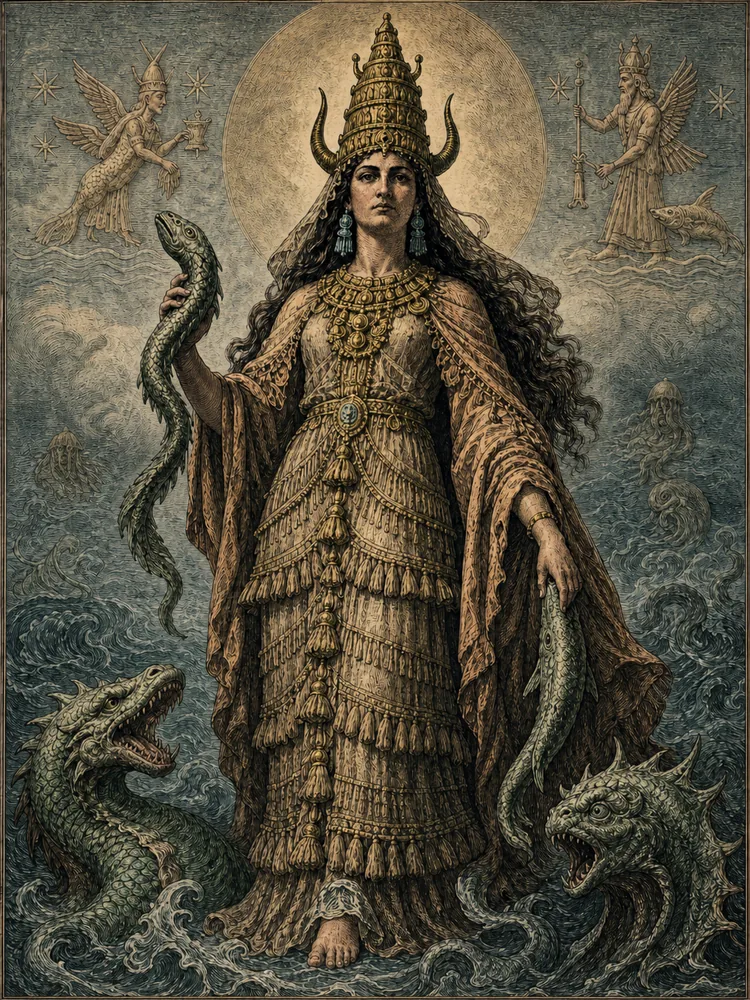
Tiamat, plate

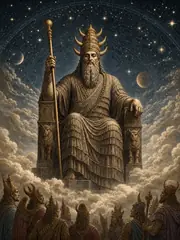
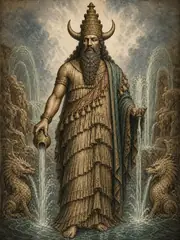
Tiamat was the great salt sea, the bitter water that surrounds the world; and Apsu was the sweet water beneath it. In the days before the world was made, the two waters were one, and from their mingling came forth all the gods: Lahmu and Lahamu first, then Anshar and Kishar, and from Anshar at length the bright Anu and the line of his sons. But the younger gods were noisy and troublesome, and disturbed Apsu's rest; and Apsu took counsel with his vizier Mummu to destroy them, though Tiamat their mother spoke against the plan, weeping that her own children should be slain.

Apsu was overcome by the cunning of Ea before he could strike, and slain in his sleep; and Tiamat was left widowed and grieving. Then certain of the gods who had loved Apsu came to Tiamat and reproached her bitterly: "When Apsu thy husband was slain, thou didst not stir, but didst sit still. Now arise, and be a mother indeed, and avenge him." Stung by their words, Tiamat rose up. She summoned eleven monsters to be her army — the great serpent, the lion-demon, the scorpion-man, the storm-fish, and others terrible to behold; and she set Kingu, one of her children, as her general, and gave into his hands the Tablet of Destinies, that the army might fight under his command.

When word of her preparations came to the assembly of the gods, terror fell upon them. Anshar sent first Ea against her, but Ea recoiled from her face and would not fight. He sent next Anu, and Anu likewise turned back. At last the young god Marduk, son of Ea, was brought before the council, and he agreed to fight on one condition: that if he prevailed, the gods should grant him supremacy over them all, and his decree should be henceforth the decree of heaven. To this they assented, hailing him with the cry, "Marduk is king!"

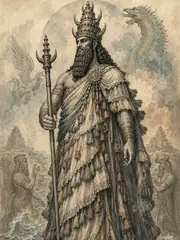
Then Marduk armed himself: he took bow and arrow, and the lightning bolt for his weapon, and the four winds for his chariot, and the seven storms for his hounds. He cast a great net to enclose her, and the four winds he set as guardians at its corners. So accoutred, he rode out to meet Tiamat upon the plain of waters.

She saw him coming, and her face was contorted in fury, and her lips moved with incantation. "Why dost thou stand against me?" Marduk cried. "Come, let us fight, thou and I." Then Tiamat opened her great jaws to swallow him; but Marduk drove the evil wind into her mouth, so that her belly was distended and she could not close it. He shot the arrow, and it cleft her heart; and she fell. He bound her, and split her body in two like a flat fish; one half he raised up to be the sky, and bolted it fast, and set guards lest the waters above should escape; the other half he made into the earth. From her eyes he made the springs of the Tigris and Euphrates; from her breasts he made the mountains; her tail he twisted up to bind sky to earth at the place we call the horizon. So out of her slain body the world was made.
Curator’s note

What the sources say, and what later tradition added. The sources for this bay

Tiamat's story, as told above, is the principal subject of the Enuma Elish — the Babylonian creation epic, composed in its surviving form probably during the reign of Nebuchadnezzar I in the late twelfth century BCE, though it doubtless draws on older material. Tiamat's name (Akkadian tiāmtu, "the sea") is cognate with Hebrew tehom, the "deep" over which the spirit of God moves in Genesis 1:2 — a fact much remarked upon, though one should not press the literary kinship into theological identity. Tiamat is not in any meaningful sense a dragon; she is the salt sea personified. The dragon-image, popular in modern reception, derives from her brood of monsters and from the medieval Christian habit of reading the Leviathan and Tiamat together. The Sumerian sources, which are older, do not have this poem; their primordial sea is named Nammu, and is the mother of Anu and of the gods, but is not slain. The motif of cosmic order won by the slaying of a sea-mother appears to be an Akkadian, perhaps specifically Babylonian, theological synthesis.

Kin in the sources

Each tie is quoted from the entry that states it.

When the sources speak

Dated witnesses for Sumer. A date marks when the evidence was written down, not when the belief began. The whole timeline

c. 3400–3000 BCE
Uruk-period writing and monumental temple economies create the earliest recoverable administrative setting for named divine institutions.
c. 2900–2350 BCE
Early Dynastic city-states preserve local cults, hymns, royal inscriptions, and god lists; later copies often transmit older compositions.
c. 2334–2154 BCE
The Akkadian Empire expands bilingual and imperial patterns of divine identification without erasing local cult titles.
c. 2112–2004 BCE
Ur III administration and scribal schooling standardize many Sumerian literary and liturgical forms.
c. 2000–1600 BCE
Old Babylonian schools copy major myths, laments, hymns, debates, and heroic narratives in the form most often used by modern editors.
c. 1650–1200 BCE
Hittite and Hurrian archives at Hattusa transmit Anatolian myths, imported Syrian materials, and ritual compositions.
c. 1400–1190 BCE
The tablets of Ugarit preserve the Baal Cycle, Kirta, Aqhat, ritual lists, and a dense Late Bronze Age West Semitic pantheon.
c. 1000–612 BCE
Neo-Assyrian and Neo-Babylonian empires collect, revise, and politically reinterpret older learned traditions.

Floor plan

The rooms follow one another in the order their peoples first appear in the written record.

  1. The Cradle of Citiesc. 3400 BCE to 395 CE. 115 works
  2. The Gift of the Nilec. 4000 BCE to 395 CE. 73 works
  3. The Olympian Orderc. 1600 BCE to 750 CE. 152 works
  4. The Persian Worldc. 2000 BCE to 1010 CE. 30 works
  5. The Levantine Borderlandsc. 1200 BCE to 500 CE. 20 works
  6. The Edges of Empirec. 2000 BCE to 1500 CE. 33 works
  7. The Etruscan Worldc. 900 BCE to 750 CE. 22 works
  8. The Roman Inheritancec. 1200 BCE to 500 CE. 58 works
  9. The Northern Inheritancec. 2000 BCE to 1600 CE. 131 works