A Compendium of the Ancient Gods
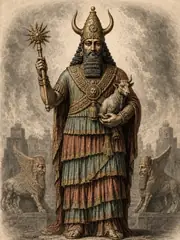
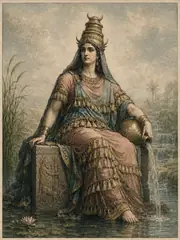
Marduk, plate

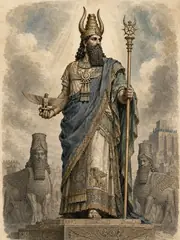
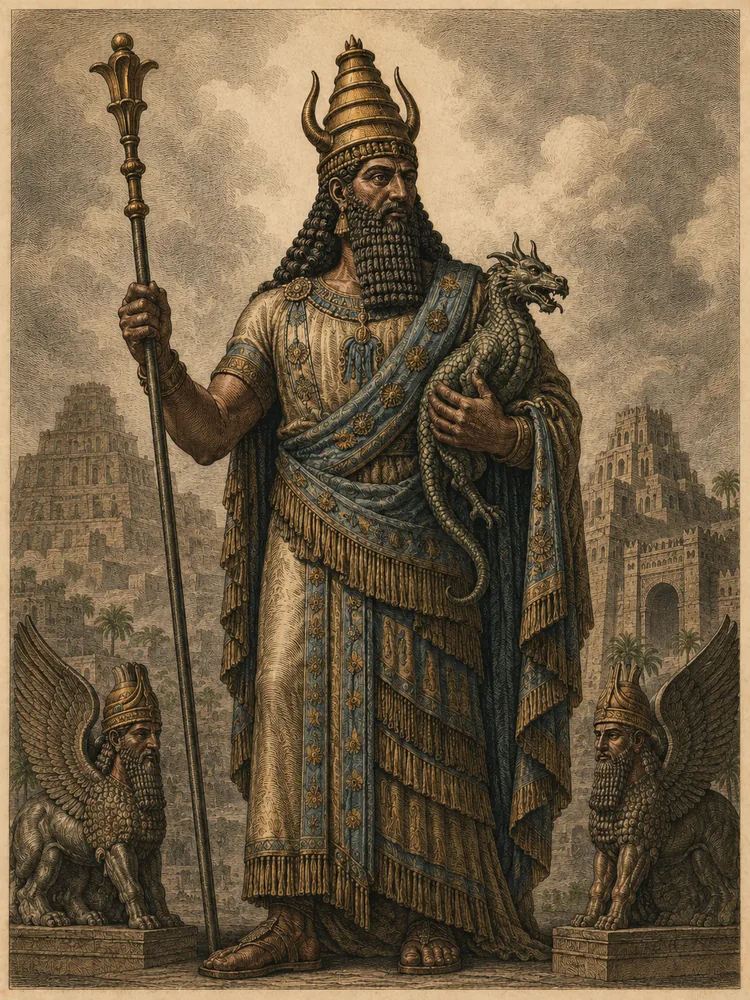
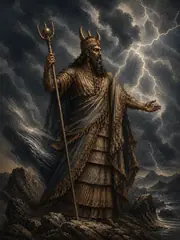
Marduk was the god of Babylon, and the king of the gods after the great battle. In his birth he was a child of Ea — that is, of Sumerian Enki — and of his consort Damkina; he was born in the Apsu, beneath the world, and his beauty and his strength were such that the gods who saw him as an infant marveled. He had four eyes and four ears; the wind was his playmate; in his hand the lightning was a toy. His grandfather Anu fashioned for him the four winds, and these he kept by him. As he grew, he grew into terror as well as beauty: when he marched, the earth shook beneath him.

When the great war with Tiamat came, and the older gods (as told in her entry) recoiled from her face, it was Marduk who agreed to fight, on condition that he be made king. The gods met in the great hall Ubshukinna, and feasted, and made him their king with one voice; they laid before him a constellation of the heavens, and bade him destroy it, and then re-create it, that his power might be tested; and at his command the constellation vanished, and at his second command it returned. Then they crowned him; and he went out, and he slew Tiamat (as told there); and he made the world from her body.

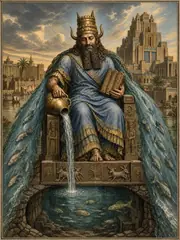
Having made the world, Marduk completed the work. He set the heavens in their courses, and assigned to the great gods their stations: to Anu the highest heaven, to Enlil the middle, to Ea the great below; he established the year, and divided the months, and set the moon and the constellations to mark the days; he founded Babylon as the seat of his cult upon the earth, and built therein the great temple Esagila, "the House Whose Top Is High." He fashioned mankind out of the blood of slain Kingu, that they might bear the labor of the gods. And the gods, beholding his work, gave him fifty names — each name a praise, each praise an office — and these fifty names occupy the closing tablets of the Enuma Elish, and contain in compressed form the whole theology of imperial Babylon.
Curator’s note

What the sources say, and what later tradition added. The sources for this bay

The Enuma Elish ("When on high..."), the Babylonian creation epic, is the source for nearly all that we know of Marduk's mythology. It survives substantially complete on seven tablets, recovered from Ashurbanipal's library at Nineveh and elsewhere. Internal evidence suggests it was composed in something close to its surviving form during the late second millennium BCE, perhaps under Nebuchadnezzar I (c. 1125–1104 BCE), as part of the program by which Marduk's supremacy among the gods was theologically established. The poem was recited in full at the Babylonian New Year (Akitu) festival, and was thus the central ritual text of the Babylonian state. Marduk's title Bel ("Lord"), originally an epithet of Enlil, came in the first millennium to refer to him so consistently that "Bel" alone, in many Akkadian contexts, simply means Marduk. The biblical "Bel and the Dragon" (the deuterocanonical addition to Daniel) refers to Marduk under this title.

Kin in the sources

Each tie is quoted from the entry that states it.

When the sources speak

Dated witnesses for Akkad, Babylon and Assyria. A date marks when the evidence was written down, not when the belief began. The whole timeline

c. 3400–3000 BCE
Uruk-period writing and monumental temple economies create the earliest recoverable administrative setting for named divine institutions.
c. 2900–2350 BCE
Early Dynastic city-states preserve local cults, hymns, royal inscriptions, and god lists; later copies often transmit older compositions.
c. 2334–2154 BCE
The Akkadian Empire expands bilingual and imperial patterns of divine identification without erasing local cult titles.
c. 2112–2004 BCE
Ur III administration and scribal schooling standardize many Sumerian literary and liturgical forms.
c. 2000–1600 BCE
Old Babylonian schools copy major myths, laments, hymns, debates, and heroic narratives in the form most often used by modern editors.
c. 1650–1200 BCE
Hittite and Hurrian archives at Hattusa transmit Anatolian myths, imported Syrian materials, and ritual compositions.
c. 1400–1190 BCE
The tablets of Ugarit preserve the Baal Cycle, Kirta, Aqhat, ritual lists, and a dense Late Bronze Age West Semitic pantheon.
c. 1000–612 BCE
Neo-Assyrian and Neo-Babylonian empires collect, revise, and politically reinterpret older learned traditions.

Floor plan

The rooms follow one another in the order their peoples first appear in the written record.

  1. The Cradle of Citiesc. 3400 BCE to 395 CE. 115 works
  2. The Gift of the Nilec. 4000 BCE to 395 CE. 73 works
  3. The Olympian Orderc. 1600 BCE to 750 CE. 152 works
  4. The Persian Worldc. 2000 BCE to 1010 CE. 30 works
  5. The Levantine Borderlandsc. 1200 BCE to 500 CE. 20 works
  6. The Edges of Empirec. 2000 BCE to 1500 CE. 33 works
  7. The Etruscan Worldc. 900 BCE to 750 CE. 22 works
  8. The Roman Inheritancec. 1200 BCE to 500 CE. 58 works
  9. The Northern Inheritancec. 2000 BCE to 1600 CE. 131 works