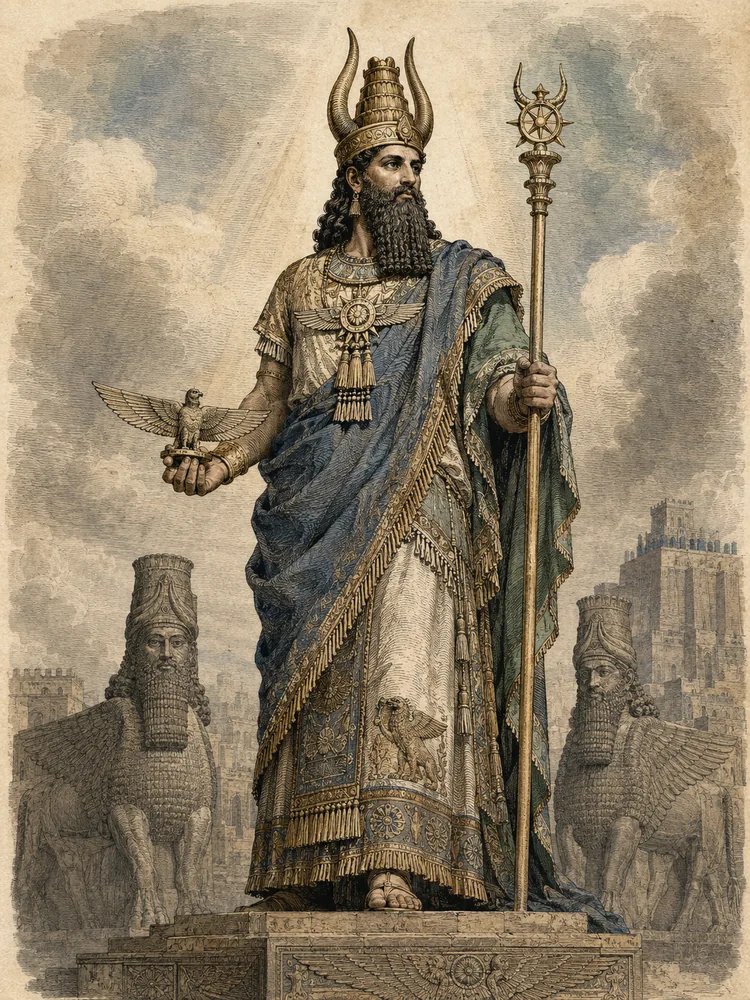
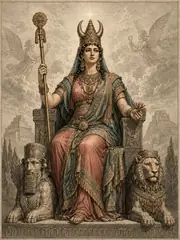
Ashur was the god of the city of Assur, that ancient stronghold upon the western bank of the Tigris from which the Assyrian nation took its name. He was, in his origin, the deified spirit of the city itself — the numen of its rock and its walls — and as Assyria grew from a city-state to a province, to a kingdom, to the great empire that under Tiglath-Pileser, Sargon, Sennacherib, and Ashurbanipal commanded the territory from the Persian Gulf to the borders of Egypt, so Ashur grew with it. By the eighth century before the common era, his theologians had assigned to him every supreme office: he was creator, sky-father, storm-lord, judge, and king of all the gods, and the very texts of the Babylonian Enuma Elish were rewritten with his name in place of Marduk, that all the labor of the cosmos might be referred to him.
Each Assyrian victory was Ashur's victory; each Assyrian conquest, a triumph of his arm. The Assyrian king was his viceroy upon the earth, ruling "by the command of Ashur"; the great campaigns of empire were prefaced in their inscriptions with the formula, "With the strength of Ashur, my lord, I went forth." His emblem was the winged sun-disk, often shown enclosing the figure of an archer — Ashur himself, drawing his bow against the enemies of Assyria — and this image was carried before the army on its standard.
Curator’s note
What the sources say, and what later tradition added. The sources for this bay
Ashur's elevation to supremacy is a textbook case of imperial theology: an originally local city-god raised, by political success, to the rank of universal sovereign. The substitution of Ashur for Marduk in the Assyrian recensions of the Enuma Elish is sometimes presented as crude, but the procedure was theologically deliberate — Sennacherib, after sacking Babylon in 689 BCE, formally transferred the kingship of the gods from Marduk to Ashur, and the textual revisions are part of the same program. After the fall of Nineveh in 612 BCE and the destruction of Assyria as a political entity, the cult of Ashur survived for some centuries in the city of Assur itself, where Parthian-period inscriptions still attest his worship. The winged-disk emblem of Ashur has been variously confused, in modern reception, with the Zoroastrian fravashi and with the Egyptian winged sun; the three traditions are distinct, though all draw on the common Near Eastern motif of the protecting solar power.
When the sources speak
Dated witnesses for Akkad, Babylon and Assyria. A date marks when the evidence was written down, not when the belief began. The whole timeline
- c. 3400–3000 BCE
- Uruk-period writing and monumental temple economies create the earliest recoverable administrative setting for named divine institutions.
- c. 2900–2350 BCE
- Early Dynastic city-states preserve local cults, hymns, royal inscriptions, and god lists; later copies often transmit older compositions.
- c. 2334–2154 BCE
- The Akkadian Empire expands bilingual and imperial patterns of divine identification without erasing local cult titles.
- c. 2112–2004 BCE
- Ur III administration and scribal schooling standardize many Sumerian literary and liturgical forms.
- c. 2000–1600 BCE
- Old Babylonian schools copy major myths, laments, hymns, debates, and heroic narratives in the form most often used by modern editors.
- c. 1650–1200 BCE
- Hittite and Hurrian archives at Hattusa transmit Anatolian myths, imported Syrian materials, and ritual compositions.
- c. 1400–1190 BCE
- The tablets of Ugarit preserve the Baal Cycle, Kirta, Aqhat, ritual lists, and a dense Late Bronze Age West Semitic pantheon.
- c. 1000–612 BCE
- Neo-Assyrian and Neo-Babylonian empires collect, revise, and politically reinterpret older learned traditions.