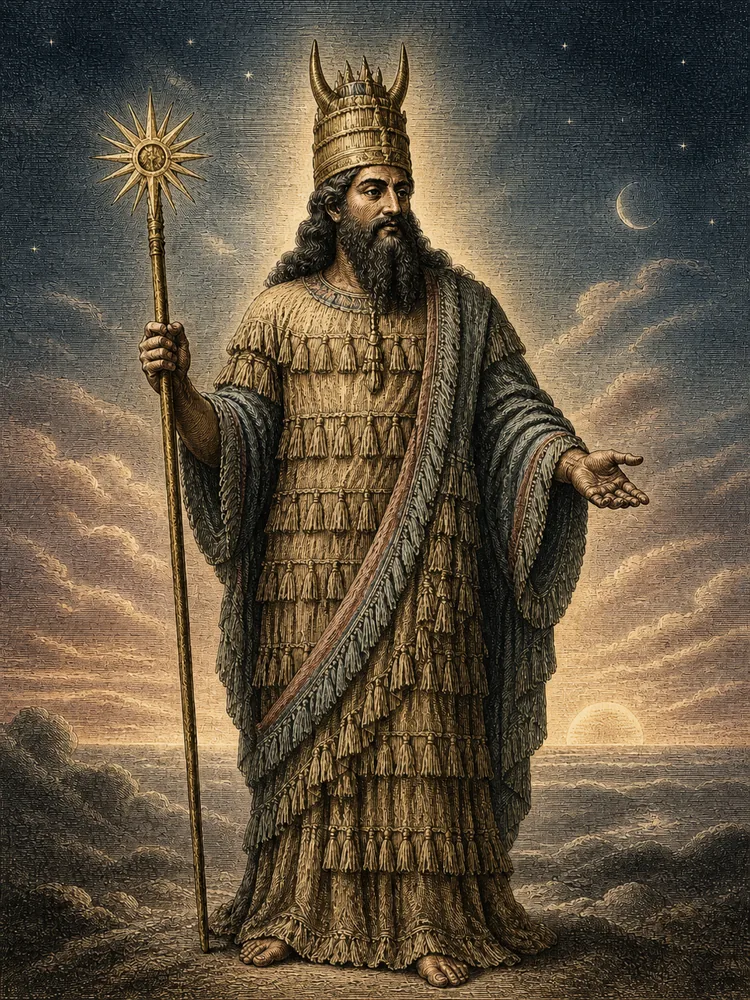
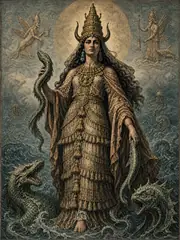
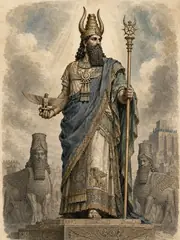
In the beginning, before there was a name for sky or for earth, there was only Apsu the freshwater and Tiamat the sea, and the two waters mingled their bodies in a single flood. From this mingling came forth Lahmu and Lahamu, silt-gods of the marsh; and from Lahmu and Lahamu, in turn, came Anshar and his sister Kishar. Anshar was the rim where the heaven met the horizon; Kishar was the rim where the earth came round to meet it. They were greater than their parents and exceeded them. Anshar lay with Kishar and engendered Anu, who would be Lord of the Sky thereafter; and so the line of the great gods began.
In the later wars of the gods, when Tiamat rose against her offspring, it was Anshar who summoned the assembly and bade them find a champion. He sent first the god Ea against her; and when Ea returned defeated, he sent his grandson Marduk, and gave him at last the lordship over all the gods, that he might fight in their stead.
Curator’s note
What the sources say, and what later tradition added. The sources for this bay
Anshar appears principally in the Babylonian Enuma Elish (Tablets I–II), the great creation poem of the second millennium BCE. The name is Akkadian, but the figure is built upon a Sumerian pattern: An-šár signifies "the totality of heaven," and his sister Ki-šár "the totality of earth." In some Assyrian recensions of the poem, Anshar's name is substituted for Ashur, the national god, and the cosmic war is reassigned to him — a pious editorial revision attested in tablets from Ashurbanipal's library. The earlier Sumerian sources, in which Anshar appears among the long lists of An's ancestors, give him no narrative of his own; he is essentially a cosmographic principle that the Babylonian poet has personified.
When the sources speak
Dated witnesses for Sumer. A date marks when the evidence was written down, not when the belief began. The whole timeline
- c. 3400–3000 BCE
- Uruk-period writing and monumental temple economies create the earliest recoverable administrative setting for named divine institutions.
- c. 2900–2350 BCE
- Early Dynastic city-states preserve local cults, hymns, royal inscriptions, and god lists; later copies often transmit older compositions.
- c. 2334–2154 BCE
- The Akkadian Empire expands bilingual and imperial patterns of divine identification without erasing local cult titles.
- c. 2112–2004 BCE
- Ur III administration and scribal schooling standardize many Sumerian literary and liturgical forms.
- c. 2000–1600 BCE
- Old Babylonian schools copy major myths, laments, hymns, debates, and heroic narratives in the form most often used by modern editors.
- c. 1650–1200 BCE
- Hittite and Hurrian archives at Hattusa transmit Anatolian myths, imported Syrian materials, and ritual compositions.
- c. 1400–1190 BCE
- The tablets of Ugarit preserve the Baal Cycle, Kirta, Aqhat, ritual lists, and a dense Late Bronze Age West Semitic pantheon.
- c. 1000–612 BCE
- Neo-Assyrian and Neo-Babylonian empires collect, revise, and politically reinterpret older learned traditions.