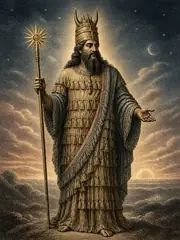
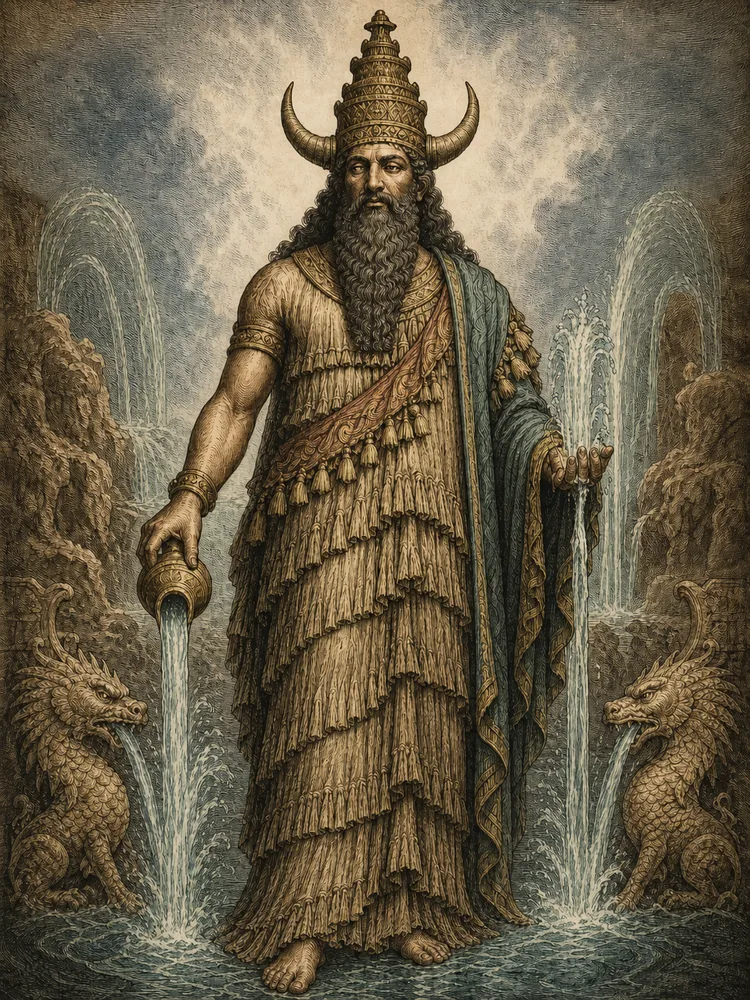
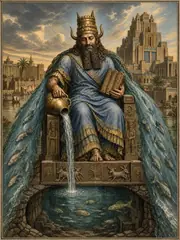
Apsu was the freshwater that lay beneath the earth, the deep wellspring from which the rivers and the marshes drew their being. He was the husband of Tiamat the salt sea, and from their commingling were begotten the first generations of the gods. But the gods, growing in number and clamor, disturbed the rest of Apsu; and he came to Tiamat in anger, saying: "By day I cannot rest, by night I cannot sleep. Let me destroy them, that quiet may return." Tiamat was reluctant — they were her own offspring — but Apsu set himself to do the deed.
The plot, however, was overheard by Ea, wisest of the gods. By a charm of his own contriving, Ea cast Apsu into a deep sleep, took from him his crown and his radiance, and slew him as he slept; and upon the body of his slain ancestor he built his own dwelling, which he named after him, the Apsu, the chamber of sweet waters beneath the world. There Ea made his throne, and there in time was born his son Marduk.
When the sources speak
Dated witnesses for Sumer. A date marks when the evidence was written down, not when the belief began. The whole timeline
- c. 3400–3000 BCE
- Uruk-period writing and monumental temple economies create the earliest recoverable administrative setting for named divine institutions.
- c. 2900–2350 BCE
- Early Dynastic city-states preserve local cults, hymns, royal inscriptions, and god lists; later copies often transmit older compositions.
- c. 2334–2154 BCE
- The Akkadian Empire expands bilingual and imperial patterns of divine identification without erasing local cult titles.
- c. 2112–2004 BCE
- Ur III administration and scribal schooling standardize many Sumerian literary and liturgical forms.
- c. 2000–1600 BCE
- Old Babylonian schools copy major myths, laments, hymns, debates, and heroic narratives in the form most often used by modern editors.
- c. 1650–1200 BCE
- Hittite and Hurrian archives at Hattusa transmit Anatolian myths, imported Syrian materials, and ritual compositions.
- c. 1400–1190 BCE
- The tablets of Ugarit preserve the Baal Cycle, Kirta, Aqhat, ritual lists, and a dense Late Bronze Age West Semitic pantheon.
- c. 1000–612 BCE
- Neo-Assyrian and Neo-Babylonian empires collect, revise, and politically reinterpret older learned traditions.