A Compendium of the Ancient Gods
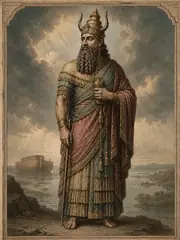
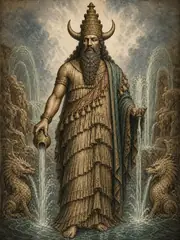
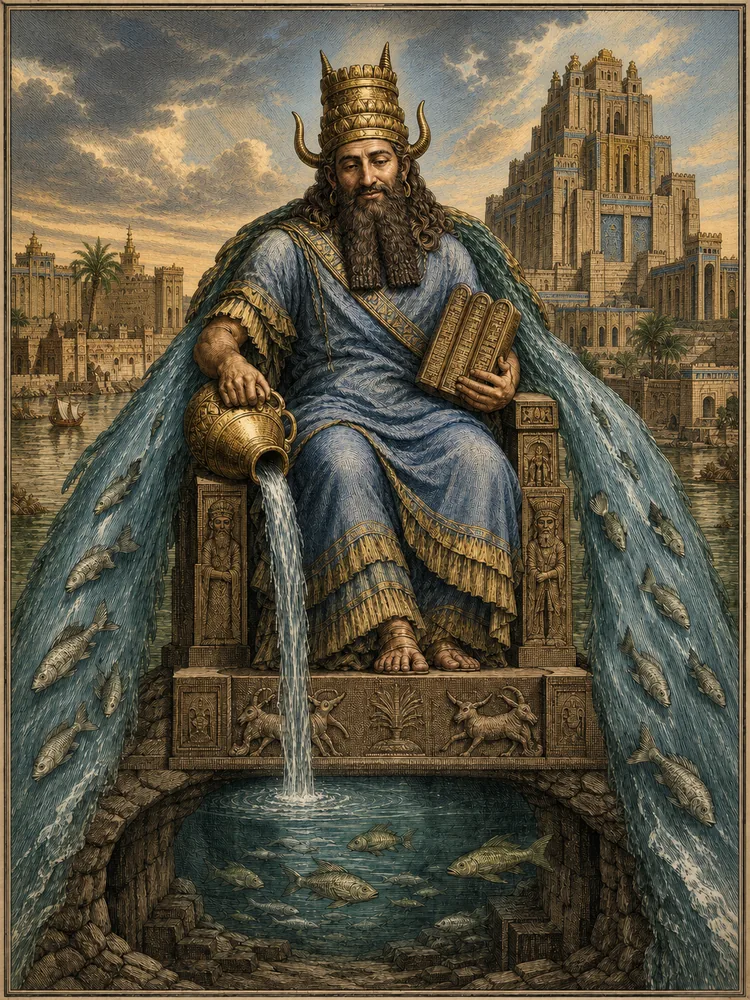
Enki, plate

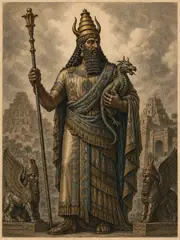
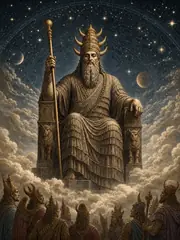
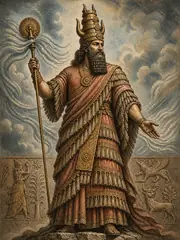
Enki was the cleverest of the gods. He dwelt in the Apsu, the great chamber of sweet waters beneath the earth; his city was Eridu, the southernmost city of Sumer, founded (so the Sumerians said) at the very beginning of human time. He was god of the waters, of wisdom, of crafts, of magic, and of the arts of civilization; and where his brother Enlil was austere and terrible, Enki was kindly and ingenious, the god to whom one turned when there was a riddle to solve, a curse to lift, or a flood to escape.

To Enki and to Ninhursag the Lady of the Foothills, the Sumerians ascribed the making of mankind. The lesser gods, weary with the digging of canals and the bearing of bricks, had risen in revolt, and Enki was sent for to find a remedy. He drew up clay from the Apsu and mixed with it the blood of a slain god, and he and the mother goddesses pinched the clay into shape, that man might bear the burden of the gods. So humankind began.

It was Enki, too, who saved mankind from the Flood. The gods, troubled by the noise of human multitudes, had decreed their destruction; Enlil pressed for the Flood; and the council was sworn to secrecy. But Enki — bound by his oath, yet unwilling to see his creatures perish — went down to the reed hut of his servant Ziusudra (in later Babylonian telling, Atrahasis, or Utnapishtim), and spoke through the wall, addressing not the man but the reeds, that the letter of his oath might be kept. "Reed hut, reed hut, hear! Wall, wall, listen! Tear down the house, build a ship; abandon possessions, save life. Take aboard the seed of all living things." The man heard, and built his ship; and when the waters came, he and his household and the beasts were saved.

Of Enki many other tales are told. He stocked the marshes with fish and the rivers with reeds, and assigned to each god his proper office; he was tricked by his daughter Inanna into surrendering the me, the divine ordinances of civilization, when she came drunken to his court at Eridu and sailed away with them in her boat to Uruk. He sired children upon Ninhursag in the paradise-garden of Dilmun, and ate eight forbidden plants there, for which Ninhursag cursed him with eight ailments — until she relented, and bore eight healing goddesses to undo what she had done. He was, in short, the patron of all those arts by which humans contrive to outlast the indifference of greater powers.
Curator’s note

What the sources say, and what later tradition added. The sources for this bay

Enki — Akkadian Ea — is among the most warmly portrayed of the Sumerian gods, and the breadth of his myth-cycle reflects the eminence of Eridu, his cult-city, in the religious memory of Sumer. His principal extant myths include Enki and Ninhursag (the Dilmun myth), Enki and the World Order, Enki and Inanna (the seizure of the me), and Enki and Ninmah (a creation contest). The flood story is told in three principal versions: the Sumerian Flood Tablet (where the hero is Ziusudra), the Old Babylonian Atrahasis Epic, and Tablet XI of the Standard Babylonian Gilgamesh (where the hero is Utnapishtim and the warning is given through a reed wall). These flood narratives stand in evident literary kinship to the biblical Flood of Noah, and the question of dependence — whether the Hebrew text drew upon the Mesopotamian, or both upon a common older substrate — is one of the great questions of comparative literature; most scholars now favor the former. The figure of the wise and tricky god who saves a chosen man from a divinely decreed deluge is, in any case, far older than Genesis.

Kin in the sources

Each tie is quoted from the entry that states it.

When the sources speak

Dated witnesses for Sumer. A date marks when the evidence was written down, not when the belief began. The whole timeline

c. 3400–3000 BCE
Uruk-period writing and monumental temple economies create the earliest recoverable administrative setting for named divine institutions.
c. 2900–2350 BCE
Early Dynastic city-states preserve local cults, hymns, royal inscriptions, and god lists; later copies often transmit older compositions.
c. 2334–2154 BCE
The Akkadian Empire expands bilingual and imperial patterns of divine identification without erasing local cult titles.
c. 2112–2004 BCE
Ur III administration and scribal schooling standardize many Sumerian literary and liturgical forms.
c. 2000–1600 BCE
Old Babylonian schools copy major myths, laments, hymns, debates, and heroic narratives in the form most often used by modern editors.
c. 1650–1200 BCE
Hittite and Hurrian archives at Hattusa transmit Anatolian myths, imported Syrian materials, and ritual compositions.
c. 1400–1190 BCE
The tablets of Ugarit preserve the Baal Cycle, Kirta, Aqhat, ritual lists, and a dense Late Bronze Age West Semitic pantheon.
c. 1000–612 BCE
Neo-Assyrian and Neo-Babylonian empires collect, revise, and politically reinterpret older learned traditions.

Floor plan

The rooms follow one another in the order their peoples first appear in the written record.

  1. The Cradle of Citiesc. 3400 BCE to 395 CE. 115 works
  2. The Gift of the Nilec. 4000 BCE to 395 CE. 73 works
  3. The Olympian Orderc. 1600 BCE to 750 CE. 152 works
  4. The Persian Worldc. 2000 BCE to 1010 CE. 30 works
  5. The Levantine Borderlandsc. 1200 BCE to 500 CE. 20 works
  6. The Edges of Empirec. 2000 BCE to 1500 CE. 33 works
  7. The Etruscan Worldc. 900 BCE to 750 CE. 22 works
  8. The Roman Inheritancec. 1200 BCE to 500 CE. 58 works
  9. The Northern Inheritancec. 2000 BCE to 1600 CE. 131 works