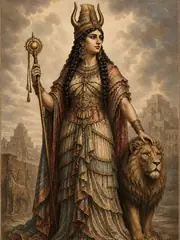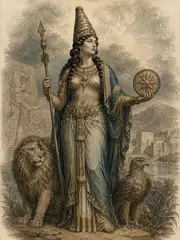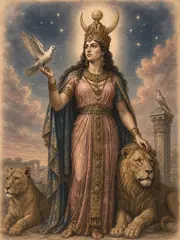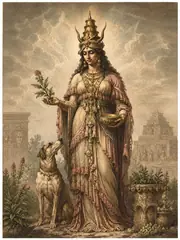
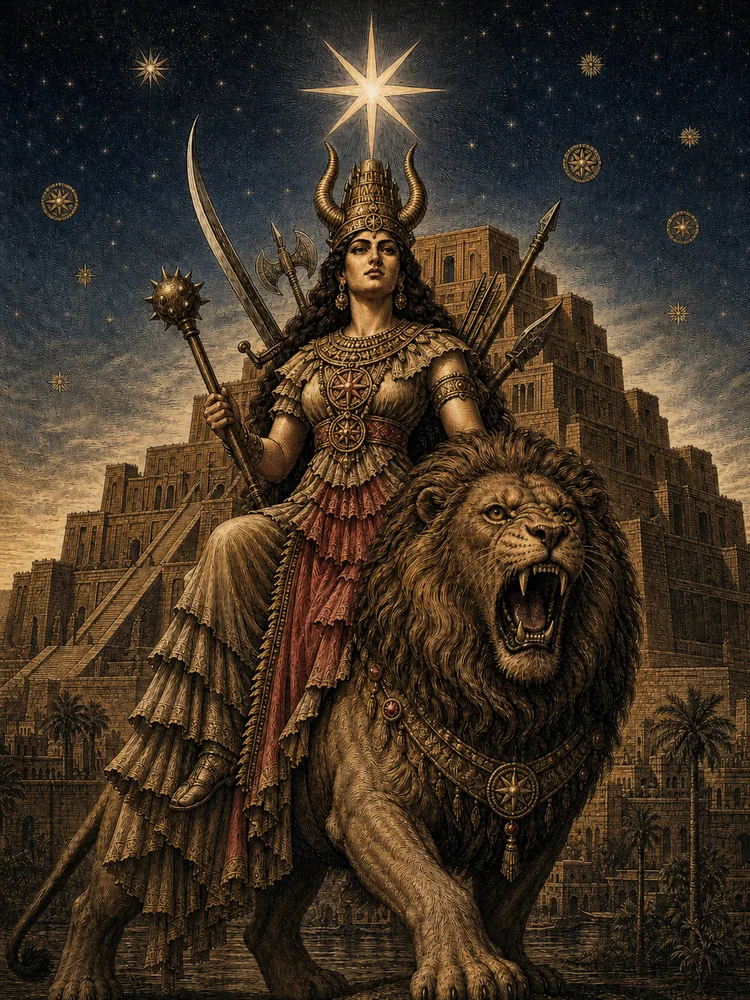
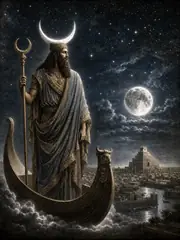
Of all the gods of Sumer, none is more vividly drawn in the surviving songs than Inanna. She was the lady of love and the lady of battle; her star was the planet Venus, the morning star and the evening star; her sacred precinct was the Eanna at Uruk, the House of Heaven that had been her father Anu's. She was beautiful, ambitious, headstrong, dangerous, and proud, and the songs do not pretend otherwise.
In her youth, before she had grown into her full power, she came one day to her father's brother Enki at Eridu, and dined with him in his hall. The wise god, made cheerful by beer, granted to her — gift after gift — the me, the divine ordinances by which civilization is conducted: kingship and priesthood and lovemaking and weaving and warfare and judgment, more than fourscore in number. Inanna piled them onto her boat and pushed off down the river toward Uruk. When Enki sobered the next morning and saw what he had given away, he sent his minions after her with monsters to recover the me; but she fought them off at every reach of the river, and brought the ordinances safely home. So Uruk became the seat of civilization, by Inanna's wit.
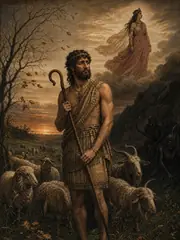
She was woman as well as goddess. The cycle of her courtship with Dumuzi the shepherd is a thing of the most delicate poetry: she pretended to her mother that she had been with her girlfriend, when in fact she had lain with him; her brother Utu the sun-god prepared the marriage-bed, and joked with her about it; she demanded gifts, she demanded ardor, and her shepherd brought her both. "Plough my vulva, my sweet," runs one of her songs, "plough my vulva, man of my heart." The Sumerians did not pretend that the queen of heaven was modest.
And then she went down. Inanna set her ear toward the great below — "set her mind" is the phrase the poets use — and she resolved to descend into the underworld and challenge her sister Ereshkigal there. She gave her vizier Ninshubur instructions: if she did not return in three days, Ninshubur was to mourn before the gods, and to seek help from Enlil, and from Nanna, and last from Enki. Then she put on her seven ornaments — the crown, the lapis necklace, the breastplate, the rod of measurement, and the rest — and went down to the gates.
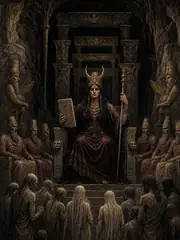
At each of the seven gates, the gatekeeper Neti made her remove one ornament; and she came at last naked into the throne-room of her sister. The seven Anunnaki of the dark realm fastened upon her the eye of death; and she was struck down, and her corpse hung upon a peg in Ereshkigal's hall, and there she rotted three days and three nights.
Then Ninshubur kept her instructions: she mourned in dust, and went up to the gods. Enlil refused to help; Nanna refused; but Enki, ever resourceful, took clay from beneath his fingernails and fashioned two creatures, the kurgarra and the galatur, beings neither male nor female, and sent them down with the food of life and the water of life. They came creeping into Ereshkigal's hall, and they found her writhing in the labor of the dead — for the dead never rest from their pangs — and they sympathized with her, sigh for sigh, until she swore by their kindness to grant whatever they should ask. They asked for the corpse upon the hook; and they sprinkled the food of life and the water of life upon it; and Inanna rose.
But none ascended from the underworld without leaving a substitute. Inanna rose, and the demons of the great below came up with her, fastened upon her, and would not be shaken off until she had given them another in her stead. She came first to her vizier Ninshubur, who was sitting in dust, mourning; and she would not give Ninshubur to the demons. She came to her son Shara, who lay in dust, mourning; and she would not give Shara. She came to her son Lulal, mourning; and she would not give Lulal. But when she came to her own city Uruk, she found Dumuzi her husband sitting upon her throne, dressed in royal robes, listening to flute-girls, taking his ease, and showing no sign of grief at all. Then her eye changed; and she said to the demons, "This one. Take him." And they seized Dumuzi, and bound him, and dragged him down. (The end of his story is told in the entry on Dumuzi.)
Many other tales are told of Inanna: how she challenged the wild man Bilgames (Gilgamesh) and was rebuffed; how she sent the Bull of Heaven against him in revenge; how she contended with the mountain Ebih, and laid it low; how she received the goddess Nisaba's tablet in the assembly. She was a goddess by whom the world was kept active. "To turn a man into a woman, to turn a woman into a man, are thine, O Inanna," runs one of her hymns; she was the figure of all that did not stay in its place.