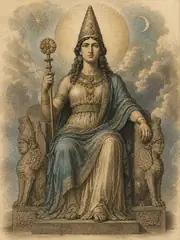
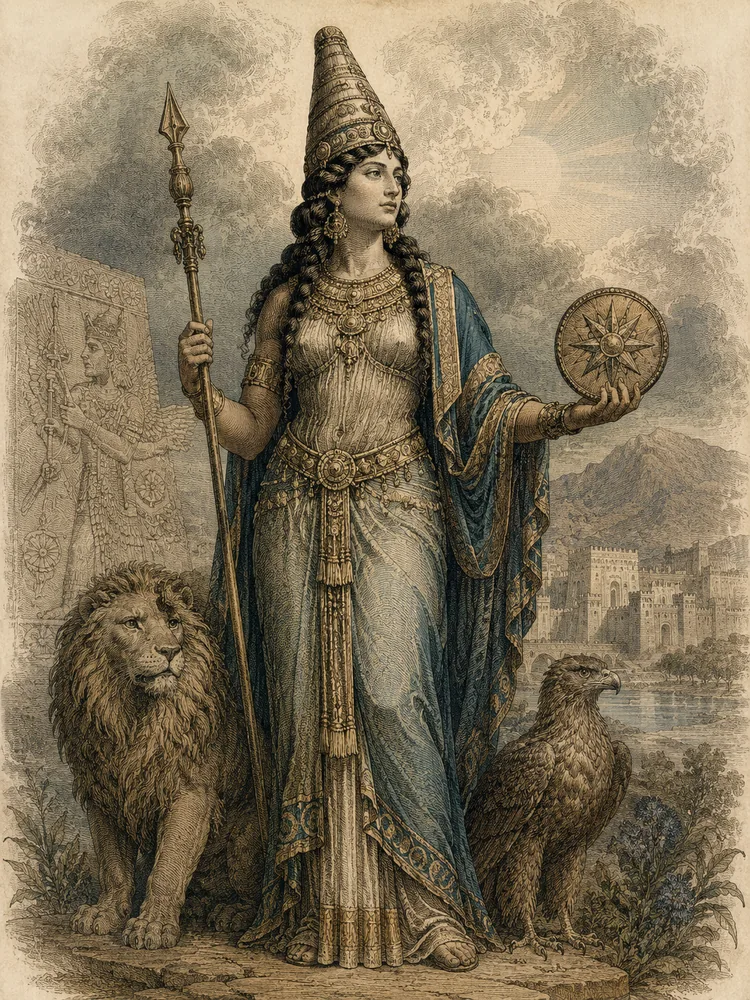
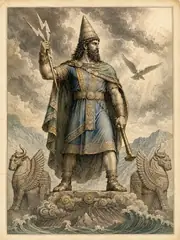
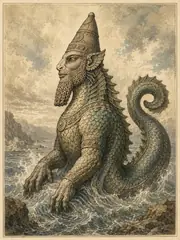
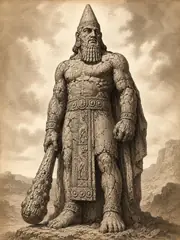
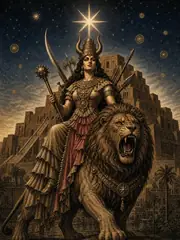
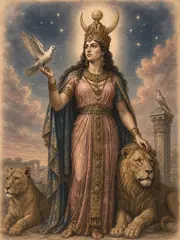
Shaushka was the Hurrian Ishtar — goddess of love, of war, of healing, and of the cunning that overcomes monsters. She was the sister of Teshub, and in the great battles against the stone-giant Ullikummi and the sea-monster Hedammu it was she who was first sent to subdue them by the power of beauty and song. She came down dressed in her most splendid raiment, accompanied by her two handmaidens Ninatta and Kulitta, and sang and danced before the monster, that he might be enchanted and grow weak. The strategy succeeded against Hedammu; against Ullikummi, who had no eyes nor ears, it failed, and other measures had to be taken.
 Before thisHepat
 Next on the wallTarhunt
Curator’s note
What the sources say, and what later tradition added. The sources for this bay
Shaushka's identification with Ishtar is direct and was acknowledged in antiquity; the same theonym is sometimes written with Ishtar's logogram in cuneiform Hurrian texts. Her temple at Nineveh was the famous one whose statue was sent to Egypt under Amenhotep III. Tushratta of Mitanni's letter on the occasion (Amarna letter EA 23) is one of the more endearing diplomatic documents of antiquity: "Thus Shaushka of Nineveh, mistress of all lands, says: 'To Egypt, the country I love, will I go, and there will I dwell.'" The mission seems not to have effected the desired cure.
Kin in the sources
Each tie is quoted from the entry that states it.
 Named as the same god asIshtar of Nineveh
Shaushka's identification with Ishtar is direct and was acknowledged in antiquity
 Sibling ofTeshub
She was the sister of Teshub, and in the great battles against the stone-giant Ullikummi
 Rival ofHedammu
The strategy succeeded against Hedammu; against Ullikummi, who had no eyes nor ears, it failed
 Rival ofUllikummi
The strategy succeeded against Hedammu; against Ullikummi, who had no eyes nor ears, it failed
The same god in other rooms
The ancient sources themselves name these as one god under different names. See Inanna, Ishtar of Nineveh, Shaushka and Astarte hung together
When the sources speak
Dated witnesses for Anatolia. A date marks when the evidence was written down, not when the belief began. The whole timeline
- c. 3400–3000 BCE
- Uruk-period writing and monumental temple economies create the earliest recoverable administrative setting for named divine institutions.
- c. 2900–2350 BCE
- Early Dynastic city-states preserve local cults, hymns, royal inscriptions, and god lists; later copies often transmit older compositions.
- c. 2334–2154 BCE
- The Akkadian Empire expands bilingual and imperial patterns of divine identification without erasing local cult titles.
- c. 2112–2004 BCE
- Ur III administration and scribal schooling standardize many Sumerian literary and liturgical forms.
- c. 2000–1600 BCE
- Old Babylonian schools copy major myths, laments, hymns, debates, and heroic narratives in the form most often used by modern editors.
- c. 1650–1200 BCE
- Hittite and Hurrian archives at Hattusa transmit Anatolian myths, imported Syrian materials, and ritual compositions.
- c. 1400–1190 BCE
- The tablets of Ugarit preserve the Baal Cycle, Kirta, Aqhat, ritual lists, and a dense Late Bronze Age West Semitic pantheon.
- c. 1000–612 BCE
- Neo-Assyrian and Neo-Babylonian empires collect, revise, and politically reinterpret older learned traditions.