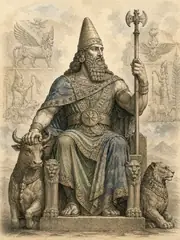
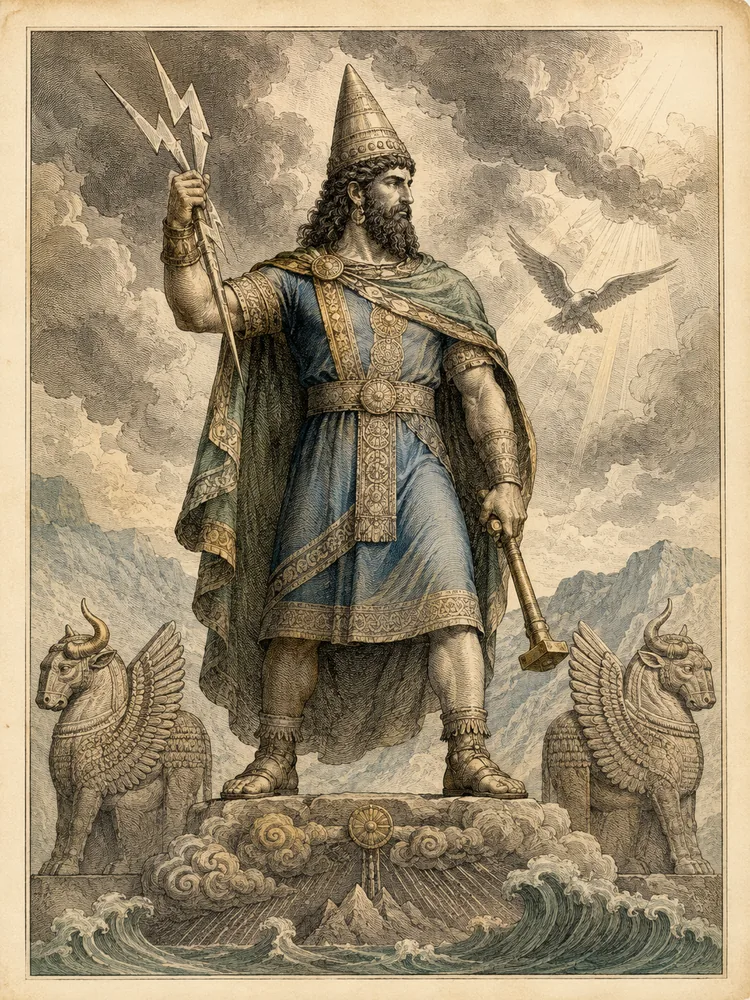
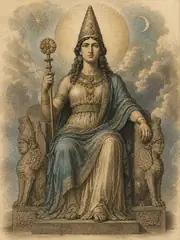
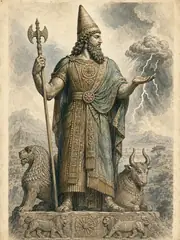
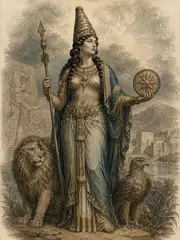
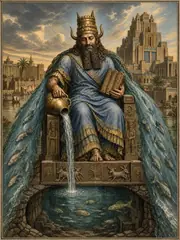
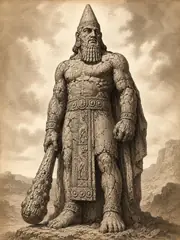
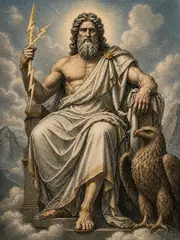
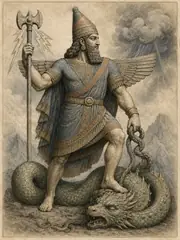
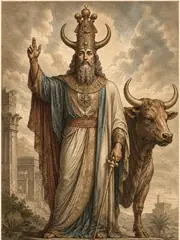
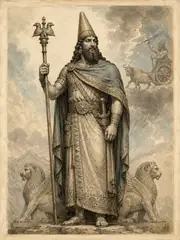
Teshub (whom the Hittites called Tessub, the Luwians Tarhunza, and the Hattians earlier by the name Taru) was the storm-god, lord of the sky, master of the lightning, and king of the gods after the overthrow of his father Kumarbi. He stood upon a chariot drawn by two bulls, Hurri and Sheri ("Day" and "Night"), and bore the lightning-axe and the thunderbolt; his face was bearded, his crown horned, and his step shook the mountains. His wife was Hepat, the great lady of the Hurrian pantheon.
In the Song of Ullikummi (told in the entry on Kumarbi), it is Teshub who is challenged by the stone-giant; in the Song of Hedammu, by a sea-monster. In each case Teshub at first contends, sometimes loses, sometimes is restored to victory by the cunning of Ea or the courage of his sister Shaushka. He is the Hurrian sky-king, but he is not invincible; his story is regularly that of a god who must contend, and whose victory must be earned.
Curator’s note
What the sources say, and what later tradition added. The sources for this bay
Teshub/Tessub is attested across the entire range of the Hurrian world (northern Mesopotamia, southeastern Anatolia, northern Syria) and into the Hittite empire, where his cult was officially adopted. The treaty texts of the Hittites regularly invoke "the Storm-God of the Sky" as chief divine witness; this is Teshub. His iconography — the bearded god with axe and lightning, atop a chariot drawn by bulls, or himself riding the bull — was extraordinarily long-lived and influential, providing the model for the depiction of Hadad/Baal in Syria, of Tarhunt among the Luwians, and possibly informing the iconography of Greek Zeus.
When the sources speak
Dated witnesses for Anatolia. A date marks when the evidence was written down, not when the belief began. The whole timeline
- c. 3400–3000 BCE
- Uruk-period writing and monumental temple economies create the earliest recoverable administrative setting for named divine institutions.
- c. 2900–2350 BCE
- Early Dynastic city-states preserve local cults, hymns, royal inscriptions, and god lists; later copies often transmit older compositions.
- c. 2334–2154 BCE
- The Akkadian Empire expands bilingual and imperial patterns of divine identification without erasing local cult titles.
- c. 2112–2004 BCE
- Ur III administration and scribal schooling standardize many Sumerian literary and liturgical forms.
- c. 2000–1600 BCE
- Old Babylonian schools copy major myths, laments, hymns, debates, and heroic narratives in the form most often used by modern editors.
- c. 1650–1200 BCE
- Hittite and Hurrian archives at Hattusa transmit Anatolian myths, imported Syrian materials, and ritual compositions.
- c. 1400–1190 BCE
- The tablets of Ugarit preserve the Baal Cycle, Kirta, Aqhat, ritual lists, and a dense Late Bronze Age West Semitic pantheon.
- c. 1000–612 BCE
- Neo-Assyrian and Neo-Babylonian empires collect, revise, and politically reinterpret older learned traditions.