A Compendium of the Ancient Gods
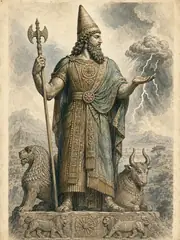
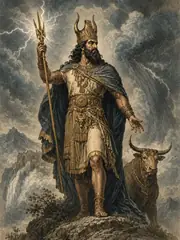
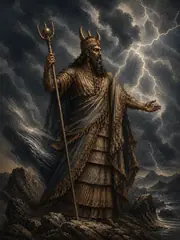
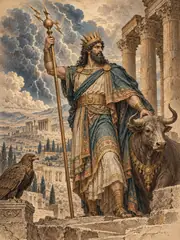
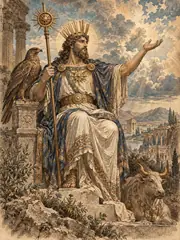
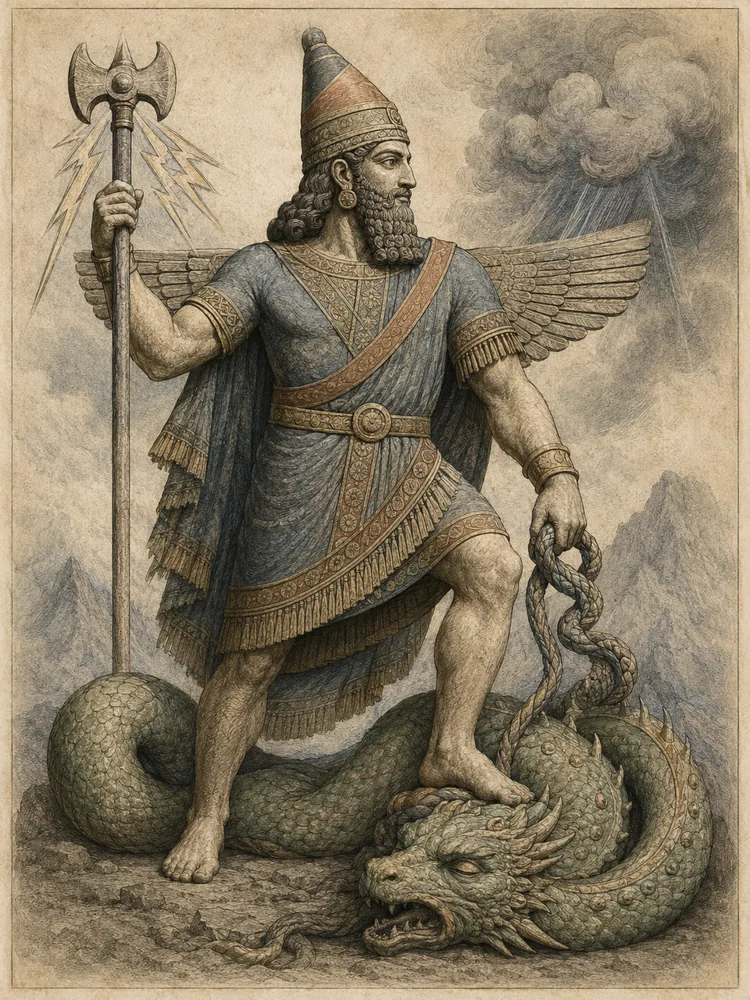
Tarhunt, plate

Tarhunt — the Hittite name for the storm-god — was lord of the sky, the rains, and the kingship; his role corresponds in nearly every particular to that of Hurrian Teshub, with whom he was systematically identified by the Hittite imperial theologians. But Anatolia preserves of him a pair of stories that are uniquely its own.

The Illuyanka was a great serpent that dwelt in the Anatolian highlands. In the first version of the tale, Tarhunt joined battle with the serpent and was overcome — defeated outright. In his shame he went to the goddess Inara, and asked her counsel; and she devised a feast at the city of Kishkilussa. She invited the serpent and his offspring, and they came up out of their pit and ate and drank to their fill, and grew so heavy with food that they could not return down again. Then Inara's mortal lover, a man named Hupasiyas — for she had taken him as her companion in the affair — bound them with a rope; and Tarhunt came forth and slew them. Hupasiyas had his price: Inara had set him in a house upon a rock, and forbidden him to look out the window at his wife; but he disobeyed, and looked, and Inara was angry, and the tale ends with his death.

In the second version, the Illuyanka took from Tarhunt his eyes and his heart in their first encounter; and Tarhunt, maimed, sired a son upon a poor man's daughter. When his son was grown, Tarhunt arranged that the son should marry the daughter of the Illuyanka, and demand of his bride's father, as the proper bride-price, the eyes and the heart of his own true father. The serpent gave them up; Tarhunt was made whole; and the second battle was joined, and the serpent slain — though the son, having sworn loyalty to his bride's family, asked his father to slay him also, and Tarhunt did so.
Curator’s note

What the sources say, and what later tradition added. The sources for this bay

The Illuyanka tale is preserved in the Hittite Myth of Illuyanka, recited at the festival called purulli at the spring New Year. The composition explicitly distinguishes its two versions; the second is described as "the older." The story stands at the head of a long Indo-European tradition of dragon-slaying storm-gods (Vedic Indra and Vritra, Norse Thor and Jörmungandr, Greek Zeus and Typhon), and the family resemblance is so close that Calvert Watkins, in his classic How to Kill a Dragon (1995), reconstructed a Proto-Indo-European poetic formula for the encounter — "the hero slew the serpent" — preserved with extraordinary fidelity across descendant traditions.

Kin in the sources

Each tie is quoted from the entry that states it.

The same god in other rooms

The ancient sources themselves name these as one god under different names. See Adad, Tarhunt, Lametrus, Papas, Baal, Zeus, Hadad, Baalshamin and Tinia hung together

When the sources speak

Dated witnesses for Anatolia. A date marks when the evidence was written down, not when the belief began. The whole timeline

c. 3400–3000 BCE
Uruk-period writing and monumental temple economies create the earliest recoverable administrative setting for named divine institutions.
c. 2900–2350 BCE
Early Dynastic city-states preserve local cults, hymns, royal inscriptions, and god lists; later copies often transmit older compositions.
c. 2334–2154 BCE
The Akkadian Empire expands bilingual and imperial patterns of divine identification without erasing local cult titles.
c. 2112–2004 BCE
Ur III administration and scribal schooling standardize many Sumerian literary and liturgical forms.
c. 2000–1600 BCE
Old Babylonian schools copy major myths, laments, hymns, debates, and heroic narratives in the form most often used by modern editors.
c. 1650–1200 BCE
Hittite and Hurrian archives at Hattusa transmit Anatolian myths, imported Syrian materials, and ritual compositions.
c. 1400–1190 BCE
The tablets of Ugarit preserve the Baal Cycle, Kirta, Aqhat, ritual lists, and a dense Late Bronze Age West Semitic pantheon.
c. 1000–612 BCE
Neo-Assyrian and Neo-Babylonian empires collect, revise, and politically reinterpret older learned traditions.

Floor plan

The rooms follow one another in the order their peoples first appear in the written record.

  1. The Cradle of Citiesc. 3400 BCE to 395 CE. 115 works
  2. The Gift of the Nilec. 4000 BCE to 395 CE. 73 works
  3. The Olympian Orderc. 1600 BCE to 750 CE. 152 works
  4. The Persian Worldc. 2000 BCE to 1010 CE. 30 works
  5. The Levantine Borderlandsc. 1200 BCE to 500 CE. 20 works
  6. The Edges of Empirec. 2000 BCE to 1500 CE. 33 works
  7. The Etruscan Worldc. 900 BCE to 750 CE. 22 works
  8. The Roman Inheritancec. 1200 BCE to 500 CE. 58 works
  9. The Northern Inheritancec. 2000 BCE to 1600 CE. 131 works