
Baalshamin — 'the Lord of Heaven' — was the late-Aramaean sky-god, who emerged from the older Canaanite Baal traditions during the Persian and Hellenistic periods and became one of the major deities of imperial-Roman Syria. His name was an epithet originally applied to various Canaanite Baalim (B'alšamem at Ugarit, B'alšamim at Phoenicia), and the figure was an abstraction of all the local Baal-figures into a single high-god of the heavens. By the time of Roman Syria, Baalshamin was a major deity in his own right, with great temples at Palmyra, at Si'a (in the Hauran south of Damascus), and at numerous lesser sites.
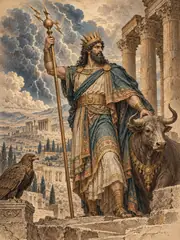
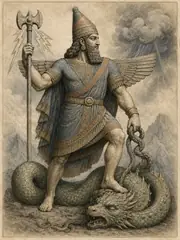
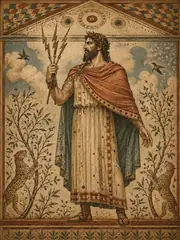
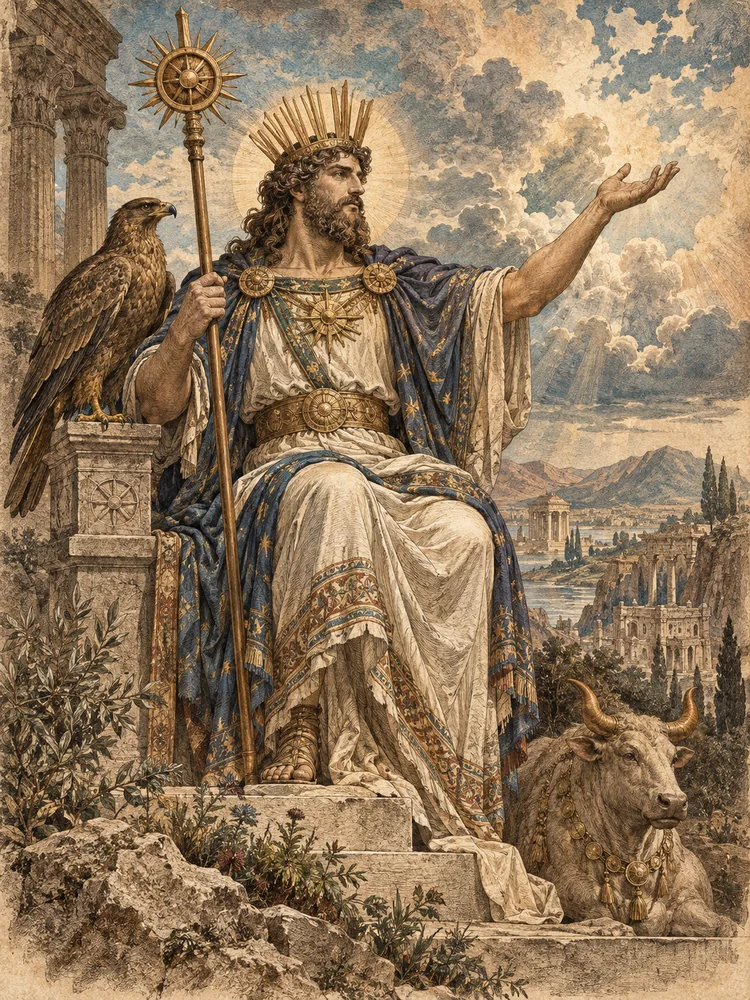
He was depicted as a bearded warrior in the eastern style, sometimes with a thunderbolt (in his weather-god aspect, where he overlapped with Hadad), sometimes with a sceptre and an eagle (in his sovereign-of-heaven aspect, where he was equated with the Greek Zeus and the Roman Iuppiter Maximus). His great temple at Palmyra — the Temple of Baalshamin, distinct from the larger Temple of Bel in the same city — was one of the best-preserved monuments of imperial Syria until its destruction by ISIS in 2015; built between 130 and 150 of our era, it had survived almost intact for nineteen centuries.
The relationship between Baalshamin and the older Canaanite Baal Hadad was complex. In some sense Baalshamin was simply Hadad in his sky-god aspect; in another sense, the two were distinct deities with overlapping but separable functions, and in some Syrian cities they were worshipped at different temples within the same pantheon. The Palmyrene case is instructive: the Temple of Bel (treated in Book III below) was the chief sanctuary of the city, but Baalshamin had his own substantial temple, and dedicatory inscriptions distinguished the two as separate deities. The same pattern is found at Si'a, at Damascus, at Heliopolis, and at lesser sites: Baalshamin operated alongside the older Baal-Hadad without simply replacing him.
The cult was syncretistic and absorptive. Greek inscriptions identify Baalshamin with Zeus Hypsistos ('Zeus the Highest'); Latin inscriptions identify him with Iuppiter Optimus Maximus or with Caelus (the personified Sky); Aramaic inscriptions sometimes pair him with the goddess Allat (treated in Book II below) as a divine couple. The figure was the high-god of late paganism in Syria, the closest the Aramaean religion came to a single supreme deity, and his cult flourished into the third century of our era. Christianization eliminated the public worship; the Temple of Baalshamin at Palmyra was converted to a Byzantine church in the fifth or sixth century, with the alteration of the cella, before its eventual destruction in our own day.