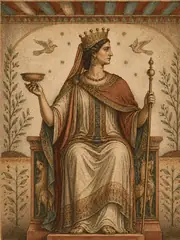
A Compendium of the Ancient Gods
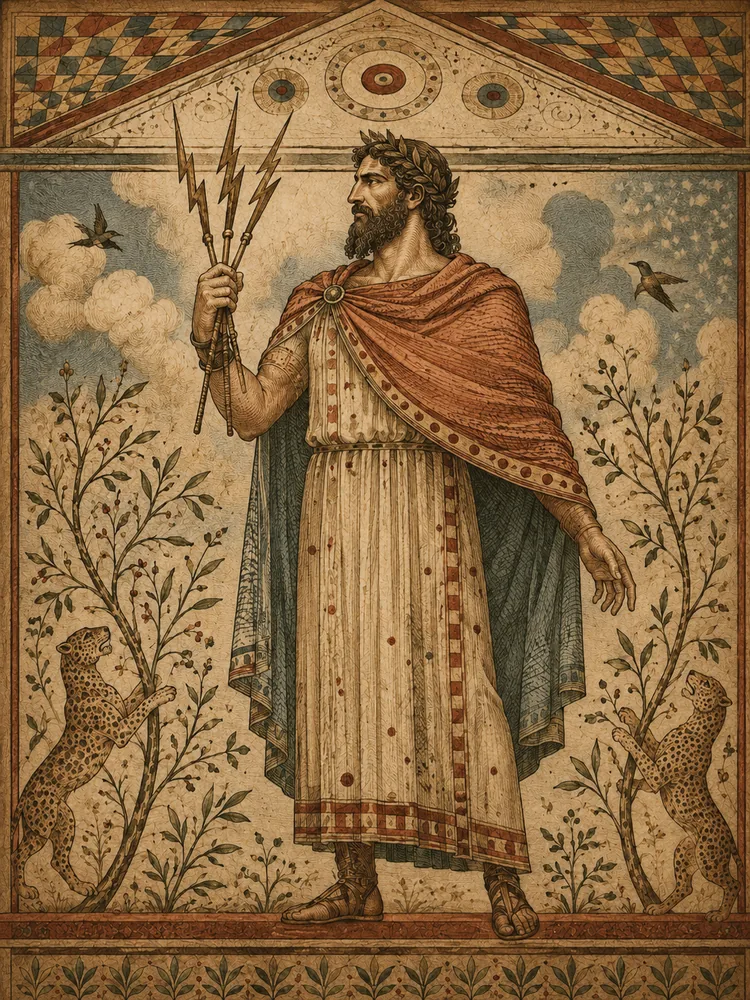
Tinia, plate

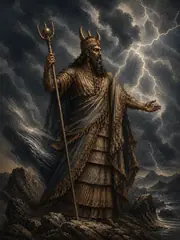
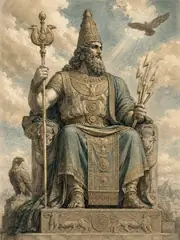
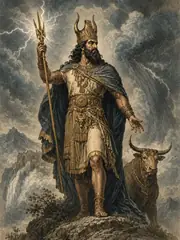
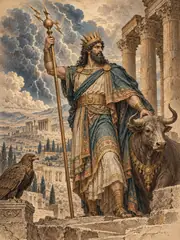
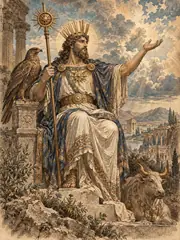
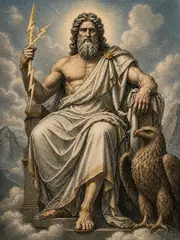
Tinia was the king of the Etruscan gods, the lord of the sky, the wielder of the thunderbolt — the figure whom the Romans equated with their Jupiter and the Greeks with Zeus. He sat enthroned upon the high heaven, holding the lightning in his right hand; about his shoulders he wore the cloak of dignity, and upon his head the crown of the king. He was the warrant of oaths, the arbiter of the cosmic order, the supreme power before whom the lesser gods bent their will.

His distinctive feature among Mediterranean sky-kings was the doctrine of the three thunderbolts. The Etruscan priestly tradition, preserved in the Libri Fulgurales (the books of lightning), held that Tinia could cast three different kinds of bolt. The first he could hurl on his own authority, as a warning or a benefice; this was the bolt of advice, called manubia prima. The second he could hurl only after consulting the Twelve Higher Gods (the dii consentes); this bolt — manubia secunda — was the bolt of judgment, more serious in its effect, requiring deliberation. The third — manubia tertia — could be cast only after consulting the still higher dii superiores et involuti, the obscure and veiled gods whose names were not known to mortals; it was the bolt of doom, irrevocable, used only as a final and decisive sentence upon a city or a kingdom.

The doctrine has no parallel in Greek or Roman theology and is one of the surest signs that the Etruscan religion was not simply a Hellenized local tradition but had a distinct character of its own. The notion that the sky-god's power was constitutionally limited — that he must consult councils for grave matters, and that his most terrible bolt required the assent of beings even greater than himself — implies a theology in which divine authority was not absolute but was held in a structured order, with each level answerable to the one above.

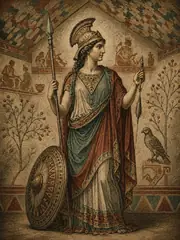
Tinia was the central figure of the Etruscan civic cult and was paired with Uni and Menrva in the temples of all the major Etruscan cities; the great temple at the federal sanctuary at Voltumna probably housed his cult-image as well, though we cannot be certain. After the absorption of Etruria into Rome, his name was almost completely replaced by Iuppiter; only the priestly tradition of the haruspices preserved the older nomenclature, and through them the doctrine of the three thunderbolts passed to Cicero and to Seneca and to the late antique compilers of Roman religious antiquities.
Curator’s note

What the sources say, and what later tradition added. The sources for this bay

Tinia is named on the Piacenza Liver (in three different regions, corresponding probably to the three thunderbolts) and on numerous bronze mirrors, where he is depicted as a bearded king with a thunderbolt. The doctrine of the three thunderbolts is preserved by Pliny the Elder (Naturalis Historia 2.138-141), Seneca (Natural Questions 2.39-49), and Servius (commentary on Aeneid 8.427); the systematic treatment in modern scholarship is Stefan Weinstock's article "Libri Fulgurales" (Papers of the British School at Rome 19, 1951) and Jean MacIntosh Turfa's Divining the Etruscan World (2012). The cult at the Capitoline triad is described by Livy (1.55-56), Dionysius of Halicarnassus (4.59-61), and Tacitus (Histories 3.72). The form of the name Tinia is variant in the inscriptions: Tin, Tina, Tinia, Tini are all attested. The relation to Indo-European *dyews ('sky') is uncertain — Etruscan is not Indo-European, and the name may be a borrowing from a neighboring language or an indigenous term.

Kin in the sources

Each tie is quoted from the entry that states it.

The same god in other rooms

The ancient sources themselves name these as one god under different names. See Adad, Tarhunt, Lametrus, Papas, Baal, Zeus, Hadad, Baalshamin and Tinia hung together

When the sources speak

Dated witnesses for The Sky Triad and the Civic Cult. A date marks when the evidence was written down, not when the belief began. The whole timeline

c. 900–750 BCE
Villanovan communities establish the Iron Age background from which historically Etruscan cities emerge.
c. 750–600 BCE
Orientalizing exchange and urban growth transform elite ritual, iconography, writing, and sanctuary display.
c. 600–475 BCE
Etruscan city-states reach their widest political and artistic influence; temples and mythic imagery proliferate.
c. 474 BCE
The defeat at Cumae marks changing Etruscan power in Campania and the Tyrrhenian world.
5th–4th centuries BCE
Tomb painting, mirrors, votive deposits, and regional cults provide dense evidence for divine and funerary imagery.
396–264 BCE
Roman conquest progressively incorporates Etruscan cities while Etruscan priestly expertise remains prestigious.
2nd–1st centuries BCE
Late inscriptions and Roman antiquarian interest document cultural integration and the persistence of divinatory traditions.
1st century BCE–1st century CE
Cicero, Varro, Livy, Seneca, and others preserve testimony about haruspicy, lightning, and prodigies.

Floor plan

The rooms follow one another in the order their peoples first appear in the written record.

  1. The Cradle of Citiesc. 3400 BCE to 395 CE. 115 works
  2. The Gift of the Nilec. 4000 BCE to 395 CE. 73 works
  3. The Olympian Orderc. 1600 BCE to 750 CE. 152 works
  4. The Persian Worldc. 2000 BCE to 1010 CE. 30 works
  5. The Levantine Borderlandsc. 1200 BCE to 500 CE. 20 works
  6. The Edges of Empirec. 2000 BCE to 1500 CE. 33 works
  7. The Etruscan Worldc. 900 BCE to 750 CE. 22 works
  8. The Roman Inheritancec. 1200 BCE to 500 CE. 58 works
  9. The Northern Inheritancec. 2000 BCE to 1600 CE. 131 works