A Compendium of the Ancient Gods
Menrva, plate

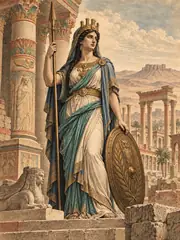
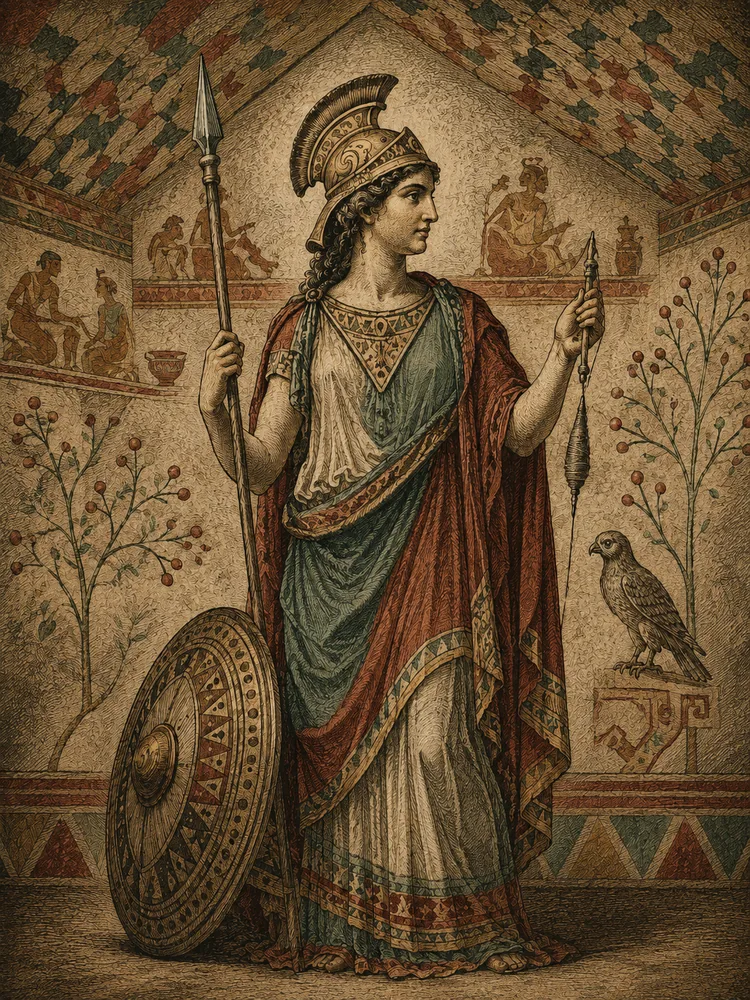
Menrva was the Etruscan goddess of wisdom, of warfare, and of the crafts — the figure equivalent to the Greek Athena and the Roman Minerva, with the Etruscan form being older than the Roman by some centuries. (The Roman Minerva, indeed, came to Rome through Etruscan mediation, with the very name being Etruscan in origin: Menrva became Minerva when adopted into Latin.) She was depicted as a tall, helmeted maiden, holding a spear and a shield, sometimes with a winged victory standing on her hand; her aegis bore the head of the Gorgon, just as the Greek Athena's did, in a clear sign of Greek mythological influence.

Yet Menrva had distinctive Etruscan features. She was particularly associated with prophecy and divination — more so than the Greek Athena — and presided over a number of oracular shrines in Etruria. She was depicted on mirrors interpreting omens for kings, conducting rites of divination over the entrails of sacrificed animals, and instructing heroes in the proper rites by which the future could be discerned. The connection with the disciplina etrusca, the elaborate science of divination by which the Etruscans were famous throughout the Mediterranean, was strong; in some sources Menrva was reckoned the divine patroness of the haruspices, the priests who read the future from the livers of sacrificial sheep.

She was also the goddess of childbirth — a function the Greek Athena had relinquished. The Etruscans depicted her on mirrors superintending the birth of children to her favored mothers, and the great terracotta sculpture from the Belvedere temple at Orvieto shows her receiving the infant Maris (the Etruscan Mars) from his mother. So the goddess of wisdom was also the goddess of those critical and dangerous moments in human life — the moment of birth, the moment of war, the moment of decision before an oracle — at which the help of a wise patroness was needed.

Menrva was the third member of the Etruscan civic triad, along with Tinia and Uni, and her cult was a regular part of Etruscan public religion. After the Capitoline temple at Rome was built by the Tarquinian kings, she became one of the three deities of the Roman state — Iuppiter, Iuno, and Minerva, the Capitoline triad — and through this incorporation she passed into the Roman imagination as Minerva and from there into the inheritance of Western civilization. Her transformation from the Etruscan Menrva to the Roman Minerva to the medieval Christian-allegorical figure of Wisdom (sapientia) traces a continuous line.
Curator’s note

What the sources say, and what later tradition added. The sources for this bay

Menrva is named on the Piacenza Liver (in two regions) and on numerous bronze mirrors. The terracotta of Menrva receiving Maris from the Belvedere temple at Orvieto is in the Faina Museum; the iconography is treated in de Grummond, Etruscan Myth, Sacred History, and Legend (2006), chapter 3. The connection to divination is documented in Cicero's De Divinatione and in Servius. The transmission to Rome is described by Livy (1.55, the Capitoline temple foundation) and is the subject of much scholarship on Etruscan-Roman religious relations; Stefan Weinstock's various articles and Robert Schilling's contributions are key references. The etymology Menrva > Minerva is straightforward.

Kin in the sources

Each tie is quoted from the entry that states it.

The same god in other rooms

The ancient sources themselves name these as one god under different names. See Neith, Athena, Allat (the Aramaean goddess), Allat (Palmyrene) and Menrva hung together

When the sources speak

Dated witnesses for The Sky Triad and the Civic Cult. A date marks when the evidence was written down, not when the belief began. The whole timeline

c. 900–750 BCE
Villanovan communities establish the Iron Age background from which historically Etruscan cities emerge.
c. 750–600 BCE
Orientalizing exchange and urban growth transform elite ritual, iconography, writing, and sanctuary display.
c. 600–475 BCE
Etruscan city-states reach their widest political and artistic influence; temples and mythic imagery proliferate.
c. 474 BCE
The defeat at Cumae marks changing Etruscan power in Campania and the Tyrrhenian world.
5th–4th centuries BCE
Tomb painting, mirrors, votive deposits, and regional cults provide dense evidence for divine and funerary imagery.
396–264 BCE
Roman conquest progressively incorporates Etruscan cities while Etruscan priestly expertise remains prestigious.
2nd–1st centuries BCE
Late inscriptions and Roman antiquarian interest document cultural integration and the persistence of divinatory traditions.
1st century BCE–1st century CE
Cicero, Varro, Livy, Seneca, and others preserve testimony about haruspicy, lightning, and prodigies.

Floor plan

The rooms follow one another in the order their peoples first appear in the written record.

  1. The Cradle of Citiesc. 3400 BCE to 395 CE. 115 works
  2. The Gift of the Nilec. 4000 BCE to 395 CE. 73 works
  3. The Olympian Orderc. 1600 BCE to 750 CE. 152 works
  4. The Persian Worldc. 2000 BCE to 1010 CE. 30 works
  5. The Levantine Borderlandsc. 1200 BCE to 500 CE. 20 works
  6. The Edges of Empirec. 2000 BCE to 1500 CE. 33 works
  7. The Etruscan Worldc. 900 BCE to 750 CE. 22 works
  8. The Roman Inheritancec. 1200 BCE to 500 CE. 58 works
  9. The Northern Inheritancec. 2000 BCE to 1600 CE. 131 works