A Compendium of the Ancient Gods
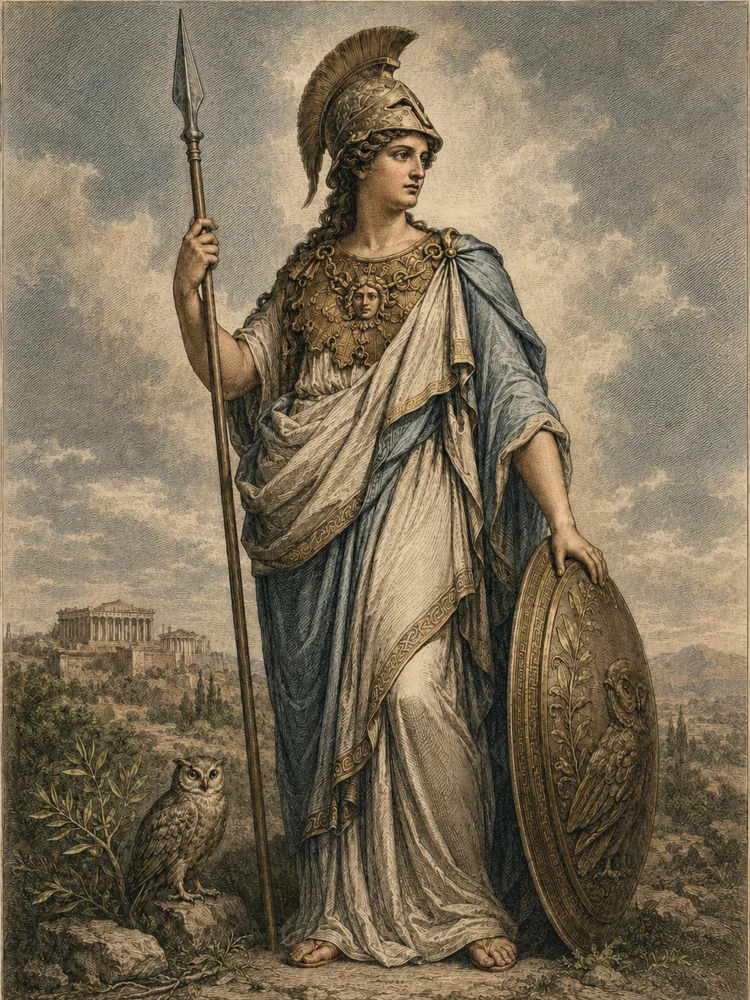
Athena, plate

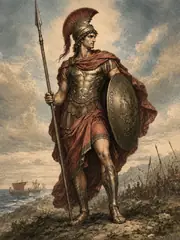
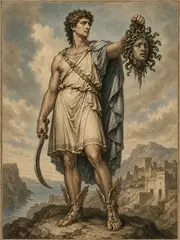
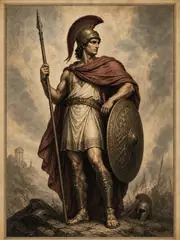
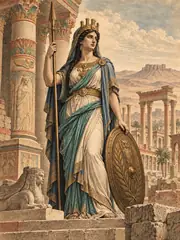
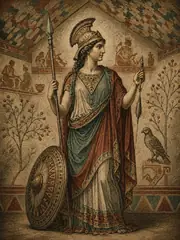
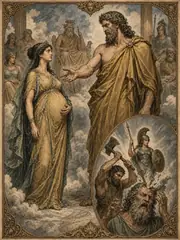
Athena was the daughter of Zeus and Metis, born from her father's head fully armed (the famous birth, told already in Metis's entry above, in which Hephaestus split Zeus's headache with an axe and Athena leapt out in the panoply of war). She was the goddess of wisdom and of the practical arts, of weaving and of pottery, of the council and of strategic warfare (as opposed to the brute-force warfare of Ares); she was also a war-goddess in her own right, but a war-goddess of strategy, intelligence, and right purpose, who fought beside the heroes she favored — Achilles, Odysseus, Heracles, Perseus — with shrewd counsel as much as with her terrible aegis. Her sacred animal was the owl, her sacred tree the olive, her sacred bird the owl, her constant attribute the helmet, the spear, and the shield bearing the gorgoneion (the head of Medusa).

She was a virgin goddess, like Hestia and Artemis. The famous tale of how Hephaestus once attempted upon her — and how she escaped him, and how the seed that fell from him upon the ground, upon Gaia, brought forth the autochthonous Athenian king Erichthonius (whom Athena raised in secret) — is among the more curious fragments of Athenian foundational mythology. Her great civic role was as patroness of Athens, which she had won from Poseidon in the contest of gifts (her olive tree against his salt spring), and whose great Acropolis was crowned by her temples — first the Pre-Parthenon (destroyed by the Persians in 480 BCE), then the great Parthenon (completed in 438 BCE, sculptural program completed by 432, the supreme achievement of classical Greek architecture), and the Erechtheion (built upon the site of her contest with Poseidon, with the salt spring and the olive tree both preserved within its precinct). Her great chryselephantine cult statue in the Parthenon, the Athena Parthenos by Phidias, was over twelve meters tall and lost in late antiquity; copies and descriptions allow rough reconstruction.

The great Athenian festival in her honor was the Panathenaea, celebrated annually with a special grand celebration every four years (the Greater Panathenaea), in which a procession bore a new robe (peplos) up to the Acropolis to be presented to her olive-wood cult-image — the procession depicted on the inner frieze of the Parthenon, the most famous sculptural narrative from antiquity. Her epithets were many: Pallas (whose etymology was already disputed in antiquity); Promachos ("front-line fighter"); Polias ("of the city"); Parthenos ("virgin"); Glaukopis ("grey-eyed," or possibly "owl-eyed"). Her Roman counterpart was Minerva, with whom she shares many attributes but whose own Italian background was more concerned with handicrafts than with war.
Curator’s note

What the sources say, and what later tradition added. The sources for this bay

The principal sources for Athena are Homer (Iliad and Odyssey throughout — she is the principal divine sponsor of Odysseus, with whom she has one of the most warmly characterized relationships in the poems), the Homeric Hymns to Athena (Hymns 11 and 28), Hesiod (Theogony 886–926), Apollodorus (1.3.6, 3.14.1), Pausanias on Athenian cult, and the great archaeological complex of the Acropolis. The birth-from-the-head iconography is widespread in Archaic and Classical Greek art. The Hephaestus-and-Erichthonius episode is in Apollodorus 3.14.6 and Hyginus, Fabulae 166. Phidias's Athena Parthenos is described by Pausanias 1.24.5–7 and Pliny, Natural History 36.18; copies (notably the so-called Varvakeion Athena, a Roman miniature now in the National Archaeological Museum of Athens) preserve the principal features.

Kin in the sources

Each tie is quoted from the entry that states it.

The same god in other rooms

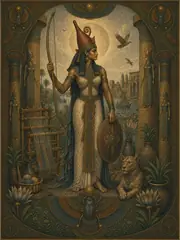
The ancient sources themselves name these as one god under different names. See Neith, Athena, Allat (the Aramaean goddess), Allat (Palmyrene) and Menrva hung together

When the sources speak

Dated witnesses for Hades and the Lesser Olympians. A date marks when the evidence was written down, not when the belief began. The whole timeline

c. 1600–1100 BCE
Mycenaean palace tablets in Linear B record offerings and divine names, but little continuous myth.
c. 1100–800 BCE
Post-palatial oral traditions and changing cult landscapes precede the surviving alphabetic epics.
late 8th–7th centuries BCE
The Iliad, Odyssey, Hesiodic Theogony and Works and Days give influential but non-exclusive divine orders.
7th–6th centuries BCE
Homeric Hymns, lyric poetry, colonization, and local sanctuary traditions multiply regional narratives.
6th–5th centuries BCE
Orphic, Pythagorean, and mystery materials develop alternative cosmogonies and afterlife doctrines.
5th century BCE
Athenian tragedy and comedy recast heroic houses and divine justice for civic audiences.
4th century BCE
Philosophers, antiquarians, and local historians interpret or criticize inherited myth.
323–31 BCE
Hellenistic poets and scholars systematize variants across an enlarged Greek world.

Floor plan

The rooms follow one another in the order their peoples first appear in the written record.

  1. The Cradle of Citiesc. 3400 BCE to 395 CE. 115 works
  2. The Gift of the Nilec. 4000 BCE to 395 CE. 73 works
  3. The Olympian Orderc. 1600 BCE to 750 CE. 152 works
  4. The Persian Worldc. 2000 BCE to 1010 CE. 30 works
  5. The Levantine Borderlandsc. 1200 BCE to 500 CE. 20 works
  6. The Edges of Empirec. 2000 BCE to 1500 CE. 33 works
  7. The Etruscan Worldc. 900 BCE to 750 CE. 22 works
  8. The Roman Inheritancec. 1200 BCE to 500 CE. 58 works
  9. The Northern Inheritancec. 2000 BCE to 1600 CE. 131 works