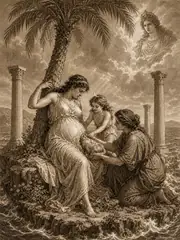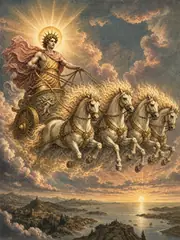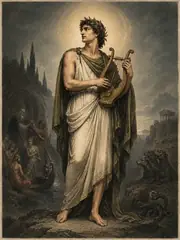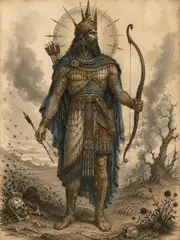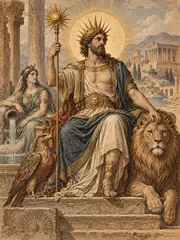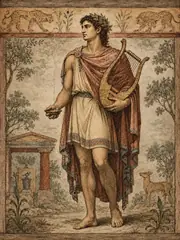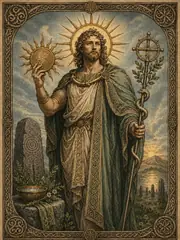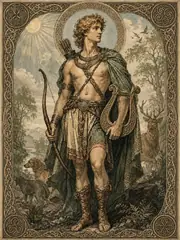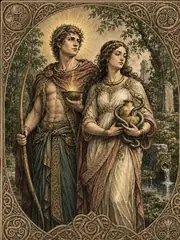
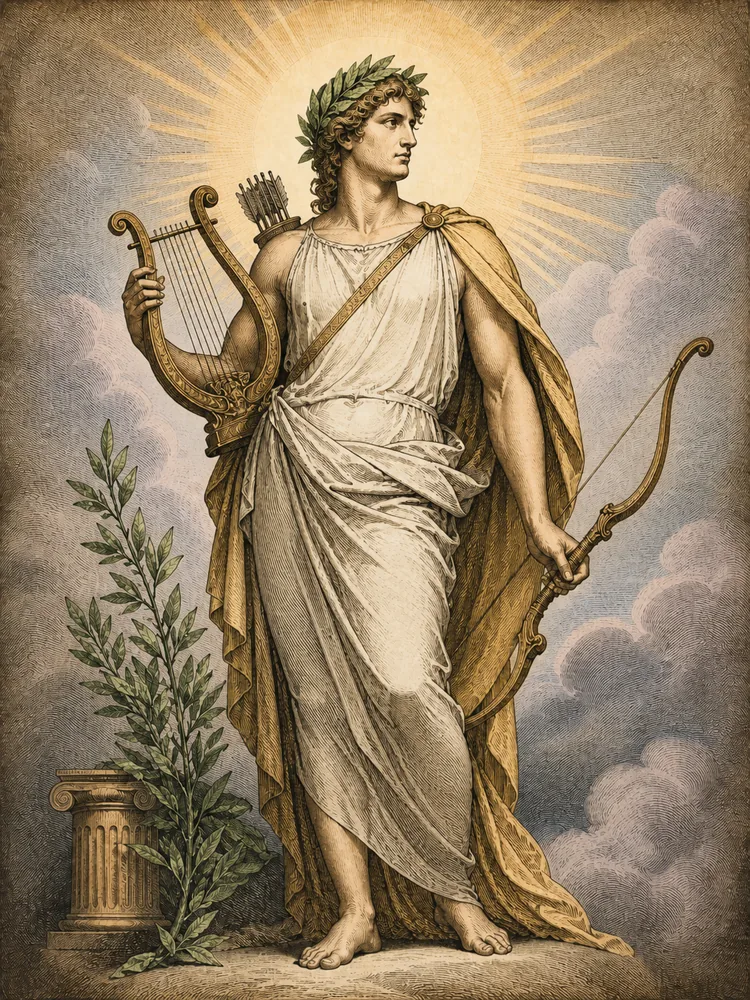
Apollo was the most complex of the Olympians and the most thoroughly Greek; the Romans, in their later identification of his name with their own, transcribed it directly rather than finding an existing equivalent. He was the son of Zeus and Leto, twin brother of Artemis, born on Delos under the conditions told in Leto's entry. His offices were several: he was the god of music and poetry, of prophecy (as keeper of the great oracle at Delphi), of medicine and healing (and of plague, its dark complement), of archery, of the disciplined manly youth, of pastoral life and the protection of flocks, and — though his solar associations are post-Hesiodic — eventually of the sun, having absorbed the office of the older Helios.
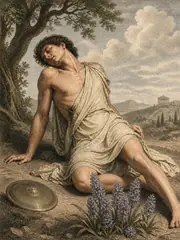
His mythological narratives are too numerous to summarize fully. As an infant on Delos, he leapt up upon his birth, demanded his bow and lyre, and proceeded to slay the great Python — the chthonic serpent that had haunted Delphi from the days when Gaia held the oracle — establishing himself thereby as the new master of the Delphic seat (the slaying was atoned for by an exile and purification, told in cult). He played the lyre at the wedding of Peleus and Thetis. He killed the giant Tityus, who had attempted upon his mother Leto. He skinned the satyr Marsyas alive when the satyr had presumed to challenge him to a musical contest and lost. He blasted with plague the Greek camp at Troy when Agamemnon dishonored his priest Chryses (the opening event of the Iliad). He loved the youth Hyacinthus, accidentally killing him with a discus and turning him into the flower; he loved Daphne, who fled from him and was turned into the laurel that became sacred to him; he loved Cassandra, gave her the gift of prophecy, and (when she refused him) added the curse that no one would believe her. He fathered Asclepius (treated separately), Orpheus (likewise), and others.
His great oracle at Delphi was the most authoritative in Greece for some twelve centuries (from at least the eighth century BCE to its closing under Theodosius in 393 CE), and the consultations of the Pythia — the priestess who, in trance, delivered the god's responses to inquiring states and individuals — directed the political and personal affairs of the Greek world to a degree difficult for the modern reader to imagine. The hexameter responses were variously interpreted; the most famous oracular sayings of Greek history ("Know thyself," inscribed on the temple; the oracle to Croesus; the wooden walls oracle to the Athenians before Salamis; the Socratic oracle that no one was wiser than Socrates) were attributed to Delphic Apollo. His other principal sanctuaries were at Delos (his birthplace), Didyma (in Asia Minor), and Claros (likewise), each with its own oracular tradition.
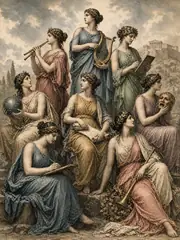
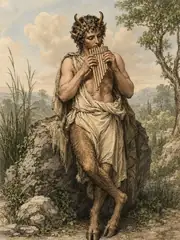
The musical and poetic dimension of Apollo was equally important. He was the leader of the Muses on Mount Helicon (his epithet Mousagetes meant "leader of the Muses"); his lyre was the instrument of civilized music, distinct from the wilder pipe of Pan. The great pan-Hellenic Pythian Games at Delphi (the second of the four great pan-Hellenic festivals) celebrated him with both athletic and musical competitions. His associations with order, measure, and the bright clarity of conscious thought made him, in Friedrich Nietzsche's famous nineteenth-century formulation, the divine principle of the Apollonian — the rational, disciplined counterpoint to the Dionysian principle of ecstatic dissolution. The opposition is Nietzsche's, not Greek; but it captures something real about Apollo's place in the Greek imagination.