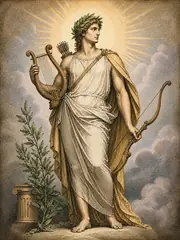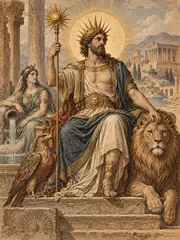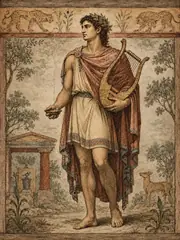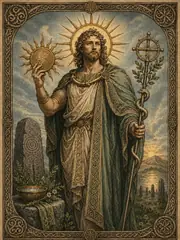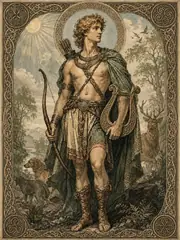
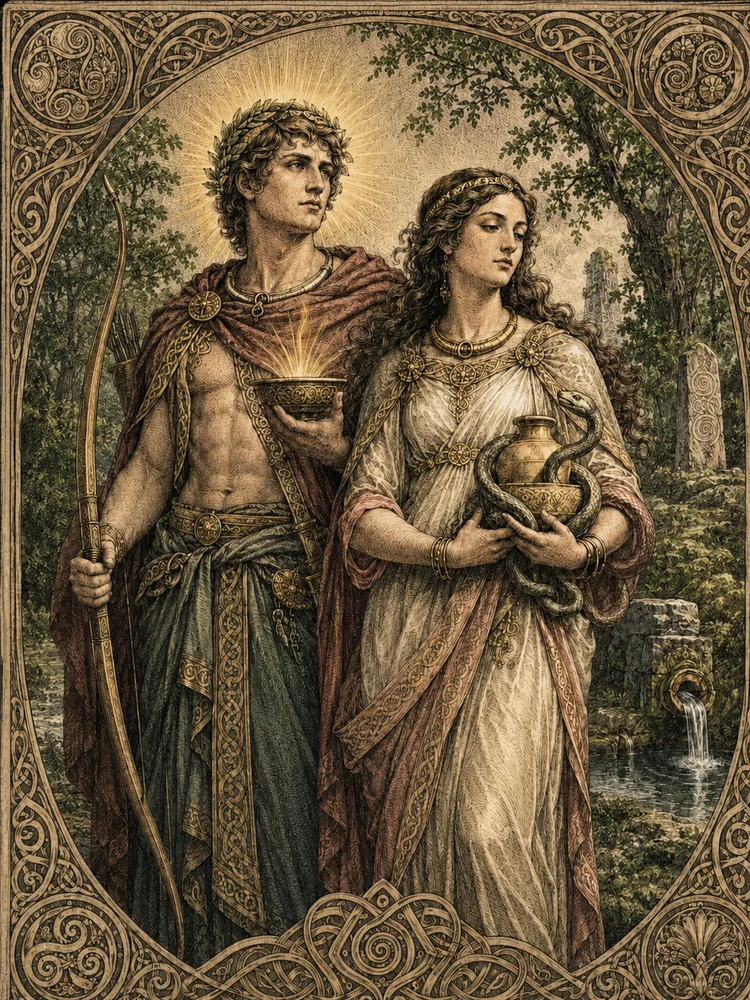
Grannus was a Gallic god of healing and of warm springs, whom the Romans equated with Apollo; the great cult-center of Apollo Grannus stood at Aachen (Roman Aquae Granni — the "Waters of Grannus"), where the hot springs that the modern city is famous for were already a sanctuary in the Roman period. The Roman emperor Caracalla, suffering from disease, made a pilgrimage to Aachen to seek healing from Grannus in 213 CE; Cassius Dio records the visit. Other major Grannus cult-sites lay at Brigetio in Pannonia, at Trier, and at numerous spring-shrines throughout the Gallic and German provinces.
His consort was Sirona, sometimes Đirona — a goddess whose name means "the Star," and who was depicted with a snake, a basket of eggs, and a basket of fruit. The pair appeared together at many of the springs, with Grannus the male healer and Sirona the female fertility-and-renewal figure; their joint worship is attested at Hochscheid in the Mosel valley, where a small temple to the pair has been excavated, and at Bourbonne-les-Bains.
Sirona's iconography combined typical Gallic fertility attributes (the eggs, the fruits) with the snake (a healing emblem common throughout the ancient Mediterranean) and stellar imagery (her name and sometimes her crown). She was perhaps the most carefully attested goddess of the Gallo-Roman healing pantheon, and her cult survived into the third century. The figures of Grannus and Sirona represent the late synthesis of indigenous Celtic deity-pairs with Roman imperial-period religiosity, and are particularly interesting for showing how the Romans organized the cults of conquered peoples without entirely effacing their pre-Roman character.