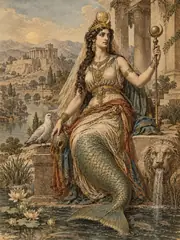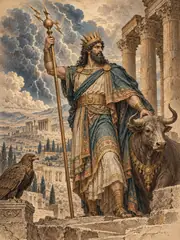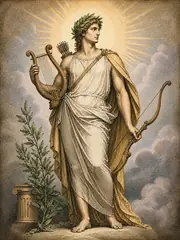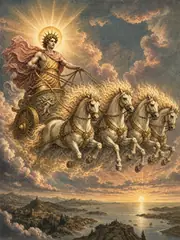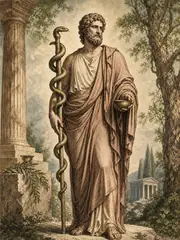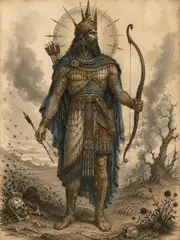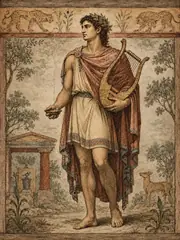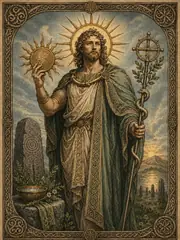
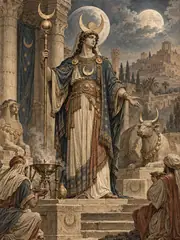
Simios was the consort or divine son of Atargatis at Hierapolis-Bambyce, the male partner of the great Syrian Goddess in her chief sanctuary. His name appears in some Greek sources as Semeios or Simios; he was a sun-god and a sovereignty-god, described by Lucian and others as having the attributes of Apollo, of Asclepius, of Helios, and of Bacchus all at once — a syncretic figure whose nature varied with the perspective of the observer. The Greek tradition identified him most often with Apollo, in his solar and oracular aspects, and the Apollo-Helios identification was probably how the Hellenized worshippers most often understood him.
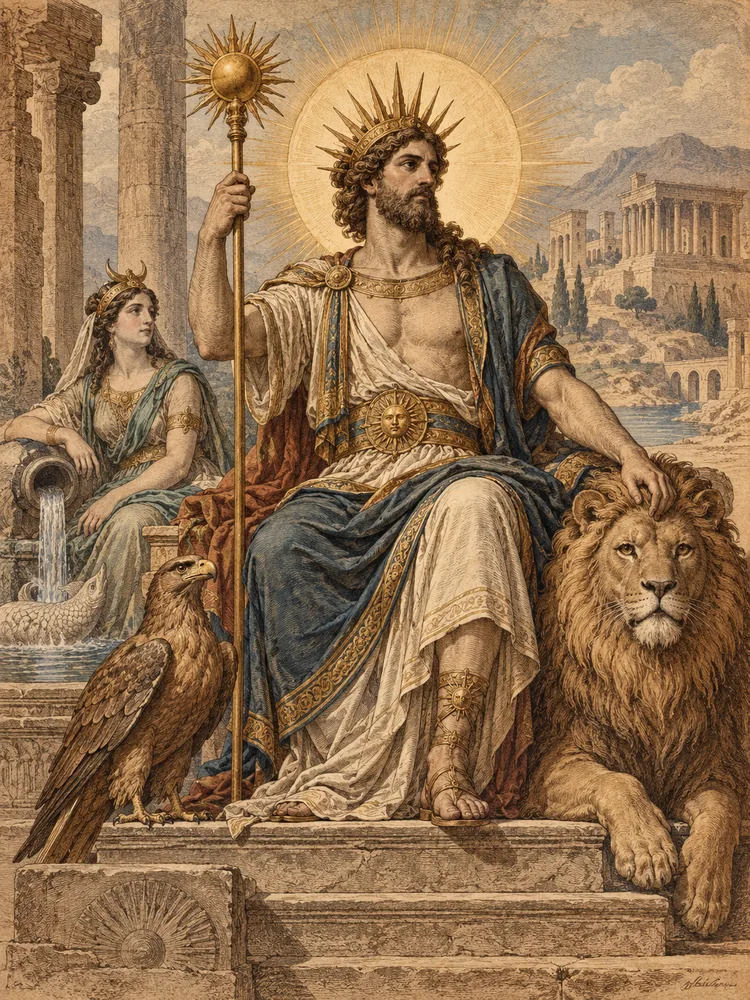
His cult-image at Hierapolis stood beside Atargatis's in the great temple; Lucian describes it as bearded (unlike most Apollo-images), seated on a throne, holding a sceptre, with rays of light around the head — a thoroughly eastern Apollo-figure with Mesopotamian solar iconography overlaid by Greek conventions. The image was carried in procession on great festival days, and was held to give oracular response to worshippers who consulted it: Simios would, in the proper rite, levitate from his throne, bear his priests through the air, and indicate his answers to questions by the direction of his motions.
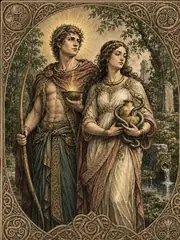
The relation between Simios and Atargatis was variously conceived. In some accounts they were husband and wife (a divine couple, as Hadad and Atargatis at Heliopolis); in others Simios was Atargatis's son (with Hadad the absent or implicit father); in still others he was a divine prince of the next generation, the sovereign of the present era under the patronage of his mother. The proliferation of relationships reflects the different sources from which Lucian and the inscriptions and the late-Roman antiquarians were drawing — different cult-traditions within the single sanctuary.
Simios's cult, like that of Atargatis, was suppressed by the Christianization of late-Roman Syria. The Apollonian aspects of his worship may have influenced the early Christian iconography of Christ Pantocrator (the bearded, enthroned, sceptre-bearing king of the universe), which emerged in the same Syrian context in the fourth and fifth centuries; the iconographic continuities are suggestive but the historical lines of descent are hard to demonstrate. The Hierapolis temple was converted to a church and eventually destroyed in the medieval period; nothing of Simios's cult survives in living religious practice, though his name and function are preserved in the inscriptions and in Lucian's account.