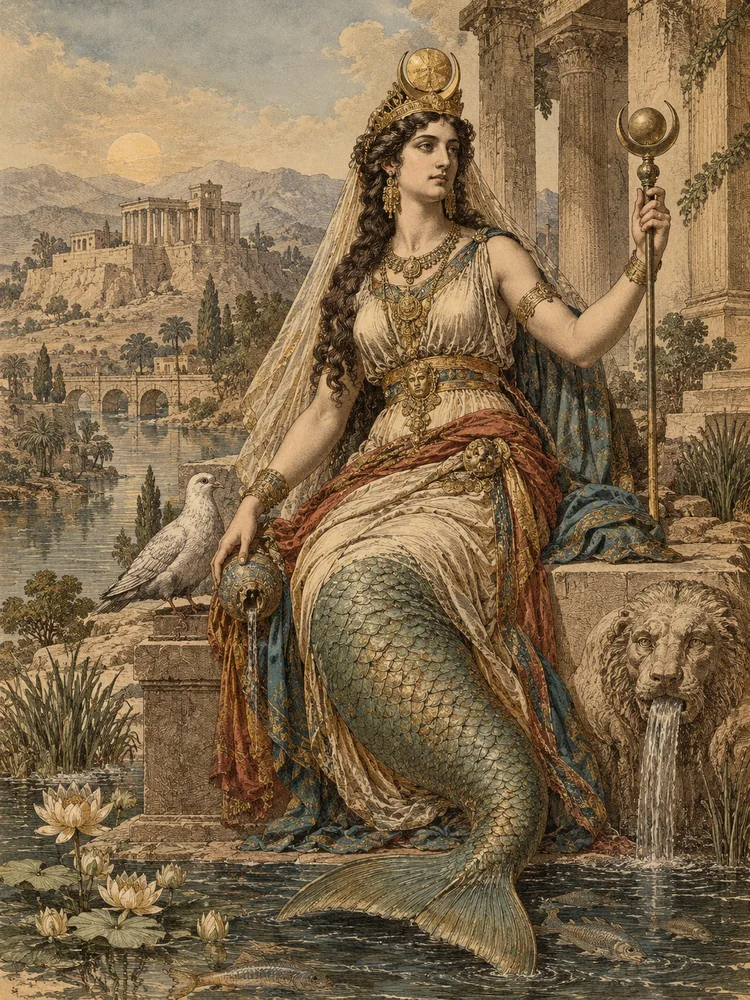
Atargatis was the great mother-goddess of Syria — the figure whom Lucian of Samosata, in his treatise De Dea Syria, simply called 'the Goddess' as if no further specification were necessary. Her name is a fusion of two older Canaanite goddesses, Athirat (Asherah) and Anat, whose cults had been merged in the late Bronze Age and whose composite figure flourished in the Iron Age and Roman-imperial Syria. She was depicted with a fish-tail (or as a mermaid-like figure), with doves around her head, and with attendant women (often eunuchs in serving-role) who maintained her sanctuary; her sacred animals were the fish and the dove, both of which were forbidden to her worshippers as food, and which were kept sacred at her temple-pools.
Her great sanctuary stood at Hierapolis-Bambyce on the Euphrates (modern Manbij in northern Syria), where Lucian visited it in the second century of our era and wrote his account. The temple was built upon a platform raised by Stratonice, the wife of the Seleucid king Seleucus I, in the early third century before our era — though the underlying cult was much older. Within the precinct stood a great pool filled with the sacred fish, who were tame and would come to the surface when called; the goddess herself was represented by a great cult-image holding a sceptre and a spindle, with rays of light around her head and the sacred animals at her feet. Twice a year a great festival was held at which water was brought from the sea (the goddess being a sea-divinity in one of her aspects, the daughter of the Phoenician sea-goddess Derceto by some accounts) and poured into a chasm beneath the temple; the chasm was held to be the place where the waters of the Flood — the great deluge of Atrahasis and Utnapishtim and Noah, common to all the Near Eastern traditions — had drained away when the Flood receded.
Atargatis's worship was famous for its eunuch priesthood. The galli — castrated men who had dedicated themselves to the goddess in the ecstatic frenzy of her annual festival — were her chief servants, and they led her processions in elaborate costumes that emphasized their feminized state. The institution of the eunuch priesthood was probably borrowed from the cult of Cybele in Anatolia, with which Atargatis's cult was closely related; the Mediterranean Mother-Goddess complex of the Roman imperial period — Cybele of Phrygia, Atargatis of Syria, Isis of Egypt, the Magna Mater of Rome — formed a single religious phenomenon with regional variations, and the cults influenced one another deeply.
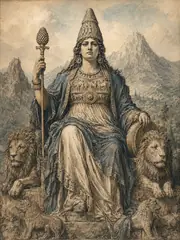
The cult of Atargatis was carried throughout the Roman empire by her merchants, soldiers, and dedicated devotees. A statue of her, in the form of the Syrian Goddess seated with lions at her feet, has been recovered from the temple of Atargatis at Delos; dedications to her appear at Rome, at Ostia, at sites along the Rhine and Danube. The Christianization of the Roman empire suppressed her cult by the late fourth century, but the great sanctuary at Hierapolis was converted (with attempts at preservation of the structure) to a Christian basilica before being lost to Arab conquest. Lucian's De Dea Syria remains our chief source for what was once the central religious institution of Roman Syria.