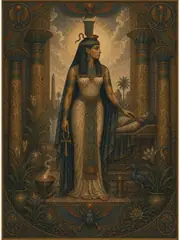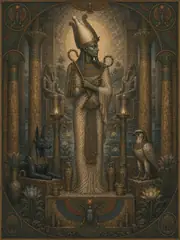
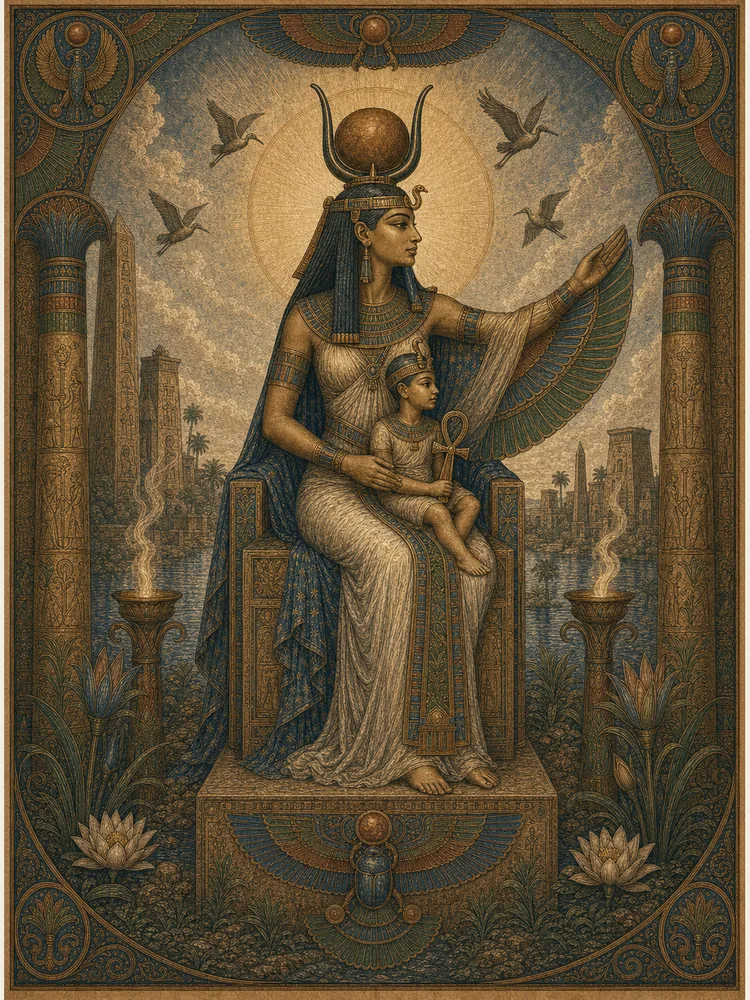
Of all the gods of Egypt, none had a longer or wider career than Isis. She began as the sister-wife of Osiris in the Heliopolitan Ennead, a goddess of the Delta marshes, mistress of the throne of Egypt (her name in hieroglyphs is written with the throne-sign upon her head, and signified "throne" before she was a goddess at all). She rose through the long elaboration of the Osirian myth into the patron saint of every difficult task: of mourning the dead, of seeking the lost, of nursing the helpless, of healing the bitten, of magic both white and black. She was the wisest of the gods, having learned the secret name of Ra by stratagem (as told in his entry); she was the most enduring of the goddesses, surviving the fall of paganism more thoroughly than any other Egyptian deity, with her temple at Philae remaining open until 553 of our era and her cult attested in Roman London, in Pompeii, in Spain, and along the Rhine.
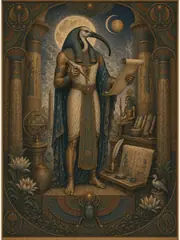
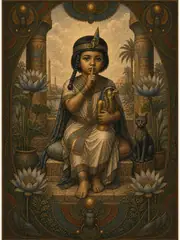
Her great labors are told in the entry of Osiris: she sought him through Egypt and Phoenicia, recovered his body from the pillar of Byblos, gathered up his scattered pieces from the length of the Nile, conceived Horus upon his recovered corpse in the form of a kite. Her labors as mother were no less arduous. She raised Horus in the marshes of Khemmis, hidden from Set, and there were tales of the child's many illnesses and her cunning treatments. Most famous is the tale of the scorpion: while she was out begging in the village (for she was disguised, and poor), Horus was stung by a scorpion sent by Set, and he lay dying when she returned. She cried out to the heavens, and her cry was such that the solar barque of Ra stopped its course; Thoth came down from the barque and gave her the spells by which the venom was reversed; Horus was saved. The spells of healing she received on that day became the basis of much of Egyptian medical magic, and the so-called "cippi of Horus" — small carved stelae depicting the child Horus standing upon crocodiles, surrounded by inscriptions of healing spells — were placed in households throughout Egypt as protection against scorpion-stings, snake-bites, and the bites of mad dogs.
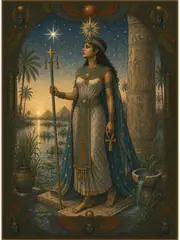
In the late tradition, Isis became more than the wife of Osiris and the mother of Horus; she became the universal goddess, the One under many names. The famous aretalogy of Isis at Cyme in Asia Minor, recorded in a Greek inscription of the second century before the common era, has the goddess speak in her own voice: "I am Isis, the queen of every land. I gave laws to mankind that none can change. I am she who findeth fruit for men. I am she that is called god by women. I divided the earth from the heaven; I appointed the way of the stars. I am she that riseth in the dog-star." Beyond Egypt, the cult of Isis swept through the Hellenistic and Roman worlds, with great temples at Pompeii, Rome itself (the Iseum Campense), London (a small shrine), Mainz, and many other cities; and her devotees held that she was the same goddess whom others worshipped under the names of Demeter, Aphrodite, Hera, Cybele, Bellona — a syncretism that the great Roman novelist Apuleius records in The Golden Ass (Book XI), when his hero Lucius receives the vision of the goddess and is initiated into her mysteries.