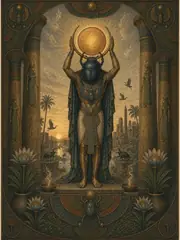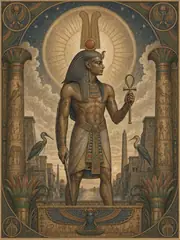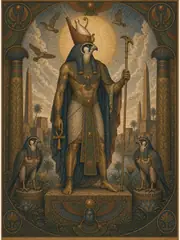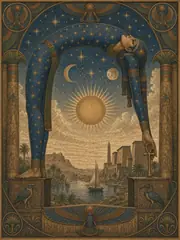
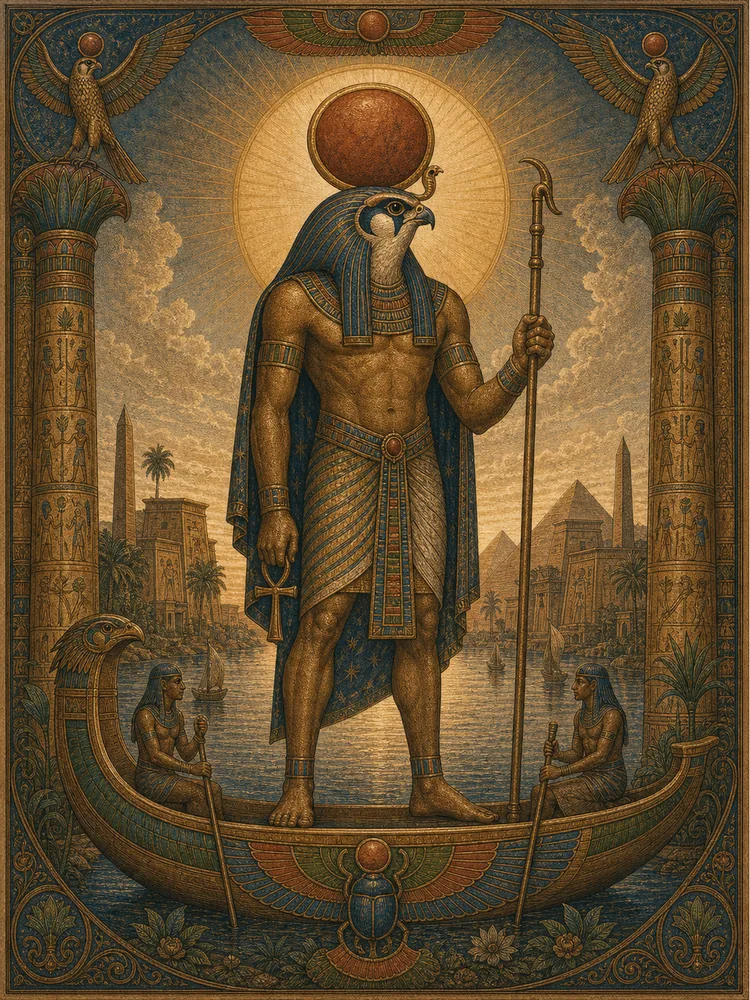
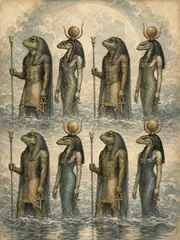
Ra was the sun, and the sun was Ra. He was the brilliant disk that crossed the sky each day, the king of heaven, the visible witness to all things done under his light. His city was Heliopolis — "City of the Sun," in the Greek translation — where his great temple stood, and where the priesthood whose theology produced the Heliopolitan Ennead and the Pyramid Texts had its center. He was depicted in many forms: as a falcon-headed man crowned with the solar disk; as a great scarab pushing the sun before him across the sky (the scarab Khepri, his morning aspect); as a ram-headed god, in his nightly journey through the underworld; or simply as the disk itself, surrounded by the protective uraeus.
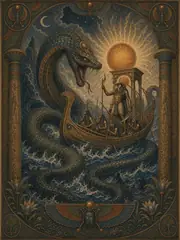
Each day Ra crossed the sky in his great solar barque, the Mandjet, accompanied by a crew of gods, with Maat the goddess of truth standing in the prow to set the course. Each evening at sunset he descended into the western horizon, transferred to the night-barque the Mesektet, and traveled through the twelve hours of the underworld, where the dead and the lesser gods adored him as he passed. At each hour his barque met new dangers — chiefly the great serpent Apep, who lay in wait in the deep places to attack the sun and overthrow creation — and at each hour the gods of his crew fought back the serpent with spells and weapons, that the sun might emerge again at dawn upon the eastern horizon, rejuvenated, born again as the morning Khepri. The doctrine that the daily rising of the sun was a victory perpetually re-won — a defeat of chaos that had to be earned every night, in the deep places, by force of will and incantation — pervades Egyptian solar theology and gives the daily rituals of the temple their fundamental seriousness.
There is a famous tale — the Destruction of Mankind — that tells of Ra in his old age. He had become an old god, his bones turning to silver, his flesh to gold, his hair to lapis lazuli, and the years had wearied him. Mankind, observing his weakness, plotted rebellion. Ra summoned his eye — that is, the goddess Hathor, his daughter — and sent her down to punish them. But Hathor in her descent became Sekhmet the lioness, and her bloodlust ran beyond the assignment: she slaughtered men until the fields were red with blood, and Ra, alarmed, sought to call her back. She would not be called back; her thirst was upon her. Then Ra brewed seven thousand jars of beer, and dyed it red with ochre, and poured it out across the fields where she would pass; and Sekhmet, taking the red beer for blood, drank deep, and slept; and so mankind was preserved.
Another tale tells how Ra, in his weariness, refused at length to share his secret name with any other god — for the name of a god is the seat of his power. The cunning Isis devised a stratagem: she gathered the spittle that fell from Ra's mouth (for he was old, and dribbled), mixed it with earth, and shaped it into a serpent, which she set in his path. The serpent bit him; and the venom was such that no god could heal him save by knowing his secret name. Ra resisted for a long time, naming himself Khepri in the morning, Ra at noon, Atum in the evening, and many other names besides; but the pain was too great, and at last he gave up his secret name to Isis, that she might cure him. From that hour, Isis held in her hand the deepest power of the gods.