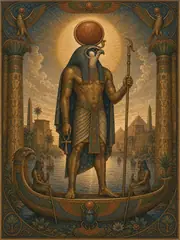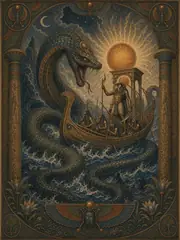
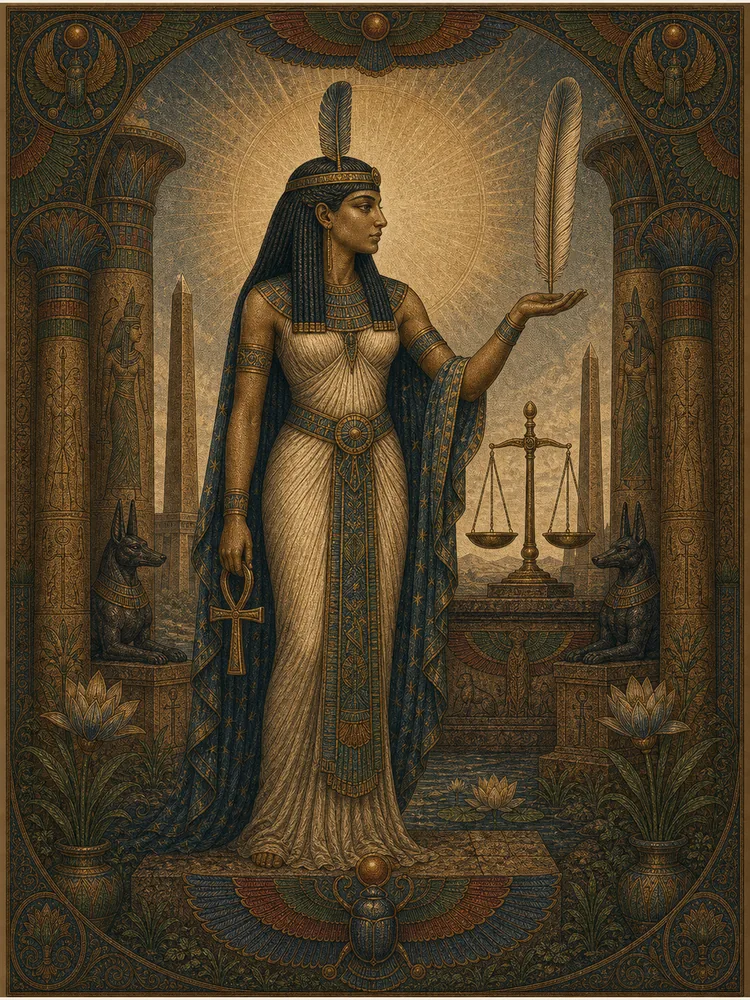
Maat was both a goddess and a principle, and the line between the two was not, in Egyptian thought, sharply drawn. She was the principle of cosmic order, the rightness by which things stand in their proper relations: the just balance of the scales, the steady course of the sun, the king's righteous judgment, the priest's punctilious offering, the upright dealings of one human with another. She was depicted as a woman crowned with a single ostrich feather, or simply as the feather itself; she was a daughter of Ra; she stood in the prow of his solar barque and set the course; her feather was the counterweight upon the great scale in the Hall of Two Truths, against which the heart of the dead was measured.
To live by Maat — to do Maat — was the Egyptian ideal of the moral life, and the wisdom-texts of every period elaborate it: speak the truth, deal justly with the weak, do not oppress the orphan or the widow, do not bear false witness, do not steal the offerings of the gods. The pharaoh's principal duty in his own theological role was "to set Maat in the place of disorder" — that is, to maintain the cosmic and social order against the perpetual encroachment of chaos. The Negative Confession, recited by the dead before the throne of Osiris (Spell 125 of the Spells for Coming Forth by Day), is a list of forty-two transgressions against Maat, each addressed to a particular underworld judge: "I have not done iniquity. I have not robbed with violence. I have not stolen. I have not slain men or women. I have not stolen grain. I have not stolen the property of the god." To pass the judgment was to be "true of voice" (maa-kheru), justified by Maat against one's accusers.