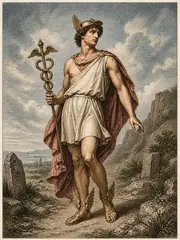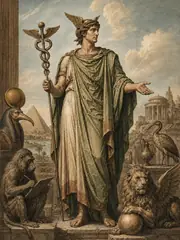
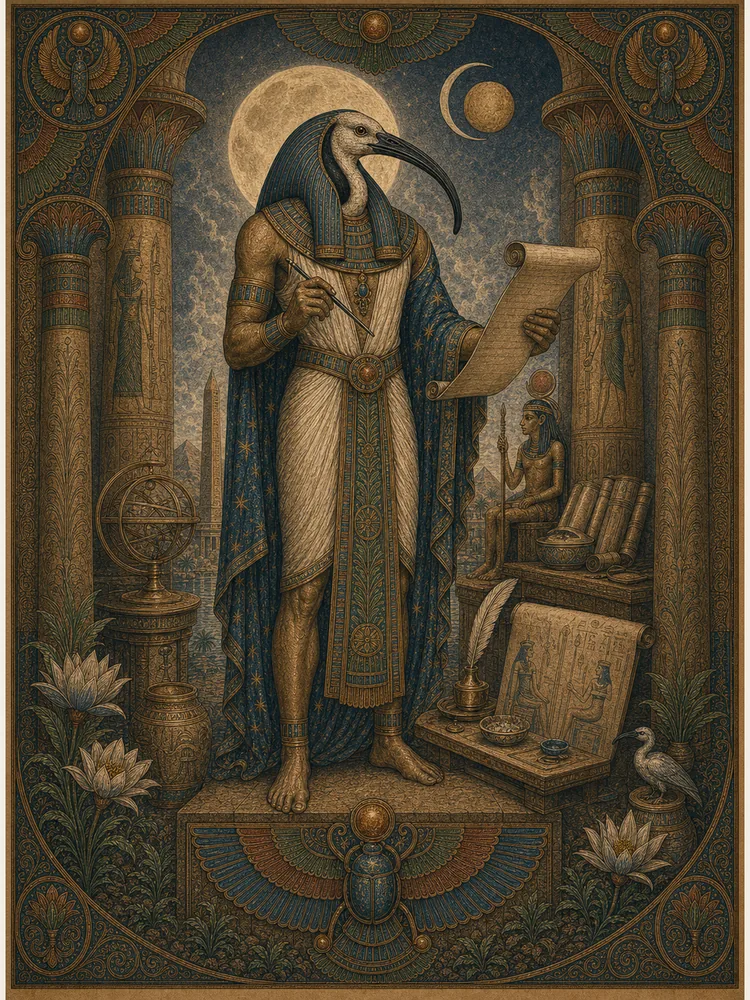
Thoth was the ibis-headed god, the patron of writing, of mathematics, of measurement, of magic, of medicine, and of all the arts of the educated mind. His city was Khmunu in Middle Egypt, which the Greeks called Hermopolis (for they identified him with their own Hermes, in his most learned and mediating aspect); and his cult-animals were the ibis, whose long curved beak resembled the writing-stylus, and the baboon, whose attentive bearing suggested the contemplative scholar. He was depicted in either of two principal forms: as an ibis-headed man holding a scribal palette and a reed-pen, or as a baboon seated in adoration of the moon. For Thoth was also a moon-god, and the lunar cycles — the months, the divisions of the year, the calculations of the calendar — were under his keeping.
His role across Egyptian mythology was that of the wise mediator, the scribe of the gods, the keeper of the records, the recorder of judgments, and the universal advisor when difficult problems arose. It was Thoth who reassembled the eye of Horus after Set had torn it apart; Thoth who taught Isis the spells by which the venom in Horus was reversed; Thoth who recorded the verdict of the divine council in the case of Horus and Set; Thoth who stood at the scale of judgment in the Hall of Two Truths and recorded the verdict upon the heart of the dead. Where there was a problem of intellect, Thoth was sent for; where there was a record to keep, Thoth made it; where there was a calculation to perform, Thoth performed it.
He was credited, in the late tradition, with the authorship of forty-two sacred books — a number derived from the forty-two nomes (administrative districts) of Egypt, and from the forty-two judges of Osiris in the Hall of Two Truths — which the Greeks under the Ptolemaic and Roman empires came to call the Hermetic Corpus, attributing them to "Hermes Trismegistus," the Thrice-Great Hermes, who was Thoth under his Greek interpretation. The actual surviving Hermetic literature, composed in Greek in the early centuries of the common era, owes more to Platonist philosophy than to genuine Egyptian tradition; but it preserves a real ancient Egyptian intuition that wisdom is a god's gift, that writing is sacred, and that the scribe is, in his small way, a participant in the work of the divine recorder.