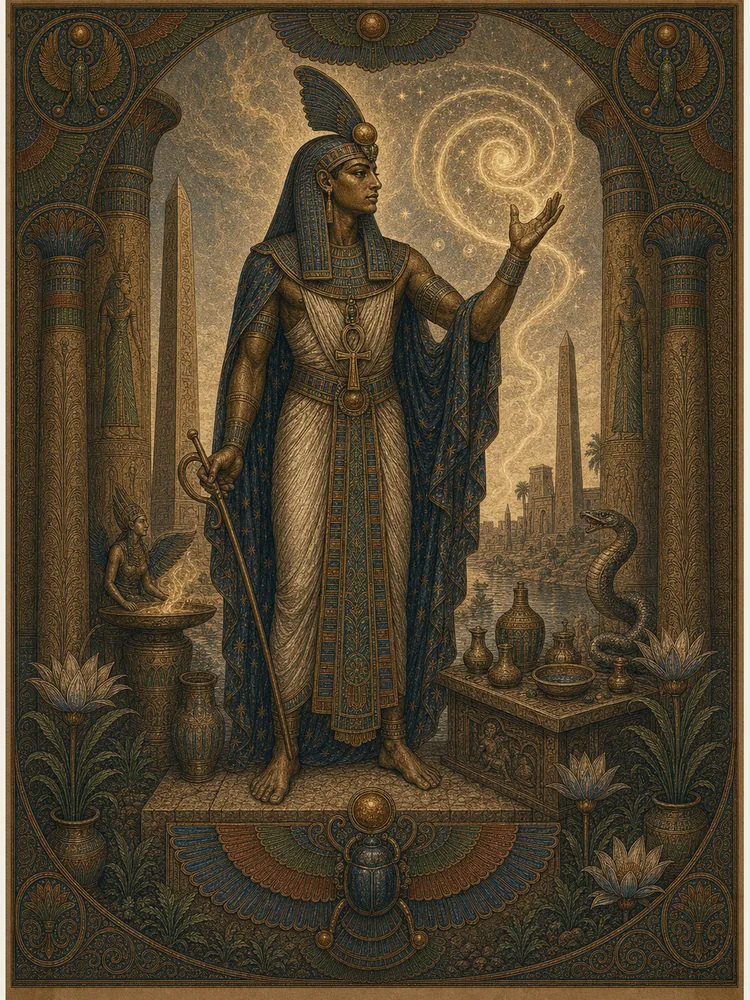
Heka was Magic — the divine principle by which spells operated, the active power that made the words of the magician efficacious. He was personified as a god, with his own iconography (a man holding two intertwined serpents) and his own cult; but he was also, more philosophically, the principle that underlay all magical practice, the energy that the magician channeled rather than commanded. The Egyptians did not, like the modern reader, distinguish sharply between religion and magic — heka was a creative force used by the gods themselves, and the great rituals of the temples were as much heka as the small charms recited over a child's cradle. "In the beginning," the Coffin Texts explain, "when the Lord of All called things into being, Heka was already with him."
Heka had no great mythological cycle; his role was rather to be presupposed by every other myth that involved divine action. Isis's recovery of Osiris was heka; Thoth's healing spells were heka; Ra's daily defeat of Apep was heka. The doctrine that the universe is, at its deepest level, sustained by spell-power — that words, properly pronounced, have efficacious power upon reality — was central to Egyptian thought, and gave the Egyptian temple cult its peculiar character: every offering was accompanied by a recitation, every act by a formula, every threshold by an incantation.