A Compendium of the Ancient Gods
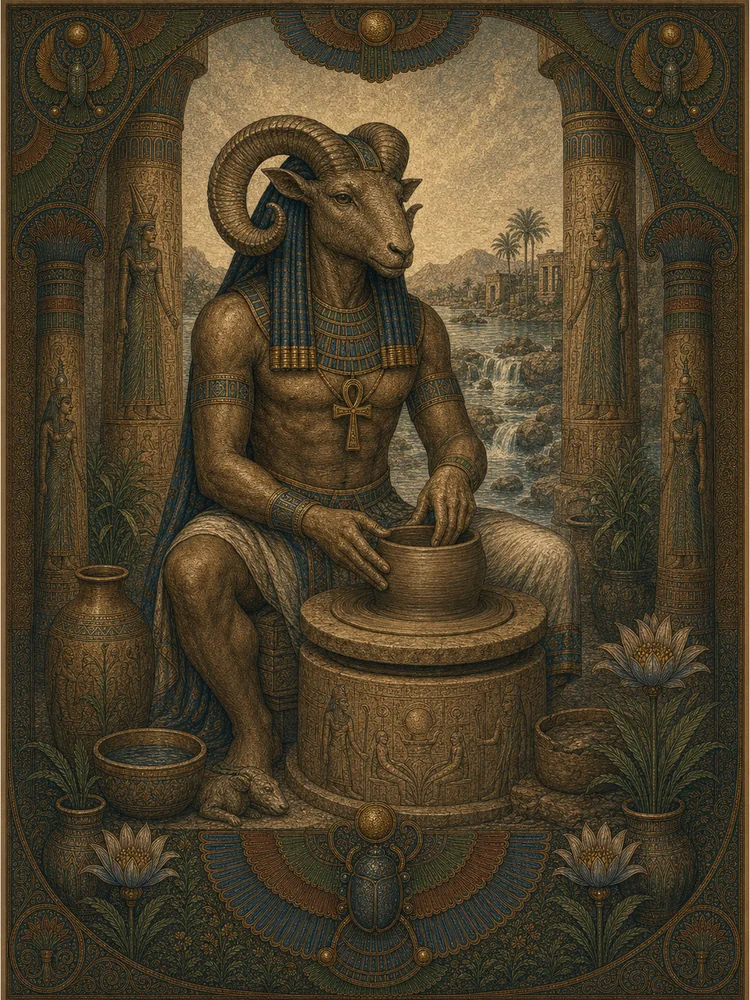
Khnum, plate

Khnum was a ram-headed creator-god whose city was Elephantine, the island in the Nile at modern Aswan that marked the southern boundary of historical Egypt and the source (so the Egyptians believed) of the inundation. The annual flood that gave Egypt her fertility issued, the priests of Elephantine taught, from the caverns of Khnum beneath their island; he was thus a god of fundamental fecundity, the giver of the waters that made the country live. He was also a creator-god of mankind in the Elephantine cosmogony: he sat at his potter's wheel and shaped each human child upon it from the clay of the Nile, fashioning the body and (in some accounts) shaping also the ka, the spiritual double, that accompanied the body throughout life. The image of Khnum at his potter's wheel, fashioning the future king from clay, was a standard motif of royal birth-scenes in the New Kingdom temples.

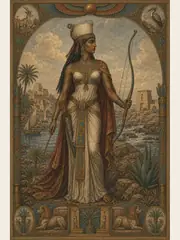
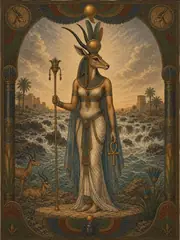
His consort was Anuket, the gazelle-goddess of the cataract, and his daughter Satet, the archer-goddess who released the inundation each summer; the three formed the triad of Elephantine, whose temple complex stood (and in its later Ptolemaic form, partly stands) on the southern tip of the island.
Curator’s note

What the sources say, and what later tradition added. The sources for this bay

Khnum's principal sanctuary was Elephantine, with a major secondary temple at Esna in Upper Egypt, where the Ptolemaic-Roman temple preserves an exceptionally elaborate hymnic theology of Khnum as universal creator. The Famine Stela on Sehel Island, claiming to record the Old Kingdom king Djoser's appeal to Khnum during a seven-year famine, is in fact a Ptolemaic-period composition (perhaps late 3rd or early 2nd c. BCE) reflecting later theological elaboration; it is nevertheless the longest connected narrative concerning Khnum to survive.

Kin in the sources

Each tie is quoted from the entry that states it.

When the sources speak

Dated witnesses for The Cities and the Sacred Animals. A date marks when the evidence was written down, not when the belief began. The whole timeline

c. 4000–3100 BCE
Predynastic regional symbols, burials, standards, and animal cults provide the deep background to later divine iconography.
c. 3100–2686 BCE
Early Dynastic kingship joins royal ideology to local cult centers and establishes many durable divine emblems.
c. 2686–2181 BCE
Old Kingdom pyramid complexes and the Pyramid Texts preserve the earliest large religious corpus.
c. 2181–1650 BCE
First Intermediate and Middle Kingdom traditions broaden mortuary access; Coffin Texts develop older royal materials.
c. 1550–1070 BCE
New Kingdom temple wealth, royal hymns, underworld books, and the Book of Going Forth by Day greatly expand the record.
c. 1353–1336 BCE
Akhenaten’s Aten program reorganizes royal cult but does not permanently erase the older divine plurality.
c. 1070–664 BCE
Third Intermediate Period priestly and regional powers reshape cult administration and divine kingship.
664–332 BCE
Late Period archaism, animal cults, and temple scholarship preserve and reinterpret older forms.

Floor plan

The rooms follow one another in the order their peoples first appear in the written record.

  1. The Cradle of Citiesc. 3400 BCE to 395 CE. 115 works
  2. The Gift of the Nilec. 4000 BCE to 395 CE. 73 works
  3. The Olympian Orderc. 1600 BCE to 750 CE. 152 works
  4. The Persian Worldc. 2000 BCE to 1010 CE. 30 works
  5. The Levantine Borderlandsc. 1200 BCE to 500 CE. 20 works
  6. The Edges of Empirec. 2000 BCE to 1500 CE. 33 works
  7. The Etruscan Worldc. 900 BCE to 750 CE. 22 works
  8. The Roman Inheritancec. 1200 BCE to 500 CE. 58 works
  9. The Northern Inheritancec. 2000 BCE to 1600 CE. 131 works