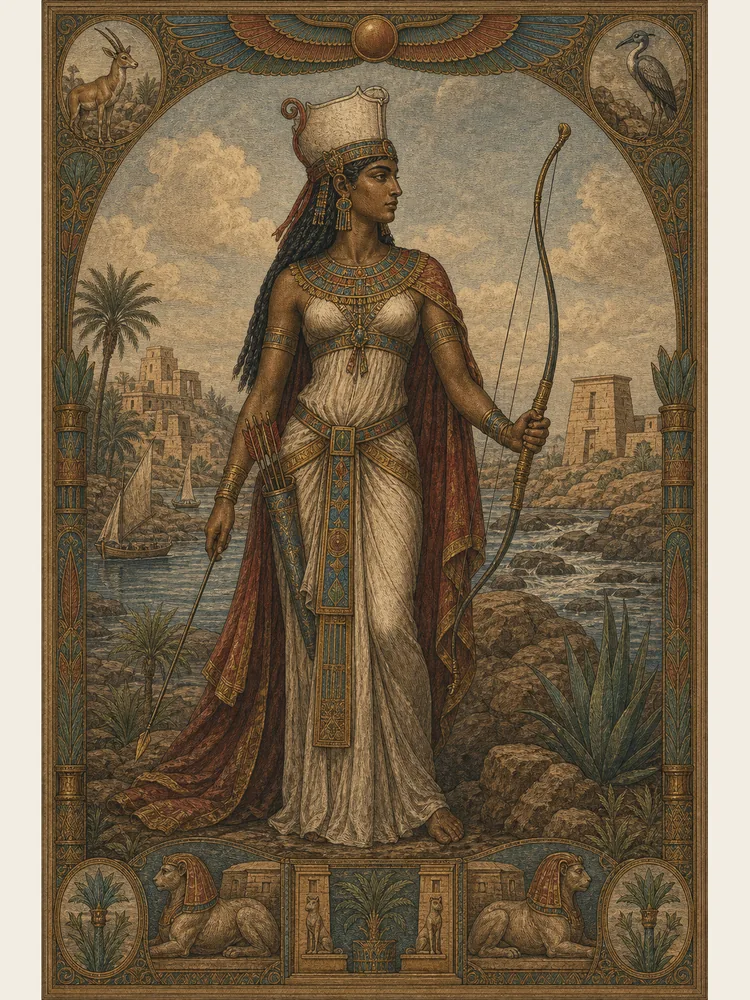
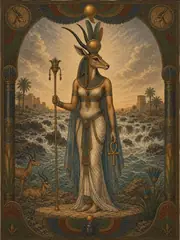
At Elephantine, the island in the Nile that lay just below the First Cataract and marked the southern boundary of Egypt proper, the king of the gods was Khnum the ram-headed potter; and beside Khnum in his temple stood his consort Satis. She was an archer-goddess: she was depicted as a woman bearing the white crown of Upper Egypt set with two gazelle-horns, and she carried in her hand a bow with arrows ready upon the string. She had two offices that complemented one another. As guardian of the southern frontier, she shot her arrows into the lands of the enemy to drive them back from Egypt's borders. As mistress of the cataract, she shot her arrows into the cliffs of the gorge to release the inundation when the time came; and the swelling waters that followed her shot were said to be the fertilizing flood pouring out of her quiver.
She was the second member of the Elephantine triad, the family of three whose cult dominated the southernmost province of Upper Egypt: Khnum the father, Satis the mother, and Anuket their daughter. Together they presided over the cataract and the inundation. Khnum, on his potter's wheel, formed the children of men from the Nile clay; Satis purified the king with libations of cataract water at his coronation, and Anuket bore the gazelle as the messenger of the inundation. The triad was venerated together from the early Old Kingdom, and the temple of Satis on Elephantine — recently and brilliantly excavated by the German Archaeological Institute — has yielded evidence of continuous cult from the late Predynastic period through the Roman Empire.
Curator’s note
What the sources say, and what later tradition added. The sources for this bay
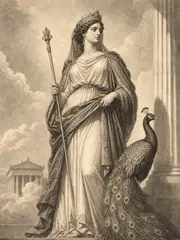
Satis (Egyptian Stt or Stỉt; Greek Satis) is attested from the First Dynasty onward and is among the oldest continuously worshipped goddesses of Egypt. Her temple on Elephantine has been excavated to a depth of stratification that extends from the late Predynastic into the Roman period; the German excavations under Werner Kaiser and his successors are among the most carefully published of any Egyptian temple complex. Her name is connected to the verb sṯỉ, 'to shoot' or 'to pour out,' which conveys both her archery and her libation function. The triad of Khnum, Satis, and Anuket is parallel in structure to the triad of Memphis (Ptah, Sekhmet, Nefertum) and Thebes (Amun, Mut, Khonsu) and exemplifies the Egyptian preference for triadic family-groups in civic theology. The Greeks identified Satis with Hera, on the basis of her position as queen-consort of the senior god of the place.
When the sources speak
Dated witnesses for The Protectors and the Sages. A date marks when the evidence was written down, not when the belief began. The whole timeline
- c. 4000–3100 BCE
- Predynastic regional symbols, burials, standards, and animal cults provide the deep background to later divine iconography.
- c. 3100–2686 BCE
- Early Dynastic kingship joins royal ideology to local cult centers and establishes many durable divine emblems.
- c. 2686–2181 BCE
- Old Kingdom pyramid complexes and the Pyramid Texts preserve the earliest large religious corpus.
- c. 2181–1650 BCE
- First Intermediate and Middle Kingdom traditions broaden mortuary access; Coffin Texts develop older royal materials.
- c. 1550–1070 BCE
- New Kingdom temple wealth, royal hymns, underworld books, and the Book of Going Forth by Day greatly expand the record.
- c. 1353–1336 BCE
- Akhenaten’s Aten program reorganizes royal cult but does not permanently erase the older divine plurality.
- c. 1070–664 BCE
- Third Intermediate Period priestly and regional powers reshape cult administration and divine kingship.
- 664–332 BCE
- Late Period archaism, animal cults, and temple scholarship preserve and reinterpret older forms.