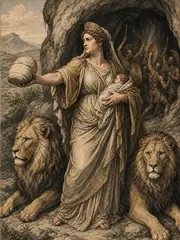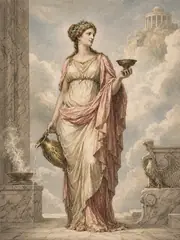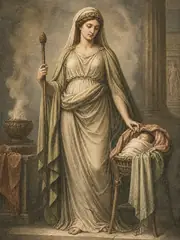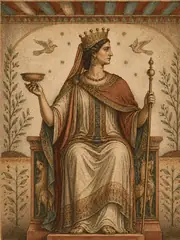
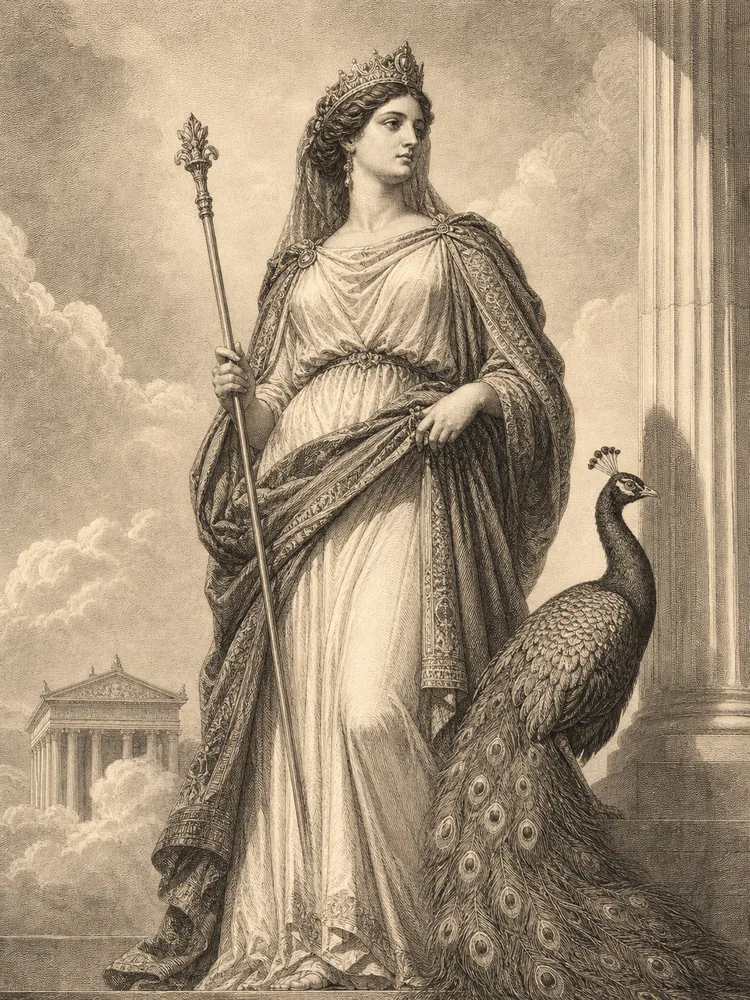

Hera was the queen of the gods, the senior wife of Zeus, the patroness of marriage and of married women, the great goddess of Argos and Samos. She was a daughter of Cronus and Rhea, sister of Zeus and Poseidon, and one of those whom Cronus had swallowed and Zeus liberated. After the Titanomachy, Zeus took her to wife with great ceremony — the marriage of Zeus and Hera was the divine prototype of every Greek marriage thereafter, celebrated in cult at the Heraion of Argos and elsewhere — and she bore him Ares, Hephaestus, Hebe, and Eileithyia. (Hephaestus, in some traditions, she bore alone, in parthenogenesis, in pique at Zeus's having brought forth Athena from his own head; this version explains why Hephaestus is sometimes treated as not fully Zeus's son.)
Hera's principal narrative role in the mythology is as the wronged wife pursuing her husband's lovers and their offspring with implacable jealousy. Her vengeance fell variously and severely. She turned Callisto into a bear; she sent two snakes against the infant Heracles in his cradle; she pursued Heracles throughout his life with the goading of madness, with the imposition of his Twelve Labors (technically dictated by Eurystheus, but Eurystheus was Hera's instrument), and with the final agony of the poisoned shirt that killed him. She drove Io across the world in cow-form, sending the gadfly Argus to keep watch over her. She delayed the birth of Apollo and Artemis on Delos by detaining Eileithyia. She afflicted Semele with the fatal demand to see Zeus in his glory. She sent the Sphinx to Thebes. She supported the Greeks in the Trojan War, with bitter enmity toward Paris, who had passed her over in the Judgment of Paris (Aphrodite winning, Hera and Athena being slighted, and the goddesses' united vengeance falling upon Troy in consequence).
Beyond her jealous rages, Hera was the great goddess of legitimate marriage and of the institution of the Greek household; her cult at Argos, where the great Heraion (excavated by the American School of Classical Studies in the 1890s) housed an enormous gold-and-ivory cult statue by Polycleitus, was among the most prestigious in Greece. She was honored at Samos with another great Heraion, possibly even more ancient. Married women across the Greek world celebrated her festivals; her wedding to Zeus was reenacted in seasonal ritual. Her Roman counterpart Juno preserved the marriage-protectress role with greater dignity than Hera retained in the literary tradition; the Greek mythological Hera was a less sympathetic figure than her cult would have suggested.