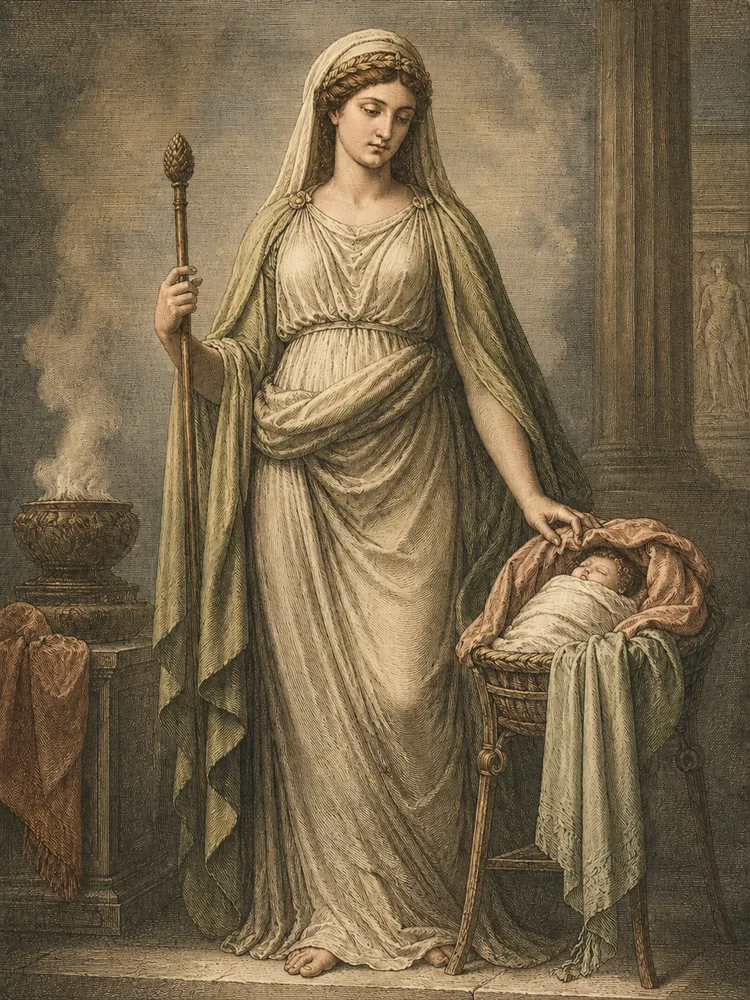
Eileithyia was the goddess who attended at childbirth, easing or delaying labor at her pleasure or her mother's command. She was a daughter of Zeus and Hera (or, in some accounts, Hera bore her in parthenogenesis); she was generally helpful to women in labor, but she could be detained or ordered to delay her arrival, as Hera detained her on Olympus when Leto was in labor on Delos for the birth of Apollo. The sound of her footsteps was the signal that the child was coming; her absence meant prolonged and dangerous labor. The Greek imagination of childbirth as governed by a particular goddess who came when she chose and could be persuaded or thwarted reflected the actual experience of premodern obstetrics, in which the difference between an easy and a fatal delivery was unpredictable and seemed to depend on forces outside human control.
 Before thisHebe
 Next on the wallEros (Later)
Curator’s note
What the sources say, and what later tradition added. The sources for this bay
Homer, Iliad 11.270, 16.187; the Homeric Hymn to Apollo 97–119 (the detention by Hera). Eileithyia had cult at numerous sites, most notably at the cave of Eileithyia on Crete near Amnisos, which has been continuously identified from the Bronze Age through classical times — one of the longest-attested cult-sites in the Greek world. Her Roman counterpart was Lucina, an epithet of Juno.
Kin in the sources
Each tie is quoted from the entry that states it.
 Child ofZeus
She was a daughter of Zeus and Hera
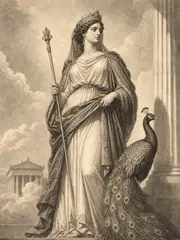 Child ofHera
She was a daughter of Zeus and Hera
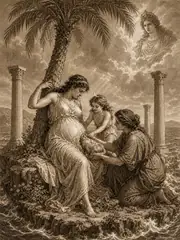 Companion ofLeto
as Hera detained her on Olympus when Leto was in labor on Delos for the birth of Apollo
When the sources speak
Dated witnesses for The Sea, the Wild and the Wind. A date marks when the evidence was written down, not when the belief began. The whole timeline
- c. 1600–1100 BCE
- Mycenaean palace tablets in Linear B record offerings and divine names, but little continuous myth.
- c. 1100–800 BCE
- Post-palatial oral traditions and changing cult landscapes precede the surviving alphabetic epics.
- late 8th–7th centuries BCE
- The Iliad, Odyssey, Hesiodic Theogony and Works and Days give influential but non-exclusive divine orders.
- 7th–6th centuries BCE
- Homeric Hymns, lyric poetry, colonization, and local sanctuary traditions multiply regional narratives.
- 6th–5th centuries BCE
- Orphic, Pythagorean, and mystery materials develop alternative cosmogonies and afterlife doctrines.
- 5th century BCE
- Athenian tragedy and comedy recast heroic houses and divine justice for civic audiences.
- 4th century BCE
- Philosophers, antiquarians, and local historians interpret or criticize inherited myth.
- 323–31 BCE
- Hellenistic poets and scholars systematize variants across an enlarged Greek world.