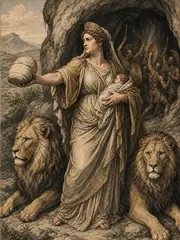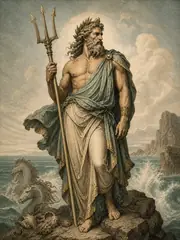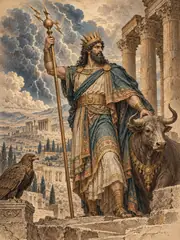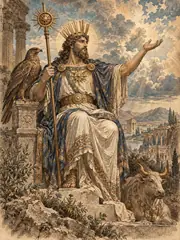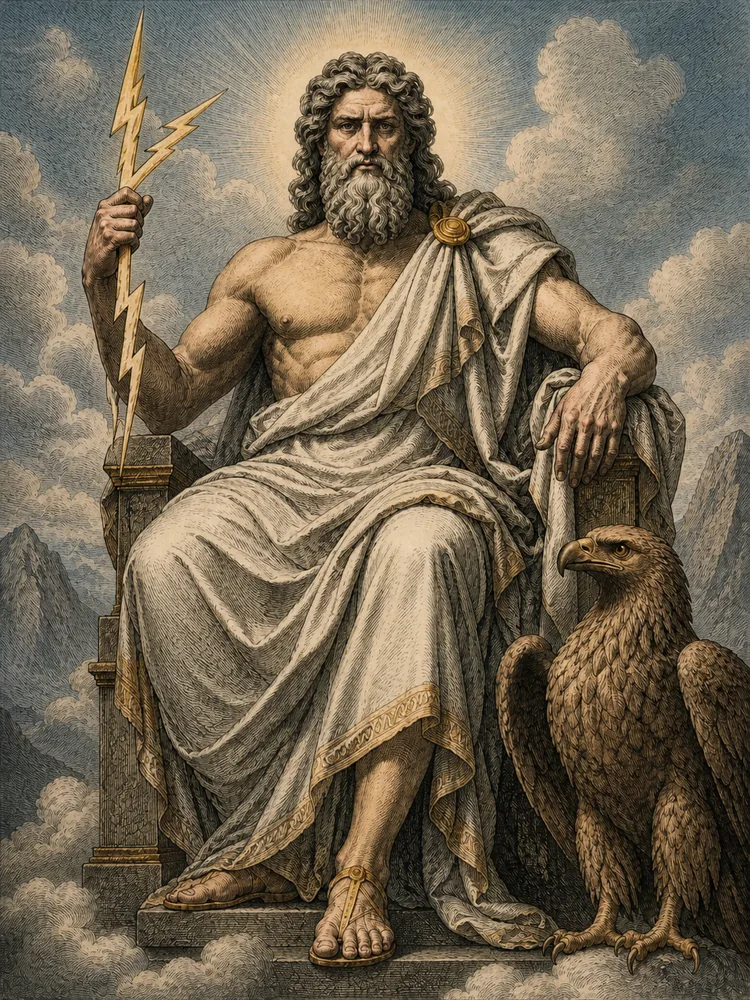
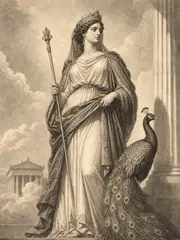
Zeus was the father and king of the gods, the lord of Olympus and of the bright sky, the wielder of the thunderbolt, the dispenser of justice, the upholder of oaths, the protector of suppliants, the patron of strangers, the maintainer of the order of the cosmos. He was the youngest son of Cronus and Rhea, the only one not swallowed by his father (his mother having substituted a stone, as told in Cronus's entry above), raised in secret on Crete, returning at manhood to overthrow his father and assume the kingship. He led the Olympians to victory in the Titanomachy, casting Cronus and the loyal Titans into Tartarus; thereafter he and his brothers Poseidon and Hades drew lots for the divisions of the cosmos, and Zeus drew the sky, Poseidon the sea, and Hades the underworld, with the earth and Olympus itself remaining common to all.
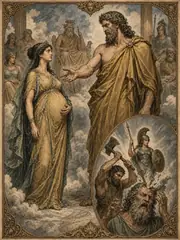
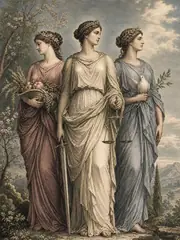
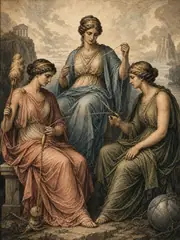
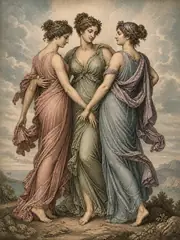
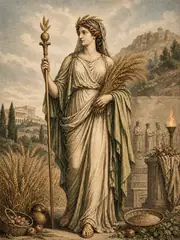
Zeus's wives and lovers were many — the catalogue, in Hesiod, runs to a roster of seven principal consorts and many lesser amours — and his children correspondingly numerous. His first wife was Metis (the Wisdom whom he swallowed before she could bear); his second was Themis, who bore him the Horae and the Moirai; his third was Eurynome, who bore him the Charites; his fourth was Demeter, who bore him Persephone; his fifth was Mnemosyne, who bore him the nine Muses; his sixth was Leto, who bore him Apollo and Artemis; his seventh and final and senior wife was his sister Hera, who bore him Ares, Hephaestus, Hebe, and Eileithyia, and who pursued his other lovers with persistent jealous vengeance. Among his many mortal and minor-divine paramours were Europa (whom he carried off in the form of a white bull and set as a continent); Leda (whom he visited in the form of a swan, and who bore him Helen and the Dioscuri); Danae (whom he visited as a shower of gold, and who bore him Perseus); Alcmene (whose bed he came to in the likeness of her absent husband Amphitryon, and who bore him Heracles); Semele (whom he visited as a mortal man, but who insisted on seeing him in his glory and was incinerated, leaving him to rescue the unborn Dionysus); Io, Callisto, Antiope, Maia, and many more. The pattern of these stories — the god in disguise, the fascinated mortal woman, the angry queen of Olympus, the heroic offspring — is one of the most distinctive in Greek myth, and has provoked centuries of interpretation, from euhemerist (the loves are dimly remembered conquests of an early Greek king) to allegorical (the unions are the joining of cosmic principles with human nature) to feminist (the loves are mythologized rapes and the Greek tradition's tolerance for them is symptomatic).
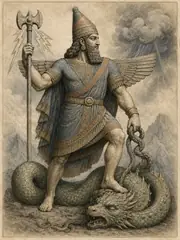
Beyond the loves, Zeus's principal mythological roles were three. He was the upholder of the cosmic order: he had defeated Cronus and the Titans, and he kept Tartarus shut against their return, and against the great serpent Typhon (whose battle with Zeus is told in the entry on Typhon below). He was the dispenser of justice in the human world: he sent the Erinyes against perjurers and the violators of guest-friendship, and his throne was attended by Themis (Right Order) and Dike (Justice). And he was the maintainer of the great oracle at Dodona in Epirus — older than Delphi, the oldest of all Greek oracles, where his will was discerned by the rustling of the leaves of a sacred oak. His great pan-Hellenic sanctuary was at Olympia in Elis, where the Olympic Games (founded traditionally in 776 BCE) were celebrated in his honor every fourth year for nearly twelve centuries; his great chryselephantine cult-statue there, by Phidias (c. 435 BCE), was reckoned one of the Seven Wonders of the World.
His Roman counterpart was Jupiter, and the conventional identification has hardened into reflex; but they were originally distinct gods (Jupiter from Indo-European *Dyeus Pater, Zeus from the cognate *Dyeus, both meaning "Sky Father" — a common origin, but a separate development thereafter), and the Roman Jupiter had a rather different character (more austere, more bound to the rites of the Roman state, less prone to the amorous adventures that gave Zeus's myth its distinctive coloring). The Roman Jupiter is treated in his proper place in Volume IV.