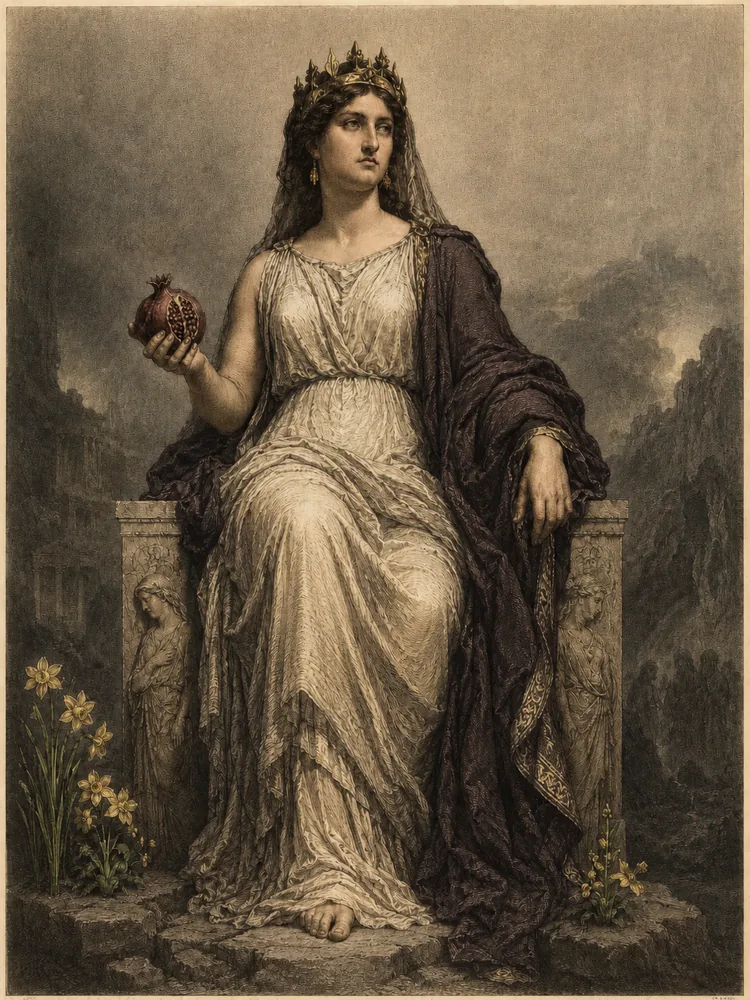
Persephone was the daughter of Demeter and Zeus, the maiden whose abduction by Hades and partial restoration constituted the central narrative of the Eleusinian cult, told in fullness in the entry on Demeter above. She had a double nature thereafter: as Kore (the Maiden) she was her mother's daughter, the spring-figure who returned each year to the upper world; as Persephone she was the queen of the underworld, the consort of Hades, the dread mistress of the realm of the dead. Greek devotion held both roles together with a careful theological tact, the goddess being addressed as Kore in the spring rites and as Persephone in the underworld liturgy. Her name was, like that of her husband, often avoided in direct speech for fear of attracting her attention; the periphrasis "the dread one" or simply "the goddess" was preferred in many contexts.
 Next on the wallHebe
Curator’s note
What the sources say, and what later tradition added. The sources for this bay
Persephone's principal narrative is given in the Homeric Hymn to Demeter (see also Demeter's entry above); cf. Hesiod, Theogony 912–914; Apollodorus 1.5.1–3; Ovid, Metamorphoses 5.341–571. Her cult-doublings (Kore-Persephone, the spring maiden and the underworld queen) reflect the Greek capacity for theological complexity in handling figures whose mythological role is itself dual.
Kin in the sources
Each tie is quoted from the entry that states it.
 Child ofDemeter
Persephone was the daughter of Demeter and Zeus
 Child ofZeus
Persephone was the daughter of Demeter and Zeus
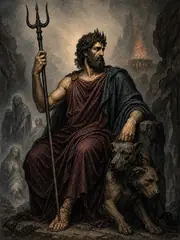 Consort ofHades
she was the queen of the underworld, the consort of Hades
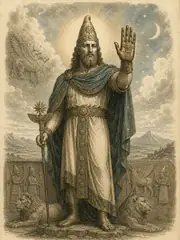 Parent ofSabazius
the form he had taken at his birth from the union of Zeus and Persephone
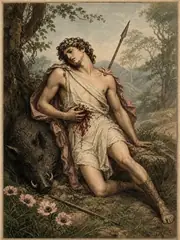 Consort ofAdonis
Persephone, opening the chest, fell in love with him also, and refused to return him
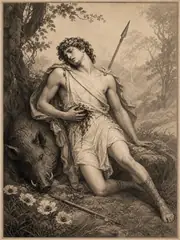 Consort ofAdonis
Persephone, lifting the lid of the chest, was herself overcome with love for the boy
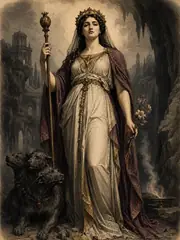 Named as the same god asProserpina
Proserpina was the Roman name for the goddess whom the Greeks called Persephone
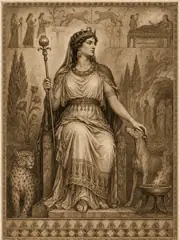 Named as the same god asPhersipnai
Her name is plainly the Etruscan adaptation of the Greek Persephone
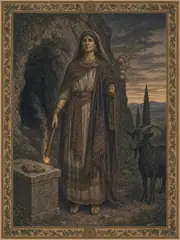 Named as the same god asAtaecina
Proserpina (the Latin form of the Greek Persephone)
The same god in other rooms
The ancient sources themselves name these as one god under different names. See Persephone, Ataecina, Phersipnai and Proserpina hung together
When the sources speak
Dated witnesses for The Sea, the Wild and the Wind. A date marks when the evidence was written down, not when the belief began. The whole timeline
- c. 1600–1100 BCE
- Mycenaean palace tablets in Linear B record offerings and divine names, but little continuous myth.
- c. 1100–800 BCE
- Post-palatial oral traditions and changing cult landscapes precede the surviving alphabetic epics.
- late 8th–7th centuries BCE
- The Iliad, Odyssey, Hesiodic Theogony and Works and Days give influential but non-exclusive divine orders.
- 7th–6th centuries BCE
- Homeric Hymns, lyric poetry, colonization, and local sanctuary traditions multiply regional narratives.
- 6th–5th centuries BCE
- Orphic, Pythagorean, and mystery materials develop alternative cosmogonies and afterlife doctrines.
- 5th century BCE
- Athenian tragedy and comedy recast heroic houses and divine justice for civic audiences.
- 4th century BCE
- Philosophers, antiquarians, and local historians interpret or criticize inherited myth.
- 323–31 BCE
- Hellenistic poets and scholars systematize variants across an enlarged Greek world.