A Compendium of the Ancient Gods
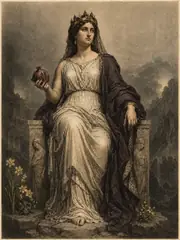
Sabazius, plate

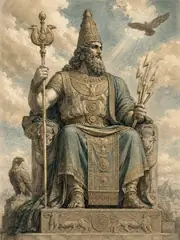
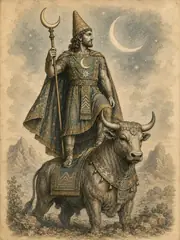
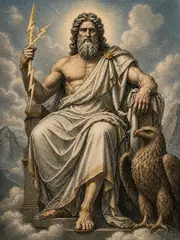
The Phrygians and Thracians shared a sky-and-fertility god whose name, in the form Sabazius (sometimes Sabazios), reached the wider Mediterranean world by the fifth century BCE and acquired thereafter a Roman-imperial diffusion that made him one of the most widely worshipped foreign gods of the late Republic and early Empire. He was identified by the Greeks with Zeus and with Dionysus — sometimes with both at once — and his mystery-rite was famous, or notorious, for the snake-handling that formed part of its initiation.

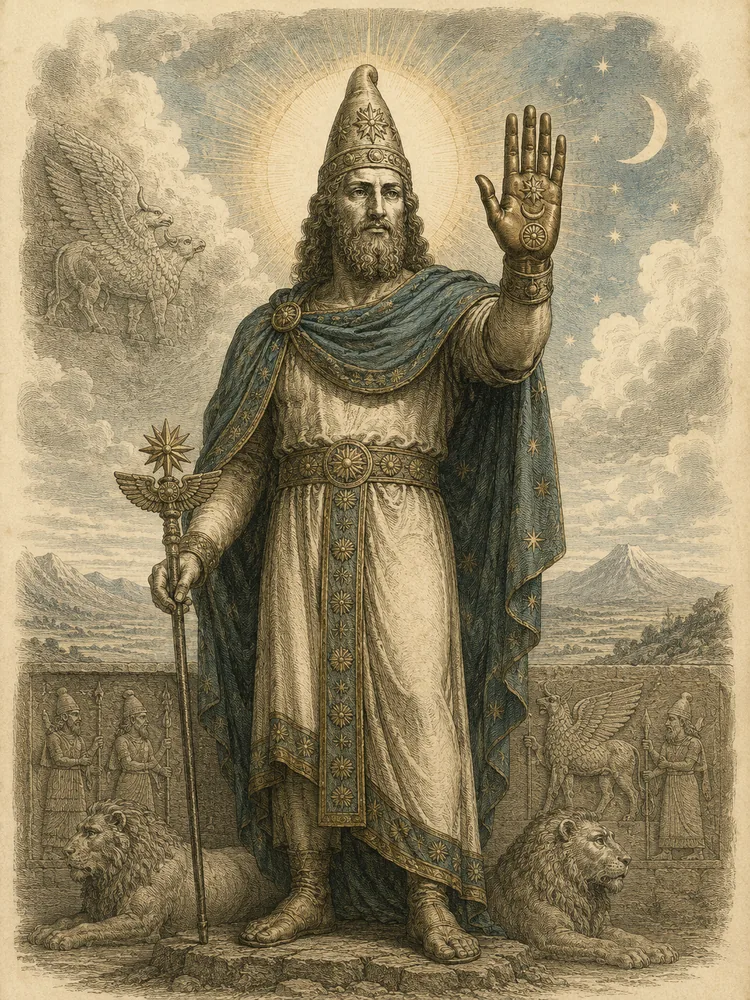
The most distinctive cult-object of his worship is a small bronze hand, raised in benediction with the thumb, index, and middle fingers extended (the gesture later carried over into Christian liturgical blessing), and decorated upon every available surface with the symbols of his cult: a snake coiled around the wrist; a frog, an eagle, a ram, a tortoise, a scorpion, a pinecone resting in the palm; a small reclining figure of the god himself. Hundreds of these "Hands of Sabazius" survive in museum collections, recovered from Roman-period sites across the empire — from Britain to Syria. Their wide distribution is the single best evidence of the cult's diffusion.

His mystery-rite involved, as one of its central acts, the passage of a live snake through the initiate's clothing — head down at the neck, drawn out at the feet — the snake being understood as the god himself in the form he had taken at his birth from the union of Zeus and Persephone. The Athenian comic stage of the late fifth century made fun of his ecstatic devotees (Demosthenes mocks his political rival Aeschines for having grown up in the cult, his mother having been a Sabaziastic priestess); but the cult outlived the mockery, and prospered for centuries.

There was, in 139 BCE, a Roman administrative confusion between the Sabazius cult and the Jewish cult of the God of Heaven, whose name Sabaoth ("of hosts") sounded similar enough to Roman ears that the praetor Cornelius Hispalus expelled both groups together from Rome. The misunderstanding is documented by Valerius Maximus and is among the more curious incidents of Roman religious administration.
Curator’s note

What the sources say, and what later tradition added. The sources for this bay

Sabazius (Sabazios) is attested in Greek sources from the late fifth century BCE (Aristophanes, Demosthenes), and in Roman-period inscriptions and monuments from across the empire. The "Hands of Sabazius" — small bronze votive hands covered in cult-symbols — are among the most distinctive Roman-period cult artifacts, with examples in the British Museum, the Louvre, the Museo Nazionale Romano, and many other collections. The 139 BCE expulsion under Cornelius Hispalus is preserved by Valerius Maximus 1.3.3 and has been a subject of substantial modern discussion, since it is one of the earliest records of Roman administrative encounter with Judaism, however confused. The mystery-rite involving the snake passing through the initiate's clothing is described by Clement of Alexandria, Protrepticus 2.

Kin in the sources

Each tie is quoted from the entry that states it.

When the sources speak

Dated witnesses for Anatolia. A date marks when the evidence was written down, not when the belief began. The whole timeline

c. 3400–3000 BCE
Uruk-period writing and monumental temple economies create the earliest recoverable administrative setting for named divine institutions.
c. 2900–2350 BCE
Early Dynastic city-states preserve local cults, hymns, royal inscriptions, and god lists; later copies often transmit older compositions.
c. 2334–2154 BCE
The Akkadian Empire expands bilingual and imperial patterns of divine identification without erasing local cult titles.
c. 2112–2004 BCE
Ur III administration and scribal schooling standardize many Sumerian literary and liturgical forms.
c. 2000–1600 BCE
Old Babylonian schools copy major myths, laments, hymns, debates, and heroic narratives in the form most often used by modern editors.
c. 1650–1200 BCE
Hittite and Hurrian archives at Hattusa transmit Anatolian myths, imported Syrian materials, and ritual compositions.
c. 1400–1190 BCE
The tablets of Ugarit preserve the Baal Cycle, Kirta, Aqhat, ritual lists, and a dense Late Bronze Age West Semitic pantheon.
c. 1000–612 BCE
Neo-Assyrian and Neo-Babylonian empires collect, revise, and politically reinterpret older learned traditions.

Floor plan

The rooms follow one another in the order their peoples first appear in the written record.

  1. The Cradle of Citiesc. 3400 BCE to 395 CE. 115 works
  2. The Gift of the Nilec. 4000 BCE to 395 CE. 73 works
  3. The Olympian Orderc. 1600 BCE to 750 CE. 152 works
  4. The Persian Worldc. 2000 BCE to 1010 CE. 30 works
  5. The Levantine Borderlandsc. 1200 BCE to 500 CE. 20 works
  6. The Edges of Empirec. 2000 BCE to 1500 CE. 33 works
  7. The Etruscan Worldc. 900 BCE to 750 CE. 22 works
  8. The Roman Inheritancec. 1200 BCE to 500 CE. 58 works
  9. The Northern Inheritancec. 2000 BCE to 1600 CE. 131 works