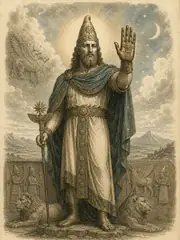
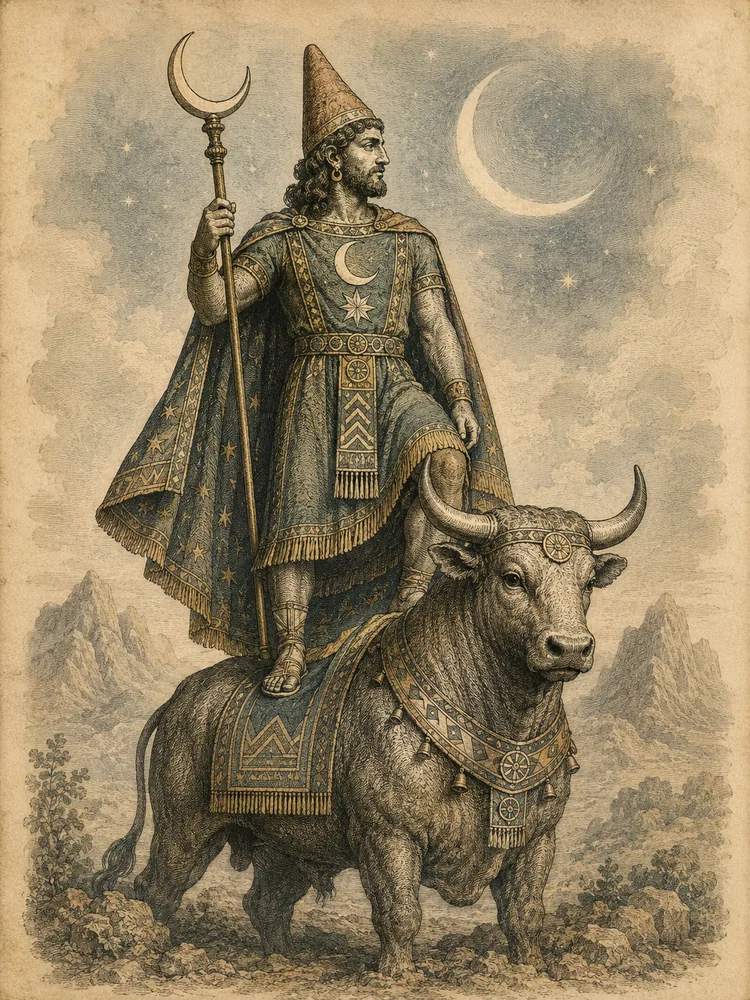
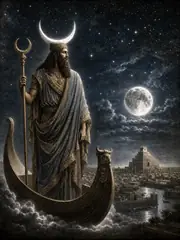
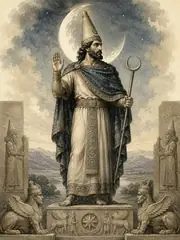
Among the gods of the Anatolian highlands whose cult prospered in the Roman period, one of the most distinctive was Men — the Phrygian moon-god — whose iconography, fixed by the second century BCE, made him instantly recognizable: a young male figure in a Phrygian cap, with the crescent of the moon rising behind his shoulders like the curving wings of a bat, standing upon (or beside) a sacred bull, his right hand raised in gesture of benediction or oath.
His cult-centers in central and southern Anatolia — Antioch in Pisidia chief among them — drew petitioners from across the Roman East, and the votive inscriptions and reliefs they left behind in great numbers fill the museums of modern Turkey. He was a god of healing as well as of the moon; he received dedications for cures, for safe childbirths, for the recovery of lost cattle. His distinguishing characteristic, in the wider context of ancient Mediterranean lunar religion, was his sex: where Greek Selene and Roman Luna were female, Men was emphatically male, retaining the masculine character that lunar deities had carried in older Anatolian and Mesopotamian tradition (Sumerian Nanna, Akkadian Sin, Luwian Arma).
When the sources speak
Dated witnesses for Anatolia. A date marks when the evidence was written down, not when the belief began. The whole timeline
- c. 3400–3000 BCE
- Uruk-period writing and monumental temple economies create the earliest recoverable administrative setting for named divine institutions.
- c. 2900–2350 BCE
- Early Dynastic city-states preserve local cults, hymns, royal inscriptions, and god lists; later copies often transmit older compositions.
- c. 2334–2154 BCE
- The Akkadian Empire expands bilingual and imperial patterns of divine identification without erasing local cult titles.
- c. 2112–2004 BCE
- Ur III administration and scribal schooling standardize many Sumerian literary and liturgical forms.
- c. 2000–1600 BCE
- Old Babylonian schools copy major myths, laments, hymns, debates, and heroic narratives in the form most often used by modern editors.
- c. 1650–1200 BCE
- Hittite and Hurrian archives at Hattusa transmit Anatolian myths, imported Syrian materials, and ritual compositions.
- c. 1400–1190 BCE
- The tablets of Ugarit preserve the Baal Cycle, Kirta, Aqhat, ritual lists, and a dense Late Bronze Age West Semitic pantheon.
- c. 1000–612 BCE
- Neo-Assyrian and Neo-Babylonian empires collect, revise, and politically reinterpret older learned traditions.