
A Compendium of the Ancient Gods
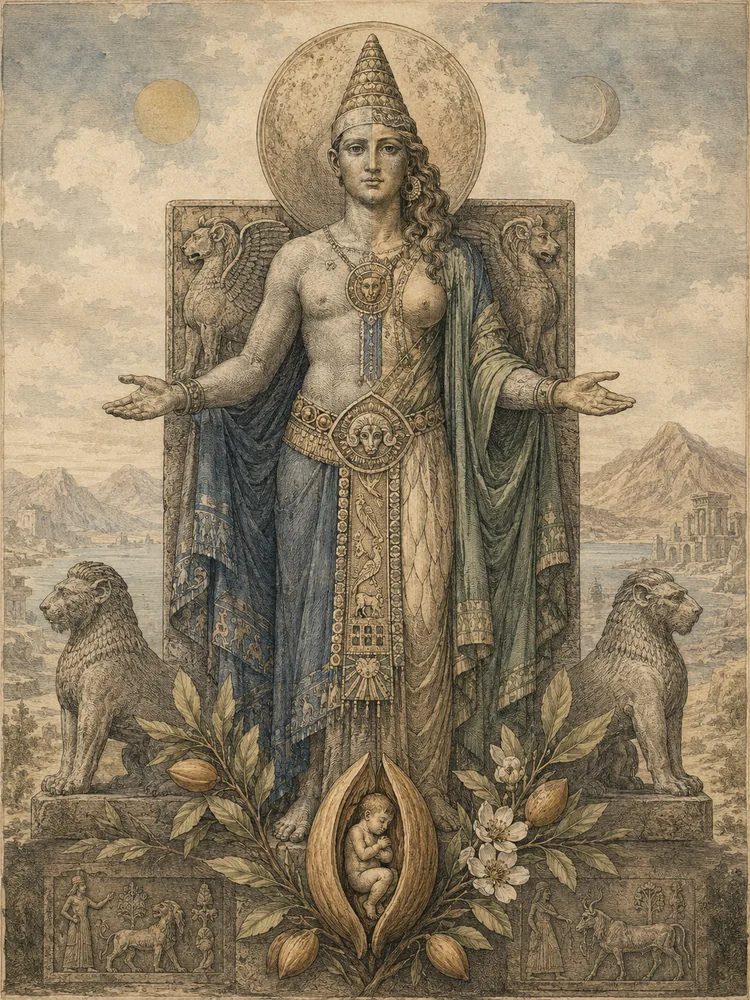
Agdistis, plate

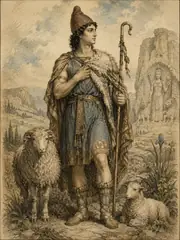
Of the strange divine beings preserved in Greek and Roman accounts of Phrygian religion, the strangest is Agdistis. Pausanias gives the principal narrative; Arnobius preserves a Christian-polemical version of the same story; the substance is consistent. Agdistis was born of a stone — Mount Agdos in Phrygia, fertilized by Zeus — and was originally hermaphroditic, possessed of both male and female parts, and so powerful that the gods feared her.

The gods, considering how to limit her, contrived a stratagem. They drugged her water; while she slept, Dionysus tied a noose about her male parts to the leg of an oak; when Agdistis awoke and rose, she castrated herself by her own movement. The severed parts fell to the ground; from them sprang an almond tree, which bore fruit in due season. A daughter of the river-god Sangarius — named Nana — passed by the tree, picked one of the almonds, and placed it in her bosom; the almond disappeared into her body, and Nana found herself pregnant.

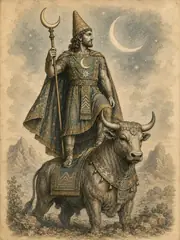
She bore a son — Attis. He grew up beautiful; Agdistis (now female only, but undiminished in passion) fell in love with him; in jealous rage, when Attis was about to marry the daughter of the king of Pessinous, Agdistis drove him mad. Attis, in his madness, castrated himself beneath a pine tree and bled to death. From his blood sprang violets; the pine tree was thereafter sacred to him; and the great Phrygian cult of Cybele-and-Attis, with its eunuch-priests the Galli who castrated themselves in imitation of the dying god, took its origin from this terrible founding myth.

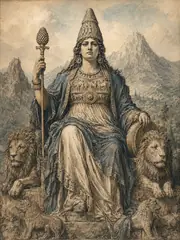
Agdistis is, in some later traditions, identified with Cybele herself; in others, she is treated as a separate goddess, the older and more dangerous version of the Mother. The Phrygians at Pessinous worshipped both; the Romans, when they imported the cult in 204 BCE, kept the figure of Cybele in the foreground but did not entirely lose track of her stranger predecessor.

Curator’s note

What the sources say, and what later tradition added. The sources for this bay

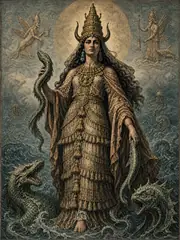
Agdistis is documented in Pausanias 7.17.10-12, Arnobius Adversus Nationes 5.5-7 (drawing on the Hellenistic mythographer Timotheus), and inscriptions from Pessinous and other Phrygian-Anatolian sites. Pausanias's narrative is the principal extended source; it is one of the strangest passages in his work, and clearly preserves a Phrygian original imperfectly understood by his Greek frame. The hermaphroditic-primordial-divinity type — present in Phanes of Greek Orphism, in Tiamat in some readings, in various other mythologies — finds its most narratively developed Mediterranean instance in Agdistis. The Roman reception of the Cybele cult is well-documented (Livy 29.10-14); whether the Romans understood the full Agdistic background is doubtful, but the eunuch-priest Galli were certainly taken on along with the goddess.

Kin in the sources

Each tie is quoted from the entry that states it.

When the sources speak

Dated witnesses for Anatolia. A date marks when the evidence was written down, not when the belief began. The whole timeline

c. 3400–3000 BCE
Uruk-period writing and monumental temple economies create the earliest recoverable administrative setting for named divine institutions.
c. 2900–2350 BCE
Early Dynastic city-states preserve local cults, hymns, royal inscriptions, and god lists; later copies often transmit older compositions.
c. 2334–2154 BCE
The Akkadian Empire expands bilingual and imperial patterns of divine identification without erasing local cult titles.
c. 2112–2004 BCE
Ur III administration and scribal schooling standardize many Sumerian literary and liturgical forms.
c. 2000–1600 BCE
Old Babylonian schools copy major myths, laments, hymns, debates, and heroic narratives in the form most often used by modern editors.
c. 1650–1200 BCE
Hittite and Hurrian archives at Hattusa transmit Anatolian myths, imported Syrian materials, and ritual compositions.
c. 1400–1190 BCE
The tablets of Ugarit preserve the Baal Cycle, Kirta, Aqhat, ritual lists, and a dense Late Bronze Age West Semitic pantheon.
c. 1000–612 BCE
Neo-Assyrian and Neo-Babylonian empires collect, revise, and politically reinterpret older learned traditions.

Floor plan

The rooms follow one another in the order their peoples first appear in the written record.

  1. The Cradle of Citiesc. 3400 BCE to 395 CE. 115 works
  2. The Gift of the Nilec. 4000 BCE to 395 CE. 73 works
  3. The Olympian Orderc. 1600 BCE to 750 CE. 152 works
  4. The Persian Worldc. 2000 BCE to 1010 CE. 30 works
  5. The Levantine Borderlandsc. 1200 BCE to 500 CE. 20 works
  6. The Edges of Empirec. 2000 BCE to 1500 CE. 33 works
  7. The Etruscan Worldc. 900 BCE to 750 CE. 22 works
  8. The Roman Inheritancec. 1200 BCE to 500 CE. 58 works
  9. The Northern Inheritancec. 2000 BCE to 1600 CE. 131 works