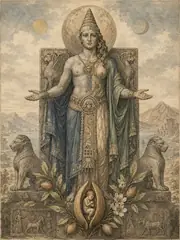
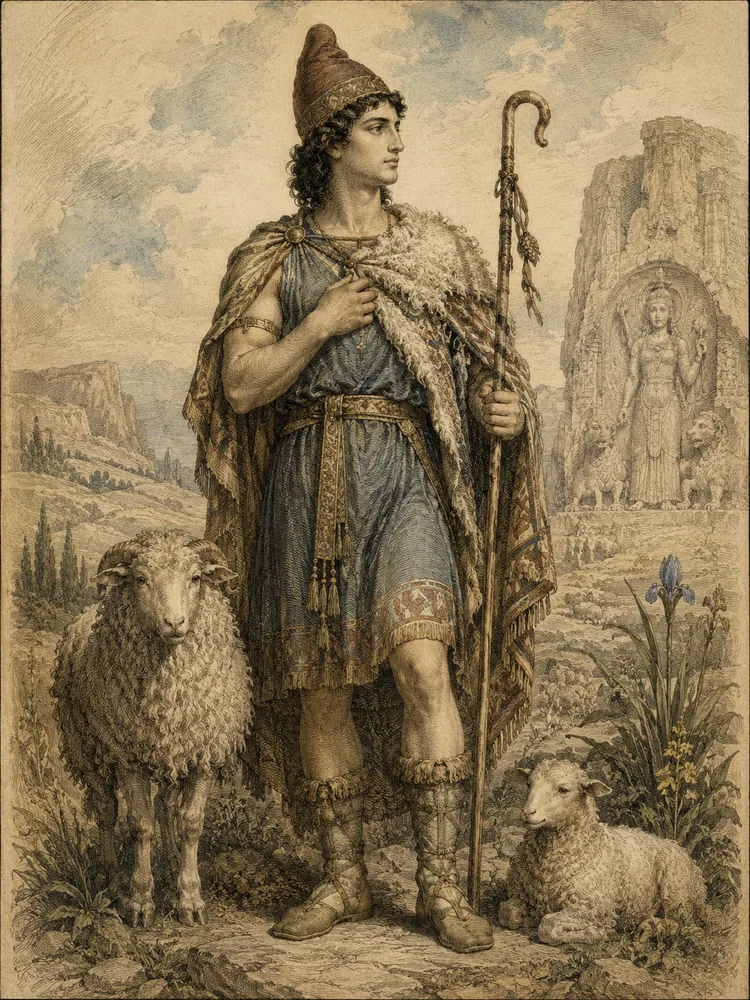

Attis was a beautiful young shepherd of Phrygia, the beloved of Cybele; and his story was told in several conflicting versions, of which the strangest and the most authentically Phrygian is preserved by Pausanias. There was, he says, a being named Agdistis, born hermaphroditic from the seed of Zeus that fell upon the rock of Mount Agdos; and the gods, alarmed by the creature's double sex, removed the male organs by a stratagem. From the blood that fell to the earth there sprang an almond tree. The daughter of the river Sangarius, walking by, plucked an almond and placed it in her bosom; the almond vanished, and she found herself with child; and so was born the boy Attis.
Attis grew exceedingly beautiful, and was beloved of Cybele (whom Pausanias calls Agdistis under another name, identifying the original hermaphroditic being with the Mother-Goddess herself). But Attis was promised in marriage to the daughter of the king of Pessinus; and on the day of the wedding feast, Cybele appeared in jealous fury, and madness seized the company. Attis, in his frenzy, fled to the mountain, and there beneath a pine tree he castrated himself, and bled to death. Cybele was filled with sorrow, and prayed that his body might never decay; and so it was granted. Each year thereafter, his death and his recovery were mourned and celebrated by the Phrygians, and afterwards by the Romans; the pine tree was cut down and brought into the sanctuary in solemn procession, and the day of his death was the Day of Blood, on which the Galli scourged themselves and renewed their vows.
In the Roman calendar, the festival of the Mother and Attis fell at the spring equinox: on the fifteenth of March was the procession of the Reed-Bearers; on the twenty-second, the Tree was felled and brought in; on the twenty-fourth, the Day of Blood; on the twenty-fifth, the Hilaria, the day of rejoicing, when Attis was held to live again.