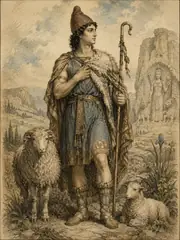
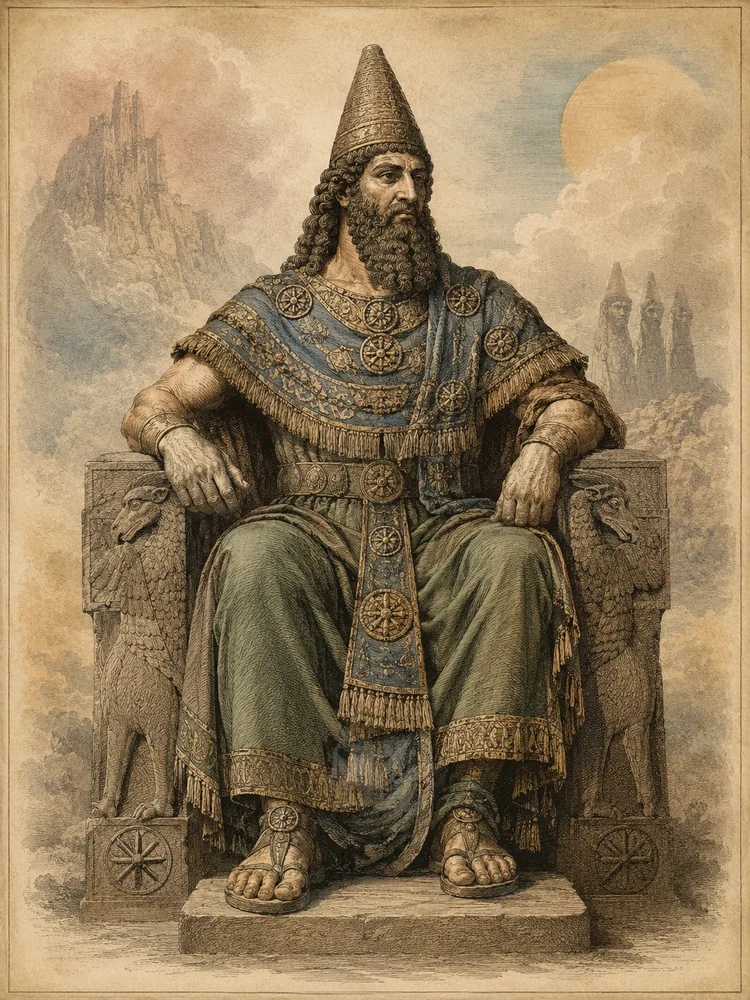
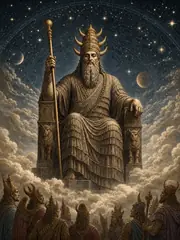
Before Anu was king of heaven, the Hurrians said, there had been another king before him: Alalu, a god whose name and origin are now obscure but whose place in the cosmic succession is preserved in the great Hurrian poem which the Hittites translated under the title of the Song of Going Forth, and which moderns call the Kumarbi Cycle.
Alalu reigned, this poem says, for nine "counted years" — the Hittite phrase suggests, perhaps, a fixed cosmic period. At the end of his reign, his cup-bearer Anu rose against him; Alalu was defeated; he fled to the dark earth, the underworld, and there sat in deposed dignity. Anu took his throne. But Anu in his turn was overthrown by Kumarbi (who castrated his master with a bite, in one of the most arresting scenes in ancient mythology); and Kumarbi was eventually overthrown by Kumarbi's son Teshub, the storm-god, who became the present ruler of the divine assembly.
The four-generation succession — Alalu, Anu, Kumarbi, Teshub — preserves an Anatolian cosmogonic tradition older than Hesiod, and one which Hesiod's own succession (the Heaven, the Sky-Castrated, the Cronus-Devourer, the Zeus-Triumphant) seems to echo so closely that direct or indirect literary kinship is now widely assumed.
When the sources speak
Dated witnesses for Anatolia. A date marks when the evidence was written down, not when the belief began. The whole timeline
- c. 3400–3000 BCE
- Uruk-period writing and monumental temple economies create the earliest recoverable administrative setting for named divine institutions.
- c. 2900–2350 BCE
- Early Dynastic city-states preserve local cults, hymns, royal inscriptions, and god lists; later copies often transmit older compositions.
- c. 2334–2154 BCE
- The Akkadian Empire expands bilingual and imperial patterns of divine identification without erasing local cult titles.
- c. 2112–2004 BCE
- Ur III administration and scribal schooling standardize many Sumerian literary and liturgical forms.
- c. 2000–1600 BCE
- Old Babylonian schools copy major myths, laments, hymns, debates, and heroic narratives in the form most often used by modern editors.
- c. 1650–1200 BCE
- Hittite and Hurrian archives at Hattusa transmit Anatolian myths, imported Syrian materials, and ritual compositions.
- c. 1400–1190 BCE
- The tablets of Ugarit preserve the Baal Cycle, Kirta, Aqhat, ritual lists, and a dense Late Bronze Age West Semitic pantheon.
- c. 1000–612 BCE
- Neo-Assyrian and Neo-Babylonian empires collect, revise, and politically reinterpret older learned traditions.