A Compendium of the Ancient Gods
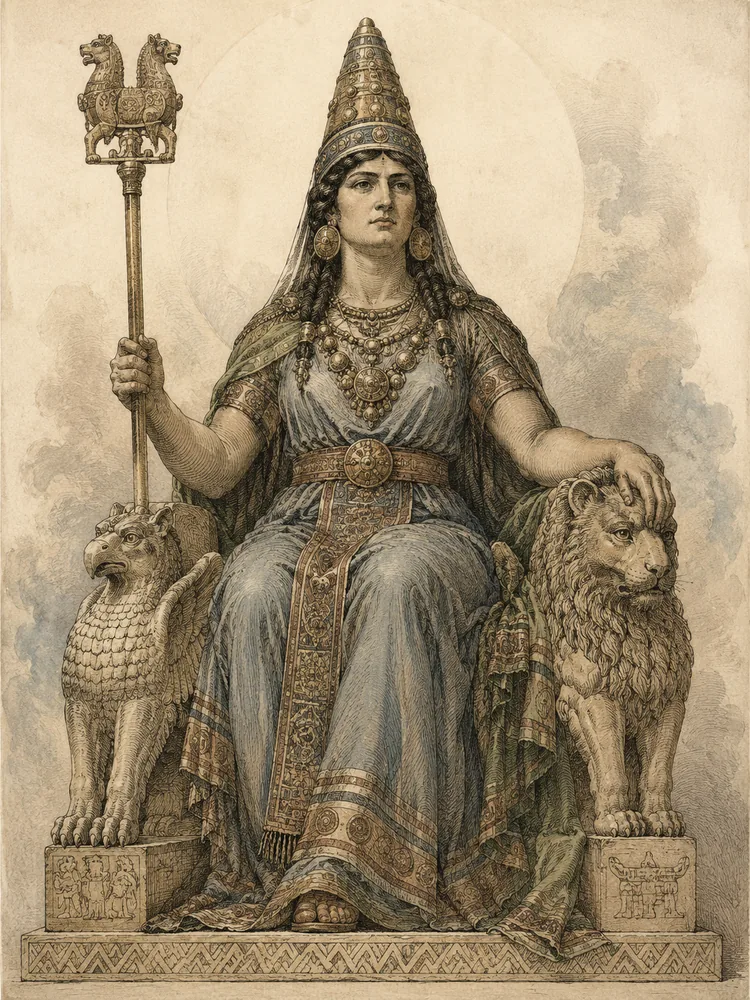
Hannahanna, plate

When the Hittite gods were perplexed — when Telepinu had vanished and the world's fertility had failed; when the divine order required wisdom that none of the active gods possessed — they turned, more often than not, to a goddess they called Hannahanna, "Grandmother." She was the matriarch of the divine family, an aged seated figure whose counsel was sought when the storm-gods and the warrior-gods were at their wits' end.

It was Hannahanna who, in the Telepinu myth, devised the means of finding the disappeared god. The other deities had searched and failed: the Sun-God's eagle had flown across the world and seen nothing, Tarhunt had stamped the heavens in his impatience, the lesser gods had sat down in despair. Hannahanna sent a bee. The bee, said the goddess, was small enough to find what the great searchers had missed; the bee should sting Telepinu in the foot when she found him, that he might wake from his angry sleep. The bee did so; Telepinu awoke; the world was restored to fruitfulness.

She was also a goddess of birth, and her cult included rituals of midwifery and childbirth-magic. The Hittites placed her, that is, at both ends of the female lifespan: she was the elder who knew, and the goddess who attends new arrivals into the world.
Curator’s note

What the sources say, and what later tradition added. The sources for this bay

Hannahanna's name is a reduplication of the Hittite word ḫanna, "grandmother"; she is a generic mother-goddess given quasi-personal name, somewhat as if a Greek text were to refer simply to "Mother-Mother." She figures prominently in the Telepinu Myth (CTH 324) and in the Disappearing-God texts more broadly, and in birth-rituals (CTH 489 and related). The bee-as-divine-messenger episode is distinctively Hittite; the search-by-small-creature for what large powers cannot find is a folkloric pattern with parallels in many traditions, but the Hittite instance is among the earliest preserved in writing.

Kin in the sources

Each tie is quoted from the entry that states it.

When the sources speak

Dated witnesses for Anatolia. A date marks when the evidence was written down, not when the belief began. The whole timeline

c. 3400–3000 BCE
Uruk-period writing and monumental temple economies create the earliest recoverable administrative setting for named divine institutions.
c. 2900–2350 BCE
Early Dynastic city-states preserve local cults, hymns, royal inscriptions, and god lists; later copies often transmit older compositions.
c. 2334–2154 BCE
The Akkadian Empire expands bilingual and imperial patterns of divine identification without erasing local cult titles.
c. 2112–2004 BCE
Ur III administration and scribal schooling standardize many Sumerian literary and liturgical forms.
c. 2000–1600 BCE
Old Babylonian schools copy major myths, laments, hymns, debates, and heroic narratives in the form most often used by modern editors.
c. 1650–1200 BCE
Hittite and Hurrian archives at Hattusa transmit Anatolian myths, imported Syrian materials, and ritual compositions.
c. 1400–1190 BCE
The tablets of Ugarit preserve the Baal Cycle, Kirta, Aqhat, ritual lists, and a dense Late Bronze Age West Semitic pantheon.
c. 1000–612 BCE
Neo-Assyrian and Neo-Babylonian empires collect, revise, and politically reinterpret older learned traditions.

Floor plan

The rooms follow one another in the order their peoples first appear in the written record.

  1. The Cradle of Citiesc. 3400 BCE to 395 CE. 115 works
  2. The Gift of the Nilec. 4000 BCE to 395 CE. 73 works
  3. The Olympian Orderc. 1600 BCE to 750 CE. 152 works
  4. The Persian Worldc. 2000 BCE to 1010 CE. 30 works
  5. The Levantine Borderlandsc. 1200 BCE to 500 CE. 20 works
  6. The Edges of Empirec. 2000 BCE to 1500 CE. 33 works
  7. The Etruscan Worldc. 900 BCE to 750 CE. 22 works
  8. The Roman Inheritancec. 1200 BCE to 500 CE. 58 works
  9. The Northern Inheritancec. 2000 BCE to 1600 CE. 131 works