A Compendium of the Ancient Gods
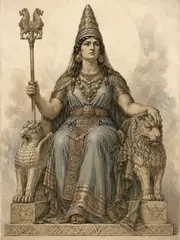
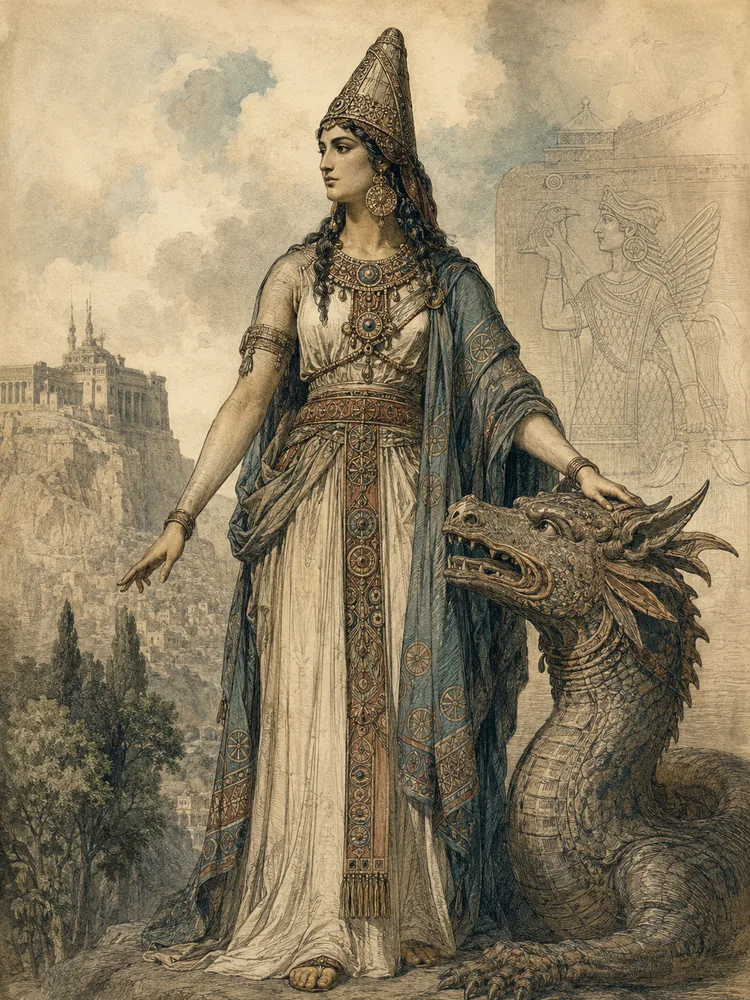
Inara, plate

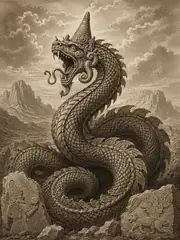
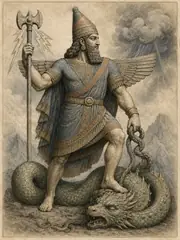
When the great dragon Illuyanka had defeated her father Tarhunt the storm-god and left him helpless, the goddess who took the work of victory upon herself was the storm-god's daughter Inara — a young, ingenious deity who solved the problem of the dragon not by direct combat but by stratagem.

Inara prepared a feast — vessels of beer and wine and every good thing — and stationed it in the place where the dragon was wont to come. She enlisted a mortal man, one Hupasiya, as her accomplice; she promised him certain rewards, and bound him by a singular condition: he must not look upon his wife and children once the affair was concluded. Hupasiya agreed. Illuyanka came to the feast; he and his many sons drank without restraint, until they were so heavy with wine that they could not return through the narrow door of their lair. Hupasiya bound them then with cords; Tarhunt came up, and slew the dragon and his children.

What followed was a curious affair, and one which Hittite religion did not soften. Inara built Hupasiya a fine house upon a cliff, set him there in comfort, and laid upon him the prohibition — he must not look down upon his family. Hupasiya endured the prohibition for some time; then he looked, and saw his wife and children below, and asked Inara to let him return. Inara, in anger at the broken promise, killed him. The mortal who had served the gods was made the gods' creature; their gifts and their angers were not, the Hittites understood, on a human scale.
Curator’s note

What the sources say, and what later tradition added. The sources for this bay

The Inara-Illuyanka narrative is preserved in two Hittite versions of the Illuyanka Myth (CTH 321), recited annually at the Purulli Festival, the Hittite New Year. The Old Hittite text gives the basic outline; a later version substitutes a mortal son of Tarhunt who marries the dragon's daughter and recovers his father's stolen heart and eyes. The episode of Hupasiya's execution for breaking a divine prohibition is among the more striking Hittite contributions to ancient narrative: it makes plain that the mortal who serves the gods does not thereby become safe from them. The cosmic-renewal context of the story — the Purulli festival celebrated the New Year as the annual victory over chaos — links this myth to a wide family of storm-god-defeats-dragon narratives across Indo-European tradition.

Kin in the sources

Each tie is quoted from the entry that states it.

When the sources speak

Dated witnesses for Anatolia. A date marks when the evidence was written down, not when the belief began. The whole timeline

c. 3400–3000 BCE
Uruk-period writing and monumental temple economies create the earliest recoverable administrative setting for named divine institutions.
c. 2900–2350 BCE
Early Dynastic city-states preserve local cults, hymns, royal inscriptions, and god lists; later copies often transmit older compositions.
c. 2334–2154 BCE
The Akkadian Empire expands bilingual and imperial patterns of divine identification without erasing local cult titles.
c. 2112–2004 BCE
Ur III administration and scribal schooling standardize many Sumerian literary and liturgical forms.
c. 2000–1600 BCE
Old Babylonian schools copy major myths, laments, hymns, debates, and heroic narratives in the form most often used by modern editors.
c. 1650–1200 BCE
Hittite and Hurrian archives at Hattusa transmit Anatolian myths, imported Syrian materials, and ritual compositions.
c. 1400–1190 BCE
The tablets of Ugarit preserve the Baal Cycle, Kirta, Aqhat, ritual lists, and a dense Late Bronze Age West Semitic pantheon.
c. 1000–612 BCE
Neo-Assyrian and Neo-Babylonian empires collect, revise, and politically reinterpret older learned traditions.

Floor plan

The rooms follow one another in the order their peoples first appear in the written record.

  1. The Cradle of Citiesc. 3400 BCE to 395 CE. 115 works
  2. The Gift of the Nilec. 4000 BCE to 395 CE. 73 works
  3. The Olympian Orderc. 1600 BCE to 750 CE. 152 works
  4. The Persian Worldc. 2000 BCE to 1010 CE. 30 works
  5. The Levantine Borderlandsc. 1200 BCE to 500 CE. 20 works
  6. The Edges of Empirec. 2000 BCE to 1500 CE. 33 works
  7. The Etruscan Worldc. 900 BCE to 750 CE. 22 works
  8. The Roman Inheritancec. 1200 BCE to 500 CE. 58 works
  9. The Northern Inheritancec. 2000 BCE to 1600 CE. 131 works