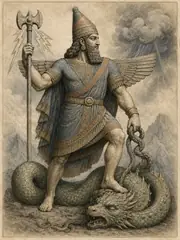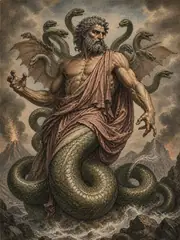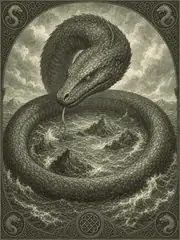
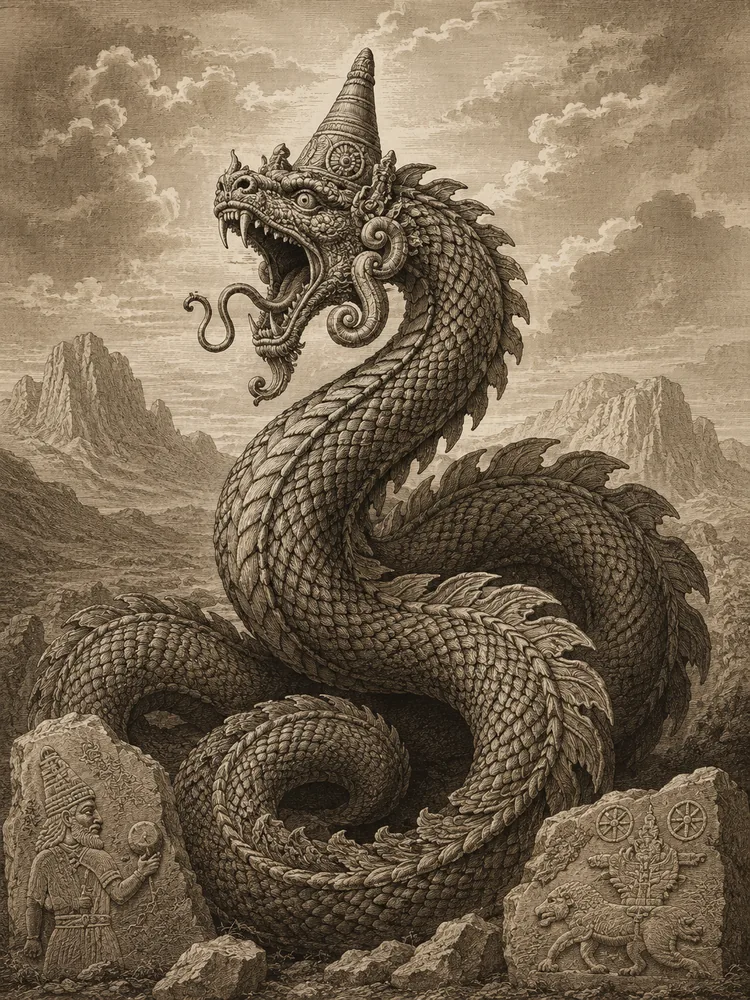
There existed, in the deep places of the world the Hittites knew, a serpent-monster whose coils could fill a valley and whose strength was greater, at least in the first encounter, than that of the storm-god himself. The Hittites called him Illuyanka — a name which is simply their word for "snake" raised to the dignity of a proper noun, as if to say: "The Snake."
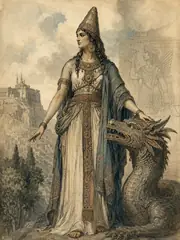
Two versions of his combat with Tarhunt are preserved. In the first, Tarhunt and Illuyanka met in battle and Tarhunt was defeated; the storm-god went weeping to the gods, and Inara his daughter contrived the feast-trap by which Illuyanka was bound and slain. In the second, Illuyanka caught Tarhunt in his coils and tore out the storm-god's heart and eyes. Tarhunt, recovering, fathered a son upon a mortal woman; the son was raised, came to manhood, and asked to marry the daughter of the dragon. The dragon, asked for his daughter's hand by this unknown suitor, demanded as bride-price the heart and eyes that Tarhunt's son must collect from his father's vanquisher. The youth retrieved the organs; his father was restored; and Tarhunt, in his second strength, killed Illuyanka. The youth, who had fulfilled his oath to his father-in-law by helping to retrieve the organs, was killed by his own request, declaring himself to be the dragon's son-in-law in death as in life.
The myth was recited annually at the Hittite Purulli Festival, the great spring rite of the New Year, when the dragon's yearly defeat by the storm-god was repeated in liturgy as an act of cosmic renewal. The order of the world, in Hittite religion, was not stable; it had to be re-won every year against an adversary who, defeated, would return.