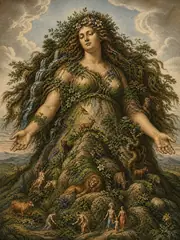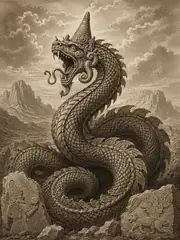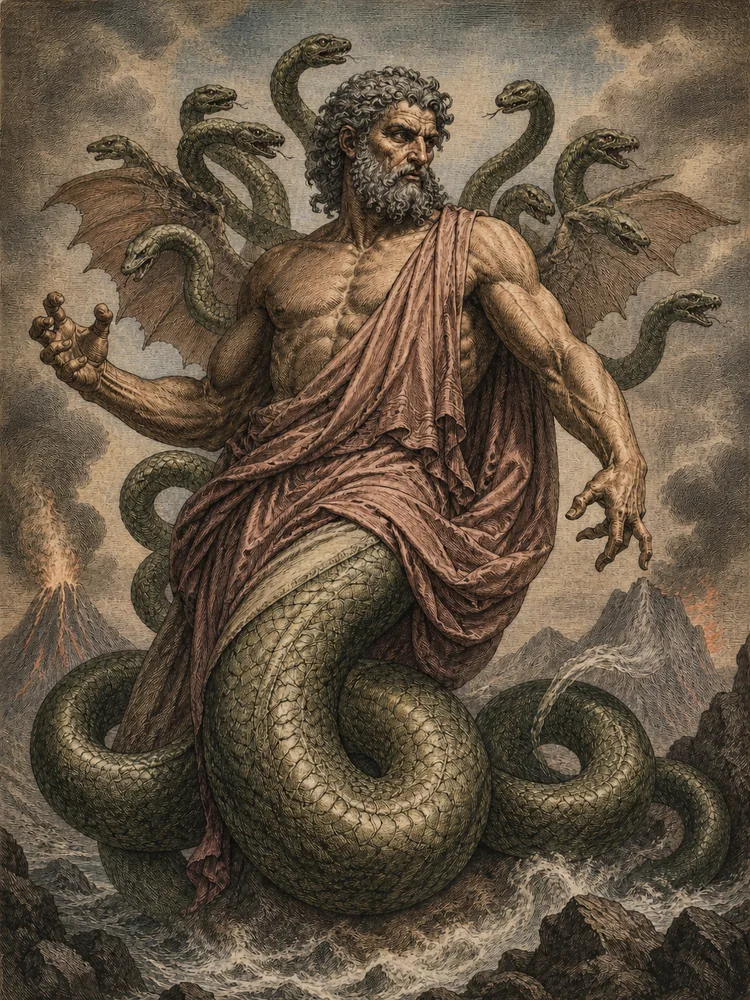
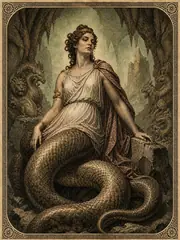
Typhon was the youngest and most terrible son of Gaia, begotten by her on Tartarus after the defeat of her elder children the Titans, that she might have an avenger against Zeus. He was a creature of cosmic scale and form: his head reached the stars; his arms extended from east to west; from his shoulders sprouted a hundred dragon-heads, each of which spoke with a different voice (sometimes the voices of gods, sometimes of bulls and lions and snakes); from his thighs to his feet he was coiling serpents; flame shot from his eyes; his roaring was such that mountains shook and the waves of the sea rose up.
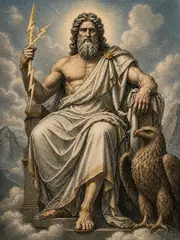
When he attacked Olympus, the gods at first fled in terror — most of them, in the Egyptian-influenced version of the myth preserved by Apollodorus, fleeing into Egypt and there hiding in the forms of various animals (and so, in this version, originating the animal-headed gods of the Egyptian pantheon, a piece of Greek anti-Egyptian mythography that should not be taken at face value). Zeus alone, with the help of Athena, stood his ground. The battle was titanic in scope: thunderbolts hurled at distances; the sea boiled; the earth was scorched; mountains were uprooted. At one stage Typhon caught Zeus, cut out the sinews of his hands and feet, and hid them in a cave on Mount Casius in Cilicia, leaving Zeus helpless in the cave under the guard of the dragoness Delphyne; Hermes and the goat-god Aegipan recovered the sinews and reattached them to Zeus, who renewed the battle. At length Zeus prevailed, hurling Typhon down with a great barrage of thunderbolts and crushing him under the bulk of Mount Etna in Sicily — which volcano's eruptions are, in the Greek imagination, Typhon's continuing struggles beneath the burden, his fiery breath escaping through the crater. The defeat of Typhon was the final establishment of Zeus's cosmic order; with it, the war of generations was at last complete.