A Compendium of the Ancient Gods
Set, plate

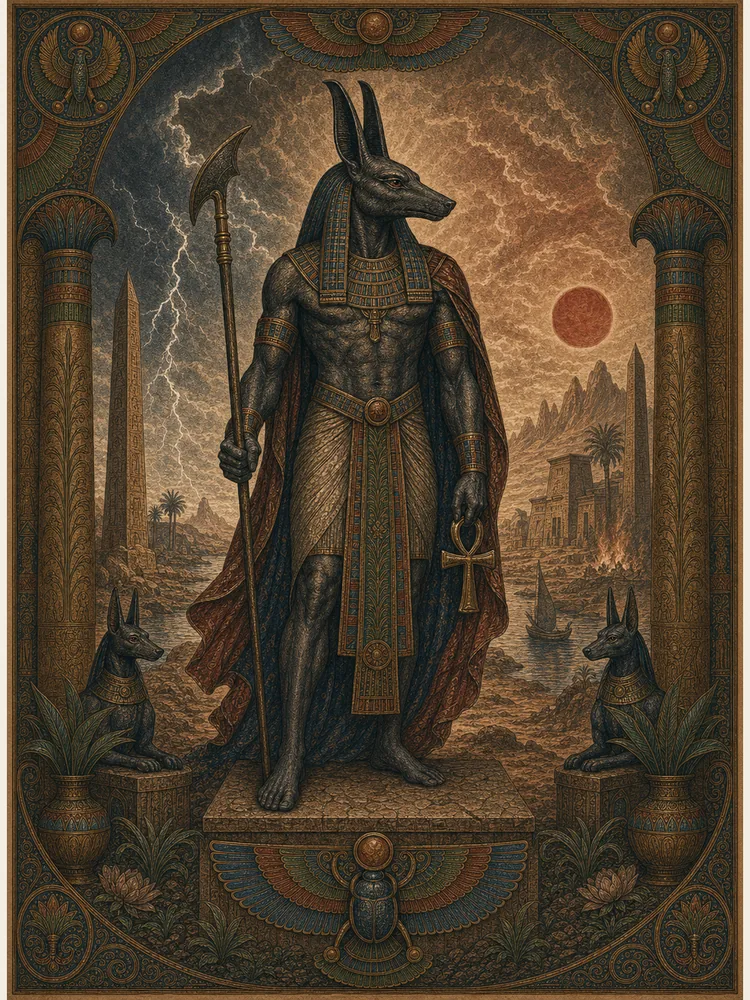
Set was the brother of Osiris and Isis, the husband of Nephthys, and the great antagonist of the Osirian myth. He was the god of the desert, of the hot wind, of foreign lands, of disorder and strife; his sacred animal was a strange composite creature — long-snouted, square-eared, forked-tailed — that has no certain modern identification, and is generally called by Egyptologists simply "the Set animal." He was depicted as a man with the head of this animal, or sometimes wholly as the creature itself.

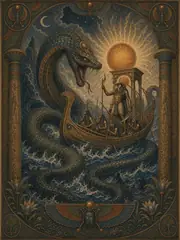
The murder of Osiris and the conflict with Horus (told in their entries) make him the principal villain of Egyptian mythology. But the Egyptian theological position on Set was more complex than simple villainy. He was, on the one hand, the rebel and fratricide; on the other, he was the indispensable defender of the solar barque against the great serpent Apep, who alone among the gods could stand in the prow each night and beat back the chaos-serpent with his spear. Without Set, the sun would not rise. The Egyptians thus held him in a peculiar double esteem — necessary, even revered in some periods (the Hyksos invaders made him their patron, and the Ramesside pharaohs of the Nineteenth and Twentieth Dynasties bore his name in royal protocols: Seti I and Seti II were named for him), but also feared and, in late periods, vilified.

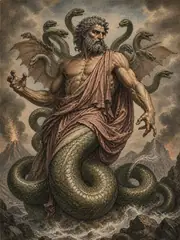
By the Late Period, the negative view came to dominate. The Persian invasions, the Greek and Roman ascendancies, and the increasing identification of foreign rule with Set's domain of foreign lands progressively darkened his mythology, and by the time of Plutarch he was straightforwardly the principle of evil — "the Egyptian Typhon," Plutarch calls him, identifying him with the Greek monster of disorder. His statues were defaced; his name was erased from older inscriptions; his cult, formerly substantial in the eastern Delta and at Ombos in Upper Egypt, dwindled to a few remote outposts. The trajectory by which a god honored as a defender becomes, over centuries, the embodiment of cosmic evil is one of the more illuminating cases in the history of religion.
Curator’s note

What the sources say, and what later tradition added. The sources for this bay

Set's mythology is preserved across the same range of sources as the rest of the Osirian cycle. The Set animal — Egyptian sha — has been variously identified by modern zoologists as an aardvark, a hartebeest, a fennec fox, an okapi, an oryx, a giraffe, an extinct species, or an entirely composite mythological beast; no consensus has been reached, and the most cautious view is that it is a deliberate hybrid. Set's two principal cult-cities were Ombos (Naqada) in Upper Egypt and Avaris in the eastern Delta; the latter was the capital of the Hyksos rulers of the Second Intermediate Period, who made Set their state god in identification with their own Levantine storm-god, possibly Baal or Resheph. The Ramesside pharaohs, themselves perhaps of Delta origin, were the last great royal patrons of Set's cult; after them his fortunes declined steadily.

Kin in the sources

Each tie is quoted from the entry that states it.

The same god in other rooms

The ancient sources themselves name these as one god under different names. See Set and Typhon hung together

When the sources speak

Dated witnesses for The Osirian Cycle. A date marks when the evidence was written down, not when the belief began. The whole timeline

c. 4000–3100 BCE
Predynastic regional symbols, burials, standards, and animal cults provide the deep background to later divine iconography.
c. 3100–2686 BCE
Early Dynastic kingship joins royal ideology to local cult centers and establishes many durable divine emblems.
c. 2686–2181 BCE
Old Kingdom pyramid complexes and the Pyramid Texts preserve the earliest large religious corpus.
c. 2181–1650 BCE
First Intermediate and Middle Kingdom traditions broaden mortuary access; Coffin Texts develop older royal materials.
c. 1550–1070 BCE
New Kingdom temple wealth, royal hymns, underworld books, and the Book of Going Forth by Day greatly expand the record.
c. 1353–1336 BCE
Akhenaten’s Aten program reorganizes royal cult but does not permanently erase the older divine plurality.
c. 1070–664 BCE
Third Intermediate Period priestly and regional powers reshape cult administration and divine kingship.
664–332 BCE
Late Period archaism, animal cults, and temple scholarship preserve and reinterpret older forms.

Floor plan

The rooms follow one another in the order their peoples first appear in the written record.

  1. The Cradle of Citiesc. 3400 BCE to 395 CE. 115 works
  2. The Gift of the Nilec. 4000 BCE to 395 CE. 73 works
  3. The Olympian Orderc. 1600 BCE to 750 CE. 152 works
  4. The Persian Worldc. 2000 BCE to 1010 CE. 30 works
  5. The Levantine Borderlandsc. 1200 BCE to 500 CE. 20 works
  6. The Edges of Empirec. 2000 BCE to 1500 CE. 33 works
  7. The Etruscan Worldc. 900 BCE to 750 CE. 22 works
  8. The Roman Inheritancec. 1200 BCE to 500 CE. 58 works
  9. The Northern Inheritancec. 2000 BCE to 1600 CE. 131 works