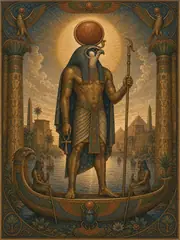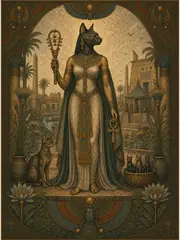
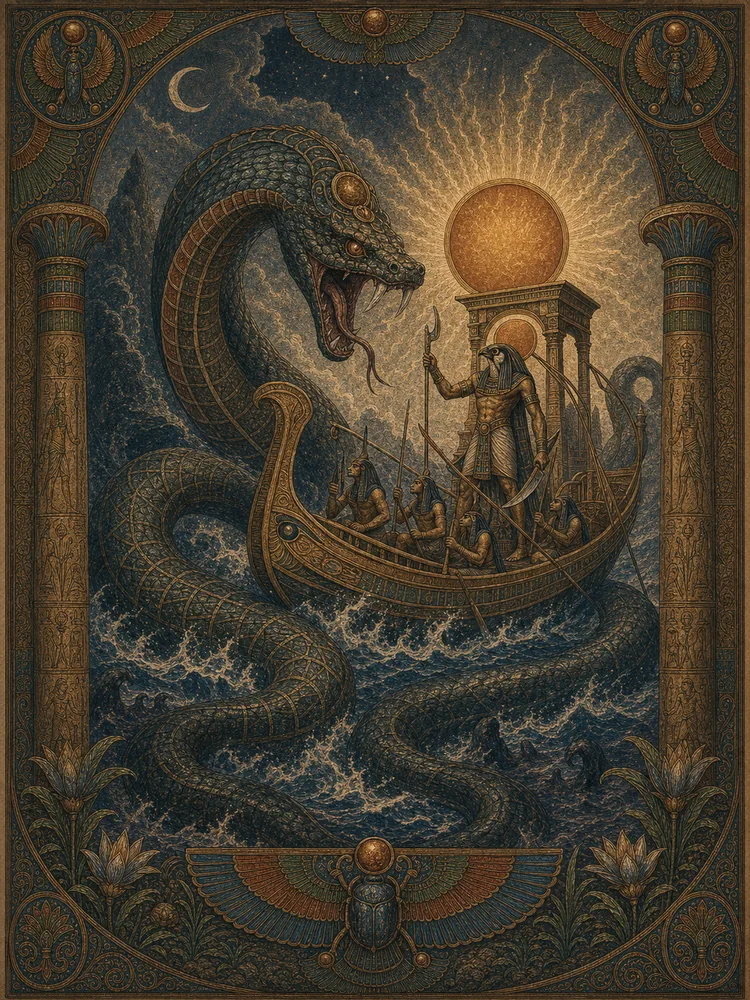
Apep — whom the Greeks called Apophis — was the great serpent of chaos, the eternal adversary of the sun in his nightly journey through the underworld. He was older than the gods, the surviving residue of the formless Nun within the ordered creation, and his sole purpose was the unmaking of order. Each night, as Ra's barque traveled the twelve hours of the underworld, Apep lay in wait at the deep bend of the seventh hour, his coils filling the channel; and the gods of Ra's crew — Set foremost among them, with his long iron spear, but also Bastet and the assembled lesser deities — attacked him with spells and with weapons, that the sun might pass and rise again upon the eastern horizon. Apep was wounded but never destroyed; for he was not, properly, a being but a principle, and could not be ended without ending the world that defined itself against him.
The Egyptian state took the daily defeat of Apep as a serious religious obligation. In the temples, particularly in the Late Period, daily and nightly rituals were performed against him: his image was drawn upon papyrus, named with his name, spat upon, trampled, dismembered, and burned, while priests recited the great Book of Overthrowing Apep — a long magical text preserved in the Bremner-Rhind Papyrus — that recounted his many forms, named his many parts, and pronounced curses upon each. The doctrine was that the proper performance of these rites assisted Ra in his nightly battle, and that the cosmos itself was sustained, in part, by the daily ritual labor of the priesthood.