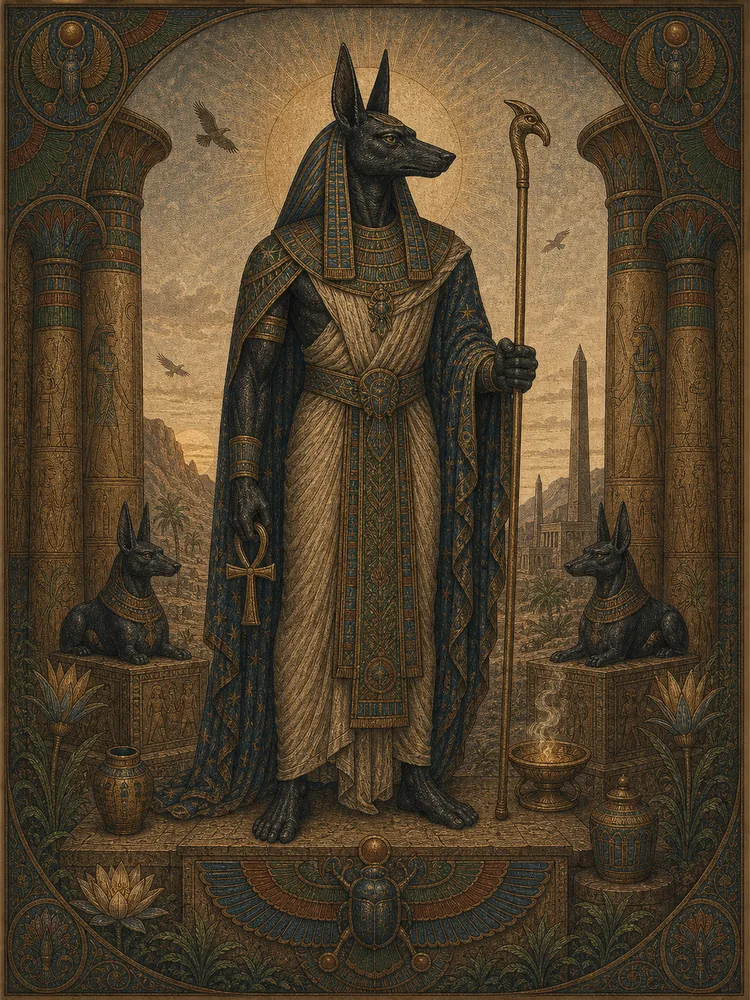
Khentamentiu — "Foremost of the Westerners," the West being the land of the dead — was an older funerary god of Abydos, in Upper Egypt, who in the deepest archaeological strata of that site stood as the principal divinity of the necropolis. He was depicted as a jackal couchant, or as a man with a jackal's head, very much like Anubis; and his title was a description of his office. As the cult of Osiris rose to dominance during the Old Kingdom and Osiris was identified with the Lord of Abydos, Khentamentiu was progressively absorbed: by the Middle Kingdom, his name had become an epithet of Osiris (Osiris Khentamentiu, "Osiris Foremost of the Westerners"), and his independent identity had largely dissolved. The temple of Khentamentiu at Abydos became the temple of Osiris at Abydos, and the great Mysteries of Osiris that were celebrated there each year carried forward, in transformed form, the older rites that had been Khentamentiu's.
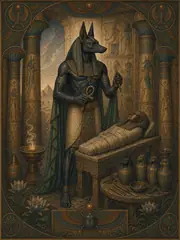 Before thisAnubis
 Next on the wallApep
Curator’s note
What the sources say, and what later tradition added. The sources for this bay
Khentamentiu's progressive absorption into Osiris is one of the clearer cases of theological succession in Egyptian religion, and the case has been carefully reconstructed by archaeologists working at Abydos. He represents an earlier stratum of the Egyptian funerary imagination, in which the lord of the dead was canine rather than mummiform, and in which the distinctive Osirian narrative of murder, recovery, and judgment had not yet been articulated. His near-disappearance from the historical record by the New Kingdom was nearly complete; by the Late Period, the name Khentamentiu functions almost exclusively as one of Osiris's many epithets.
Kin in the sources
Each tie is quoted from the entry that states it.
 Merged intoOsiris
by the Middle Kingdom, his name had become an epithet of Osiris
When the sources speak
Dated witnesses for The Osirian Cycle. A date marks when the evidence was written down, not when the belief began. The whole timeline
- c. 4000–3100 BCE
- Predynastic regional symbols, burials, standards, and animal cults provide the deep background to later divine iconography.
- c. 3100–2686 BCE
- Early Dynastic kingship joins royal ideology to local cult centers and establishes many durable divine emblems.
- c. 2686–2181 BCE
- Old Kingdom pyramid complexes and the Pyramid Texts preserve the earliest large religious corpus.
- c. 2181–1650 BCE
- First Intermediate and Middle Kingdom traditions broaden mortuary access; Coffin Texts develop older royal materials.
- c. 1550–1070 BCE
- New Kingdom temple wealth, royal hymns, underworld books, and the Book of Going Forth by Day greatly expand the record.
- c. 1353–1336 BCE
- Akhenaten’s Aten program reorganizes royal cult but does not permanently erase the older divine plurality.
- c. 1070–664 BCE
- Third Intermediate Period priestly and regional powers reshape cult administration and divine kingship.
- 664–332 BCE
- Late Period archaism, animal cults, and temple scholarship preserve and reinterpret older forms.