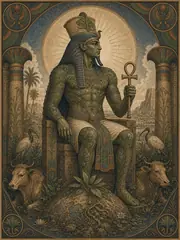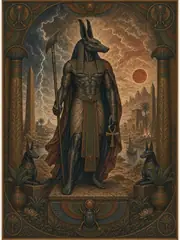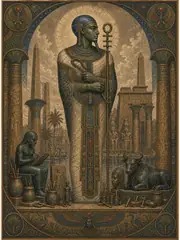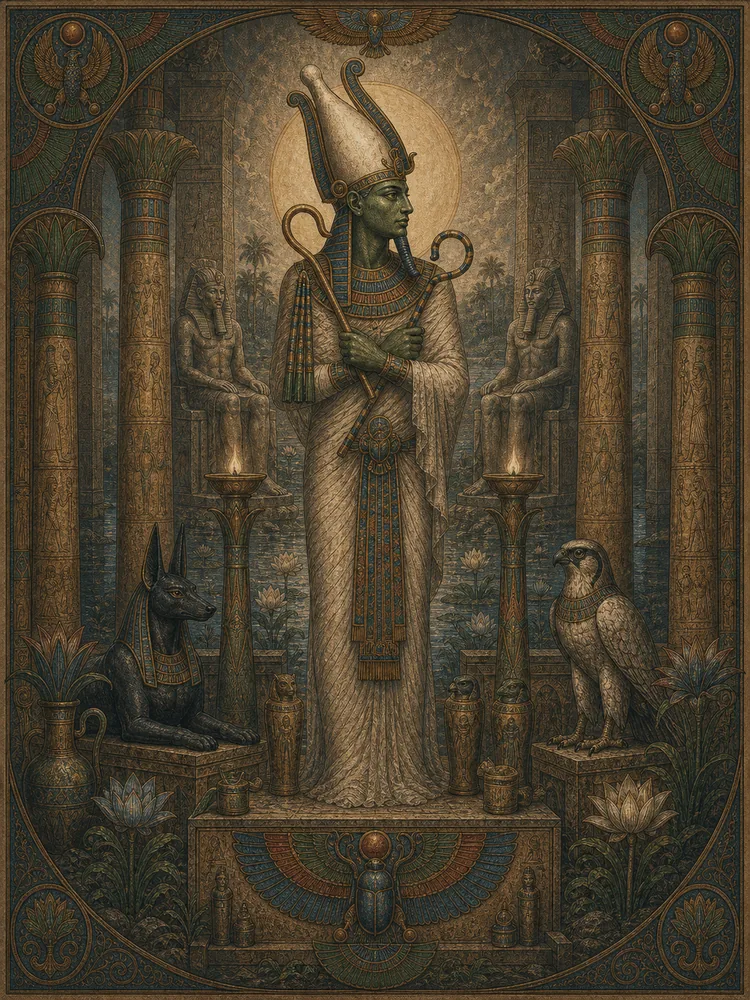
Osiris was the eldest son of Geb the earth and Nut the sky, born on the first of the five extra days that Thoth had won from the moon. He was the eldest of his generation, the rightful heir to the throne of Egypt, and in his youth, before any of the events that gave him his later character, he was the king of the land — Egypt's first civilizing monarch, who taught his people agriculture, gave them laws, and traveled abroad to bring the same gifts to other nations. His sister Isis was his wife and his trusted minister, and the kingdom flourished.
But Osiris had a younger brother, Set, who hated him for his eminence and coveted the throne. Set conspired with seventy-two accomplices, and prepared a sumptuous chest, exactly the measure of Osiris's body, and at a feast he offered the chest as a gift to whichever guest could fit himself within it. Each guest tried, and none fit; but Osiris, when his turn came, lay down within it, and the chest fitted him perfectly. At a signal, the conspirators slammed shut the lid, sealed it with molten lead, and threw the chest into the Nile. It floated downstream and out into the sea, and was carried by the currents to the coast of Phoenicia, where it lodged in the trunk of a tamarisk tree growing by the shore. The tree grew prodigiously around the chest, enclosing it, until the king of Byblos cut down the tree to make a pillar for his palace; and so the body of Osiris was hidden within the pillar of the king's hall.
Isis, learning of her husband's death, cut her hair and rent her garments and went forth in mourning to seek him. By the testimony of children, by the sniffing of dogs, by the wisdom that magic gave her, she traced the chest at last to Byblos. There she took service in the palace, anonymously, as nurse to the queen's child; and she nursed the child upon her finger, and at night, when the palace was silent, she would place him in the fire to burn away his mortality, while she herself, transformed into a swallow, flew round the pillar that held her husband, lamenting. The queen one night discovered her, snatched the child from the fire, and in the discovery the goddess revealed her identity. Isis was given the pillar; she split it open, recovered the chest with the body within it, and returned to Egypt.
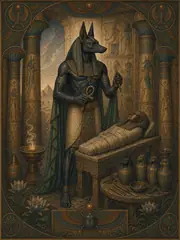
She concealed the body in the marshes of the Delta and went to her sister Nephthys, that the two of them might prepare the rites of mourning. But Set, hunting by night, came upon the body where she had hidden it, and in his fury hacked it into fourteen pieces, and scattered them through the length of Egypt. Then Isis, with Nephthys her sister and Anubis her son, set out a second time, and traveled the whole land, gathering up the pieces. Wherever a piece was found, she built a shrine and gave it burial — for which reason, the priesthoods of fourteen Egyptian cities each claimed to possess Osiris's tomb. Of the fourteen pieces, thirteen were recovered; the fourteenth, the phallus, had been swallowed by the fish of the Nile, and could not be found. Isis fashioned a substitute of gold or wood (the sources differ) and reassembled the body; and she breathed her own breath into it, and it lived again — but in a body fit only for the underworld, not for the living world above. So Osiris descended, and became thereafter the king of the dead and the judge of souls.
But before he descended — or so Isis's posthumous magic contrived — she had made love to him in the form of a kite, hovering over his recovered body, and had conceived a son. This son she bore in secret, in the marshes of Khemmis in the Delta, and named him Horus; and she raised him there hidden, that Set might not find him before he was grown. The story of Horus belongs in his own entry below.
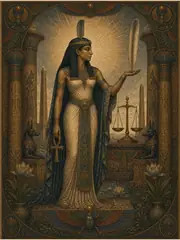
And Osiris, lord of the dead, sat thereafter upon his throne in the Hall of Two Truths in the underworld, and judged the souls of men. The dead came before him, escorted by Anubis, and Anubis led them to the great scale, upon one pan of which the heart of the dead was placed, and upon the other the feather of Maat, the feather of truth. If the heart was light — if it had not, in the life of the man, been weighed down with falsehood and oppression — the heart and the feather balanced, and the dead was admitted into the company of Osiris and granted the eternity of the Field of Reeds. But if the heart was heavy with sin, it sank in the scale, and was thrown to Ammit, the Devouress, the monster who waited beside the scale with the head of a crocodile, the forequarters of a lion, and the hindquarters of a hippopotamus; and Ammit ate it, and the soul of the dead was annihilated. So the doctrine of judgment was given to the Egyptians, and they lived their lives accordingly: the maxim of every wisdom-text was that the wise man would so order his conduct that his heart, when it came at last to the scale, should not weigh it down.