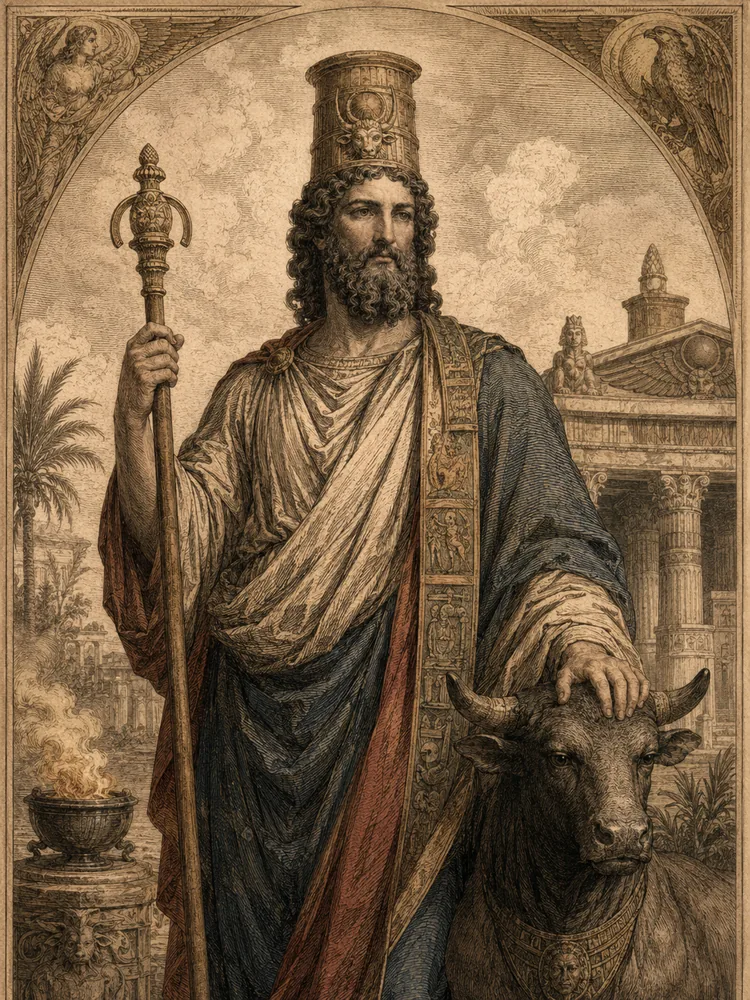
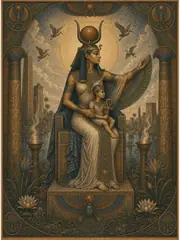
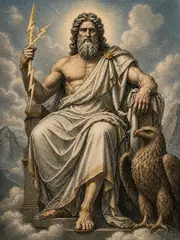
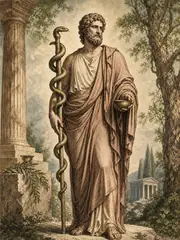
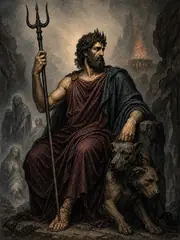
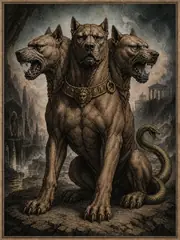
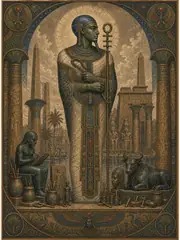
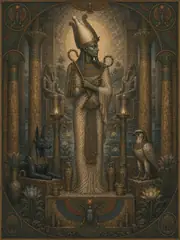
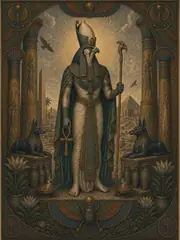
Serapis was a Hellenistic deity created (or codified, depending on one's view of the historical evidence) by Ptolemy I Soter (305–282 BCE) for the new capital city of Alexandria, as a unifying god for the mixed Greek-Egyptian-and-other population of the new Hellenistic foundation. His Egyptian dimension came from Osiris-Apis (Asar-Hapi, the dead Apis bull identified with Osiris in his underworld aspect — treated in Volume II under Apis), whence his name. His Greek dimension was supplied by his iconography: a bearded Greek god in the manner of Zeus or Asclepius or Hades, seated on a throne, accompanied by Cerberus, with a modius (grain-measure) on his head signaling his fertility-and-underworld functions. The theological synthesis was deliberate; the cult promoted the worship of Serapis alongside Isis (his counterpart, treated in Volume II) as the patrons of the Ptolemaic state.
From Egypt the cult spread across the eastern Mediterranean and eventually to Rome and the western provinces, particularly during the first three centuries of our era, when Egyptian religious imports were widely popular. The great Serapeum at Alexandria, with its monumental statue of the god (variously attributed to Bryaxis or to other sculptors), was reckoned one of the architectural wonders of the late ancient world; it was destroyed in 391 CE by a Christian mob under the patriarch Theophilus, an event of considerable cultural significance and one of the most dramatic moments of the late-pagan/early-Christian transition. Serapeae also stood at Rome (in the Campus Martius), at Pozzuoli, at Carthage, and at many other major cities of the empire. The cult declined with the rest of late paganism; Serapis was not, in the end, the universal god the Ptolemies had hoped he might become.
Curator’s note
What the sources say, and what later tradition added. The sources for this bay
The principal ancient source for Serapis's establishment is Plutarch, De Iside et Osiride 28 (giving the tale of Ptolemy's vision and the importation of a statue from Sinope, a tale that may be more aetiological than historical); Tacitus, Histories 4.83–84 (a similar account); Clement of Alexandria, Protrepticus 4.42 (Christian polemical treatment). The destruction of the Alexandrian Serapeum in 391 CE is described by Rufinus, Historia Ecclesiastica 11.22, and by Socrates Scholasticus, Historia Ecclesiastica 5.16. Modern scholarship: see L. Vidman, Sylloge Inscriptionum Religionis Isiacae et Sarapiacae (1969); the historiography of the cult's foundation is complex, with some scholars (e.g., John Stambaugh) arguing for genuine Ptolemaic theological invention and others (Paul Veyne and others) preferring a model of Greek-Egyptian synthesis with deeper roots. For Serapis's relationship to the Apis-bull tradition, see the entry on Apis in Volume II.
When the sources speak
Dated witnesses for The Deified Virtues and the Imperial Mystery Cults. A date marks when the evidence was written down, not when the belief began. The whole timeline
- c. 1000–750 BCE
- Iron Age communities of Latium and neighboring peoples develop the cult landscapes later absorbed into Roman tradition.
- traditional 753 BCE
- Roman foundation chronology places Romulus and the first civic institutions at the beginning of the city’s sacred history.
- traditional 7th–6th centuries BCE
- The regal period is credited with priesthoods, calendars, temples, and the organization of public rites.
- 509–264 BCE
- Republican expansion incorporates Latin, Sabine, Etruscan, and Italian cults through treaty, migration, and evocatio.
- 264–146 BCE
- Mediterranean conquest accelerates Greek interpretation and the importation or redefinition of foreign gods.
- 204 BCE
- The Magna Mater is formally brought from Pessinus during the Second Punic War.
- 1st century BCE
- Varro, Cicero, and other antiquarians document rites and divine names amid civil war and institutional change.
- 27 BCE–14 CE
- Augustan restoration monumentalizes selected ancestral cults and rewrites Roman sacred history.