A Compendium of the Ancient Gods
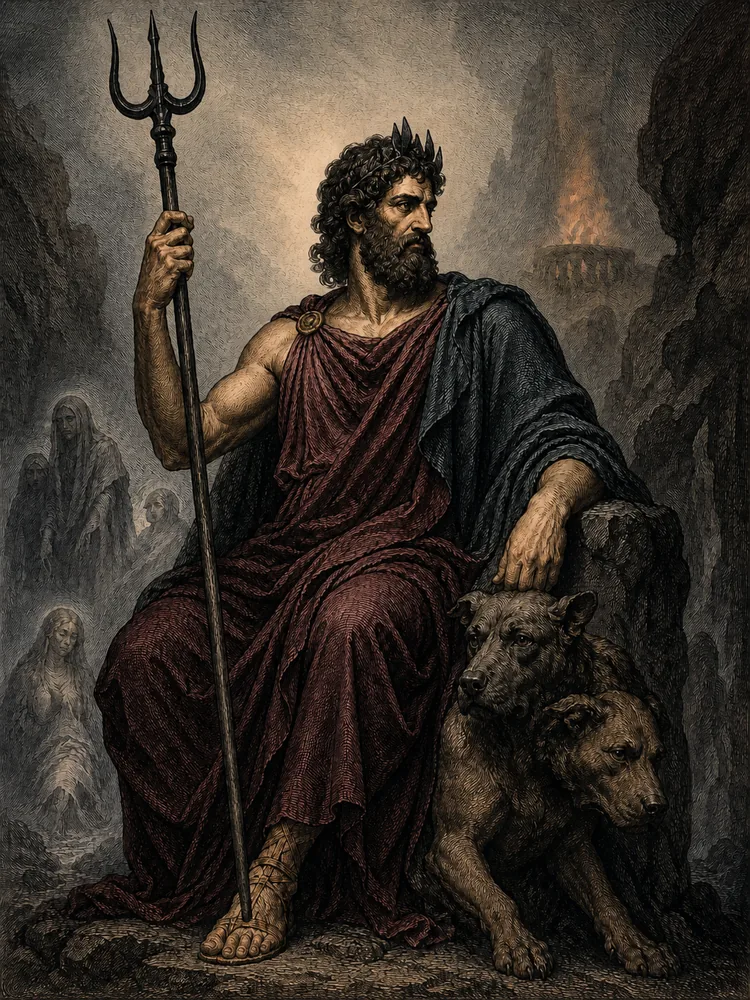
Hades, plate

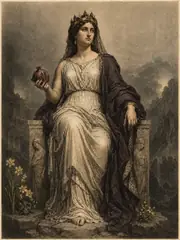
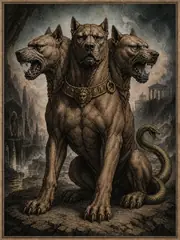
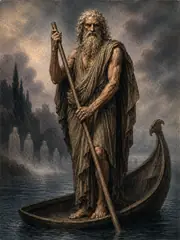
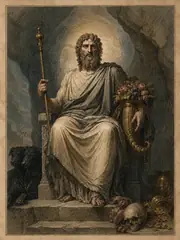
Hades was the lord of the dead and the king of the underworld — the realm that bore his name, into which the souls of all mortals descended at death. He was a son of Cronus and Rhea, brother of Zeus and Poseidon; in the lottery after the Titanomachy he drew the underworld, while Zeus took the sky and Poseidon the sea, and the earth's surface was held in common. He dwelt in a great palace in the underworld, with his queen Persephone (whom he had abducted from her mother Demeter, as told in her entry); he was attended by the three-headed dog Cerberus at the gates of his realm, by Charon the ferryman of the river Styx, and by various judges of the dead. His realm contained the various distinguished places of mythological geography: the Asphodel Meadows where most souls drifted indistinguishably; the Elysian Fields where the favored heroes enjoyed a happy afterlife; Tartarus far below, where the great sinners (Tantalus, Sisyphus, Ixion) were eternally punished and where the defeated Titans were imprisoned.

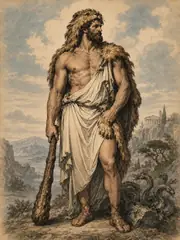
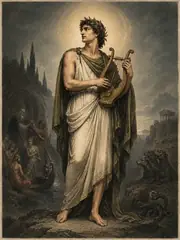
Hades's narrative role is limited compared with his brothers'. He is not a frequent character in the great mythological cycles, partly because his realm was dreaded and partly because he was generally held to be implacable and inflexible — once the dead came to him, he did not release them. The great exceptions were Heracles, who descended to fetch Cerberus and was permitted to do so; Orpheus, who descended to fetch his Eurydice, charmed Hades with his music, was granted her release on condition that he not look back, and lost her by his backward glance; and Theseus and Pirithous, who descended to abduct Persephone, were trapped on the chairs of forgetfulness and rescued only by Heracles (Theseus) or never (Pirithous). The Greeks were reluctant to name Hades — calling the dead the place of forgetting — for fear of attracting his attention; the euphemism Plouton ("the wealthy"), referring to the wealth of the earth from which all mortal goods came, was widely used and gave Latin the name Pluto by which the god is more commonly known in Western tradition.
Curator’s note

What the sources say, and what later tradition added. The sources for this bay

Homer, Iliad 15.187–193 (the lottery), Odyssey 11 (Odysseus's visit to the borders of Hades' realm); Hesiod, Theogony 455, 768–774; Apollodorus 1.5.1, 2.5.12 (the Heracles descent). The geography of Hades is given most fully in Plato's Phaedo and in the Aeneid Book 6. The euphemism Plouton (Pluto) was the name preferred in cult, both because of avoidance of the dread name and because the god of the underworld was also the god of buried wealth — the rich seams of metals beneath the earth being his property. The conflation with Plutus (god of wealth, son of Demeter and Iasion) is technically wrong but was already in progress by the fifth century BCE.

Kin in the sources

Each tie is quoted from the entry that states it.

The same god in other rooms

The ancient sources themselves name these as one god under different names. See Hades, Aita and Dis Pater hung together

When the sources speak

Dated witnesses for Hades and the Lesser Olympians. A date marks when the evidence was written down, not when the belief began. The whole timeline

c. 1600–1100 BCE
Mycenaean palace tablets in Linear B record offerings and divine names, but little continuous myth.
c. 1100–800 BCE
Post-palatial oral traditions and changing cult landscapes precede the surviving alphabetic epics.
late 8th–7th centuries BCE
The Iliad, Odyssey, Hesiodic Theogony and Works and Days give influential but non-exclusive divine orders.
7th–6th centuries BCE
Homeric Hymns, lyric poetry, colonization, and local sanctuary traditions multiply regional narratives.
6th–5th centuries BCE
Orphic, Pythagorean, and mystery materials develop alternative cosmogonies and afterlife doctrines.
5th century BCE
Athenian tragedy and comedy recast heroic houses and divine justice for civic audiences.
4th century BCE
Philosophers, antiquarians, and local historians interpret or criticize inherited myth.
323–31 BCE
Hellenistic poets and scholars systematize variants across an enlarged Greek world.

Floor plan

The rooms follow one another in the order their peoples first appear in the written record.

  1. The Cradle of Citiesc. 3400 BCE to 395 CE. 115 works
  2. The Gift of the Nilec. 4000 BCE to 395 CE. 73 works
  3. The Olympian Orderc. 1600 BCE to 750 CE. 152 works
  4. The Persian Worldc. 2000 BCE to 1010 CE. 30 works
  5. The Levantine Borderlandsc. 1200 BCE to 500 CE. 20 works
  6. The Edges of Empirec. 2000 BCE to 1500 CE. 33 works
  7. The Etruscan Worldc. 900 BCE to 750 CE. 22 works
  8. The Roman Inheritancec. 1200 BCE to 500 CE. 58 works
  9. The Northern Inheritancec. 2000 BCE to 1600 CE. 131 works