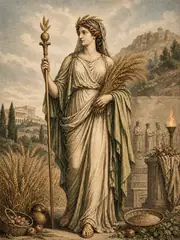
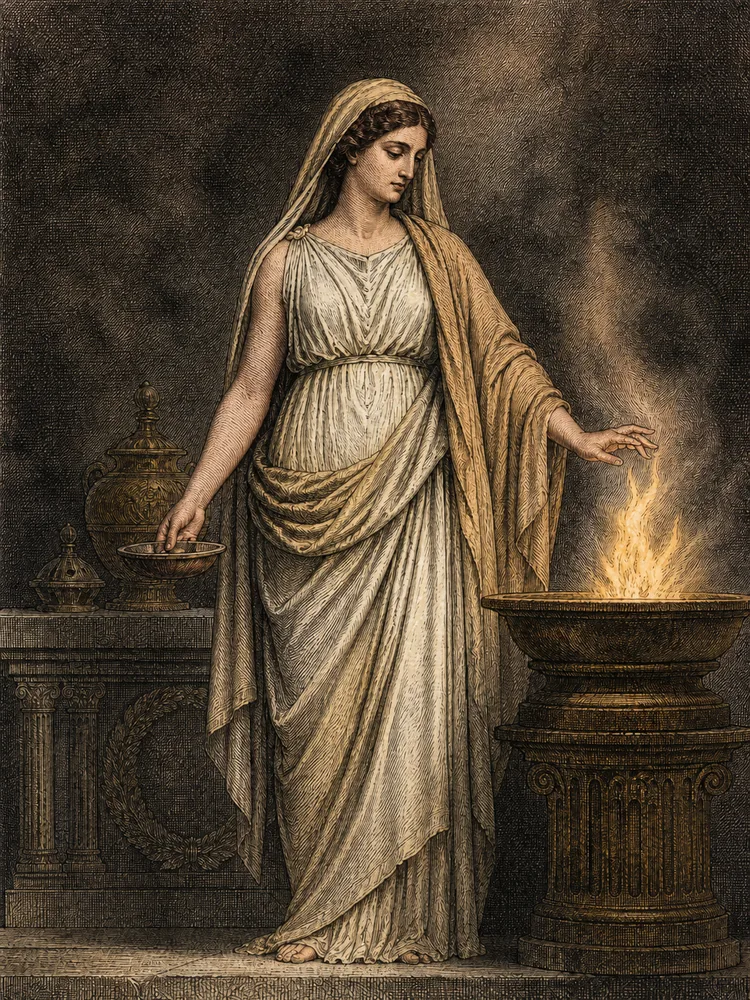

Hestia was the goddess of the hearth — of the central fire of every home, of every temple, of every city. She was the eldest of the children of Cronus and Rhea, the first to be swallowed and the last to be disgorged when Cronus brought up the swallowed siblings; she received from Zeus the privilege of receiving the first portion of every household sacrifice, and her fire burned in the central hearth of every Greek home and at the public hearth of every Greek city, where it was kept perpetually alight as the common flame from which household fires could be re-lit if they failed. She vowed perpetual virginity, refusing both Apollo and Poseidon when they courted her, and was thereafter exempt from the entanglements of love and marriage that occupied the other goddesses.
She had little extended narrative; her dignity was that of the constant, the central, the unmoving. Her cult was, in its way, the most universal of any Greek god's: every household, every city, had her flame. But she was not the subject of great temples or famous statues; she was the goddess of the hearth that one had at home, not of the temple to which one made pilgrimage. In some later canonical lists of the twelve Olympians, Dionysus replaces her — perhaps because her lack of narrative made her seem dispensable to the systematizers, perhaps because Dionysus's later importance demanded inclusion. But in the older tradition Hestia was firmly among the twelve, and her quiet centrality was honored.