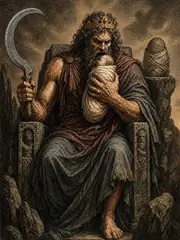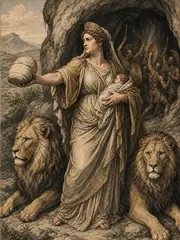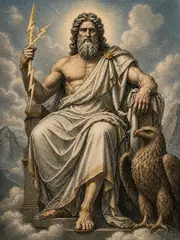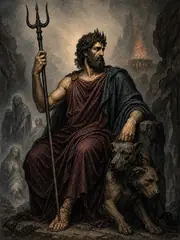
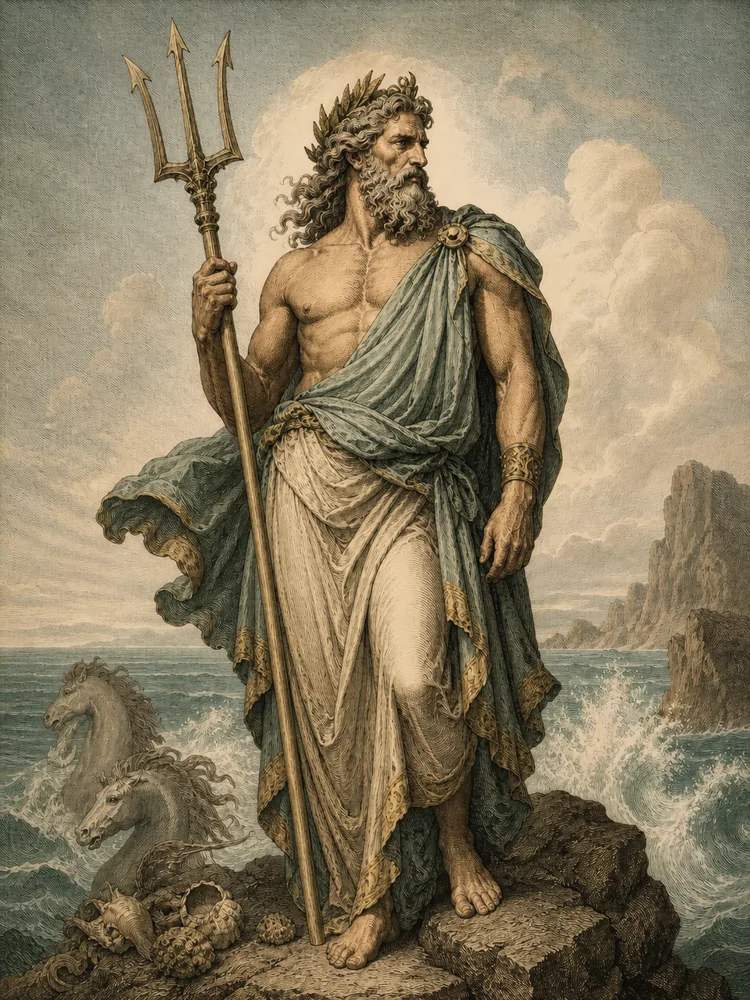
Poseidon was the god of the sea, of horses, and of earthquakes — three offices that the Greeks held to be related, the sea-god being also the god whose movement made the earth tremble, and the horse being his sacred animal because it was as swift and as untameable in its element as he was in his. He was a son of Cronus and Rhea, brother of Zeus and Hades; in the lottery after the Titanomachy he drew the sea, while Zeus drew the sky and Hades the underworld. He dwelt in a golden palace beneath the waters, drove a chariot drawn by hippocampi (sea-horses with the foreparts of horses and the tails of fish) across the surface, and carried the trident — a three-pronged spear with which he could split rocks, raise storms, and shake the earth.
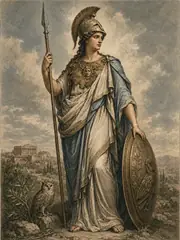
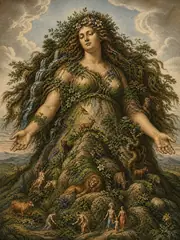
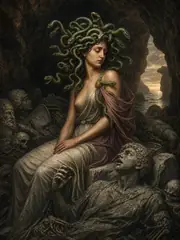
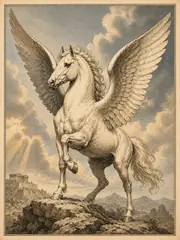
His narrative roles were various. He was a frequent antagonist in the Odyssey, where his pursuit of Odysseus (in vengeance for the blinding of his son the Cyclops Polyphemus) extended the hero's wanderings to ten years. He contended with Athena for the patronage of Athens — striking the Acropolis with his trident to produce a saltwater spring, while Athena produced the olive tree, the council of the Olympians awarding the city to Athena because her gift was more useful — but he retained considerable cult on the Acropolis nonetheless, and the salt spring his trident made was visible there in classical times. He was the father, by various unions, of a great catalogue of children both heroic and monstrous: the giant Antaeus by Gaia, the giant Orion (in some traditions), the cyclopes by various unions, the winged horse Pegasus by the Gorgon Medusa, the hero Theseus by Aethra (sharing paternity with the mortal Aegeus), and many more. His loves and rapes were second only to those of his elder brother Zeus.
His great pan-Hellenic sanctuary was at the Isthmus of Corinth, where the Isthmian Games (one of the four great pan-Hellenic athletic festivals) were held in his honor every two years. His chief cult-cities were Corinth, Helike (a city in Achaea destroyed by an earthquake and tsunami in 373 BCE — a destruction that ironically struck the city most devoted to him), and the great cape sanctuary at Sounion, where the columns of his temple still stand at the southern tip of Attica.